
The Marshmallow Test by the late Walter Mischel was published in 2014 by a man who, at least at the time of writing, was widely regarded as the world’s leading expert on self-control.
Steven Pinker called Mischel “one of the most influential psychologists of the twentieth century.” Carol Dweck referred to him as “one of the greatest psychologists of our time.”
Daniel Kahneman described The Marshmallow Test as “one of the most insightful research stories in the history of psychology.”
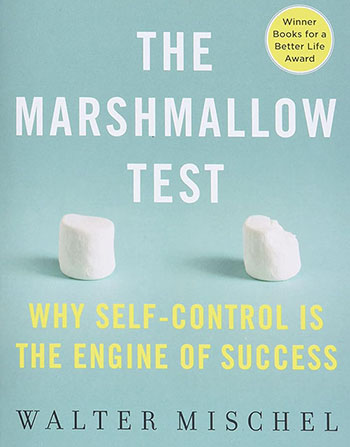
Mischel is the psychologist who led the famous Stanford marshmallow experiments beginning in the late 1960s – studies that would become some of the most widely cited findings in all of psychology.
The basic setup was almost childlike in its simplicity, – well, actually it was, literally. A preschooler (4 years old) is seated in a room and offered a marshmallow. The child is told that if they don’t eat it right away, they’ll receive a second marshmallow later. Then the researcher leaves the room.
Some children eat the marshmallow almost immediately. Others struggle, fidget, distract themselves, or find creative ways to resist. Those who succeed are rewarded with a second treat.
What made these experiments famous was not what happened in that room, but what happened later.
The researchers followed the children for years – in some cases decades – and found that, on average, the children who were better able to delay gratification tended to do better in many areas of life in the future.
They showed better academic outcomes, better emotional regulation, better coping skills, and healthier behaviors.
This is the story most people have heard. But as Mischel makes clear throughout the book, the experiments that took place in “the surprise room” is only part of what’s discussed in the book.
One of the most important contributions of The Marshmallow Test is correcting the myth that these studies proved some people are simply born with willpower and others are not.
Mischel is explicit on this point: self-control is not a fixed personality trait. It is a set of cognitive and emotional skills that can be learned, practiced, and strengthened.
The children who waited were not morally superior or unusually disciplined. They used strategies – often unconsciously – that made waiting easier. They redirected attention. They changed how they thought about the reward. They altered the situation in small but meaningful ways.
In later chapters, Mischel expands beyond talking about the original experiments and explains how these same mental processes operate in adulthood.
He describes how attention, memory, emotion, and stress interact to either strengthen or undermine self-control. He shows how temptation becomes more powerful when we focus on it directly, and weaker when we learn to reframe or distance ourselves from it.
A recurring theme in the book is that self-control is situational. People may be highly disciplined in one area of life and struggle in another. This doesn’t mean it’s a character flaw – it reflects how the brain responds to cues, stress, fatigue, and emotional states.
Mischel also addresses criticisms of the marshmallow research directly, including the role of environment, trust, and socioeconomic factors. He acknowledges that self-control does not exist in a vacuum, and that stable, predictable environments make delayed gratification easier. This nuance strengthens the book rather than weakens it.
Although the subtitle describes self-control as “the engine of success,” the book is not motivational hype. It is careful, measured, and evidence-based. Mischel doesn’t argue that willpower alone guarantees success, nor does he suggest that habits or environment make self-control irrelevant.
In fact, one of the more useful ideas in the book is the distinction between effortful self-control and automatic habits. Strong habits reduce the need for constant willpower, but they don’t eliminate it.
Even with good habits and a supportive environment, self-control is still required during periods of stress, fatigue, or emotional strain – precisely the moments when people are most likely to slip.
This makes the topic especially relevant for health and fitness endeavors, where long-term success often hinges on your ability to resist short-term temptations and stay consistent under imperfect conditions.
When people ask what weight loss – and long term weight maintenance – really boils down to, self-control is often at the top of the list.
Mischel uses plenty of examples about resisting food temptations. But that said, The Marshmallow Test remains firmly a book about psychology, not a health and fitness manual per se. You won’t find a checklist of tactics or a list of rules to follow.
What you will find is something more important and generizable: a deep understanding of how self-control actually works, and why it sometimes fails even in intelligent, motivated people.
The writing is readable and accessible throughout. While a lot of research is discussed, the book never feels too academic. Mischel was not only a pioneering scientist, but also a good communicator.
I recently started my second read of the book after many years, and I think it has aged well. If anything, the subject matter feels even more relevant today, in our environment of instant gratification and constant distraction (need any self-control to stop that scroll?)
If you prefer listening, the audiobook is available on Audible. I saw I had extra credits, so I grabbed it even though I’ve had the paperback a long time. I find that ideas really stick if you both read and listen.
I found it interesting that Alan Alda was the narrator. He’s a pretty good reader, but I can’t stop thinking of Captain Benjamin Hawkeye Pierce (MASH TV show reference in case that’s before your time).
Even if you’ve read other books on willpower and self-control – such as Kelly McGonigal’s excellent The Willpower Instinct — The Marshmallow Test is still well worth reading. It covers different topics and it’s also the research foundation that a lot of later books built upon.
If you’re interested in psychology, behavior change, how to develop self-control, and what influences long-term success, not just short-term results, you will enjoy this book. I think it’s an important topic and important book.
You can Get the Book At Amazon. This is our Amazon Associates Affiliate Link
Tom Venuto, Book nerd and author of:
Burn the Fat, Feed the Muscle
Flexible Meal Planning For Fat Loss
Related and highly recommended reading on self control and willpower:
The Willpower instinct: How Self Control Works, Why It Matters And How You Can Get More Of It
 About Tom Venuto, The No-BS Fat Loss Coach
Tom Venuto is a natural bodybuilding and fat loss expert. He is a former competitive bodybuilder and today works as a full-time fitness coach, writer, blogger, and author. In his spare time, he is an avid outdoor enthusiast and backpacker. His book, Burn The Fat, Feed The Muscle is an international bestseller, first as an ebook and now as a hardcover and audiobook. The Body Fat Solution, Tom’s book about emotional eating and long-term weight maintenance, was an Oprah Magazine and Men’s Fitness Magazine pick. Tom is also the founder of Burn The Fat Inner Circle – a fitness support community with over 52,000 members worldwide since 2006. Click here for membership details
Disclosure: Burn the Fat Inner Circle posts may use affiliate links to third-party websites and online stores such as Amazon. When readers purchase a product or book, we may earn a small commission at no additional cost to the reader, which helps support our website. We only recommend and link to books or products we have reviewed and recommend



Leave A Comment