
Whether alcohol really makes you gain weight has been controversial for decades. Technically speaking, you don’t instantly store alcohol as body fat – alcohol is oxidized ahead of other fuels. (Meaning, your liver has to clear it as a toxin before anything else is metabolized). Moderate drinking has also been debated, with some studies suggesting cardiovascular benefits and others arguing alcohol has no place in a healthy lifestyle. Looking at both classic and newer research reveals surprising insights about alcohol, insulin resistance, abdominal fat… and why some people drink and gain fat while others don’t.
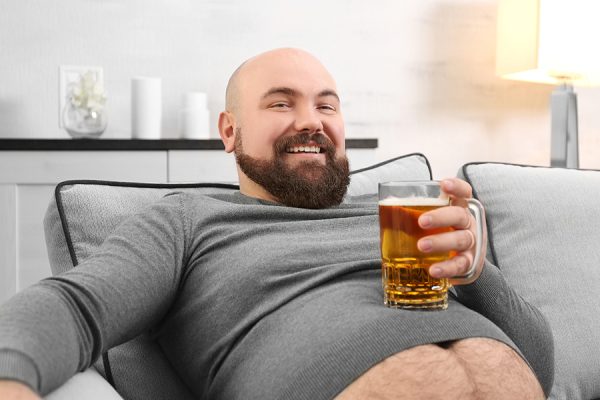
The truth about the beer belly
A classic study by Ulf Riserus and Erik Inglesson was based on the Swedish Uppsala Longitudinal cohort. The researchers found that alcohol intake in older men did not improve insulin sensitivity, which contradicted their own hypothesis and numerous previous studies.
They also said there was a very “robust” association between alcohol intake, waist circumference and waist to hip ratio. They pointed out that a high alcohol intake, especially hard liquor, was closely associated with abdominal body fat, not just overall body mass.
Abdominal fat accumulation is not just a cosmetic problem, it can be a serious health risk. Abdominal fat, also known as “android” or “central” obesity, increases the risk for cardiovascular disease, high blood pressure, high blood lipids, glucose intolerance and elevated insulin levels.
Many other studies have also found a link between alcohol intake and abdominal fat, but this too has been controversial. A older study that was widely publicized by the BBC dismissed the concept of the “beer belly.”
Nevertheless, it looks like there’s some scientific support to it after all (or at least a “liquor belly”).
Hormones may be strongly involved because high alcohol intake has been shown to decrease blood testosterone in men, and also increase cortisol levels, which can lead to visceral fat accumulation.
Why is there so much controversy? Why the discrepancy in research findings about alcohol’s influence on obesity, abdominal fat, and insulin sensitivity?
Well, here’s the real story of why some people don’t get fat when they drink:
A lot of the confusion is because epidemiological research can’t show cause and effect relationships and mistakes are easily made in drawing associations based on limited data.
With the nature of these longitudinal studies, you have to look at the lifestyle and nature of drinkers in general. Also, the Swedish study focused on older men, so age may have been a factor. You may be more likely to deposit alcohol right on your belly as you get older.
When you hear that alcohol increases belly fat, you also have to look at what else is going on in the life of the drinker, particularly what the rest of a person’s diet looks like, and how alcohol intake affects appetite and eating habits.
Research says that alcohol can mess up your body’s perception of hunger, satiety and fullness. If drinking stimulates additional eating, or adds additional calories that aren’t compensated for and which lead to positive energy balance, then you get fat. You may also get fat in the belly, no thanks to what booze does to hormones.
Another thing that confounds the reports on whether alcohol contributes to weight gain is the fact that the game changes in heavy drinkers.
We know that alcohol contains 7 calories per gram and these calories always count as part of the energy balance equation… or do they?
With chronic excessive alcohol consumption, it’s possible that not all of these calories are available for energy. Due to changes in liver function and something called the microsomal ethanol oxidizing system (MEOS), alcoholism may be a real case of where some calories don’t count. Many alcoholics also skip meals and eat less with increasing alcohol consumption.
Alcohol metabolizing pathways notwithstanding, even if binge drinkers, daily drinkers or heavy drinkers consume most of their calories from alcohol, if they eat very little, and remain in a calorie deficit, they will not get fat.
Compound this with the hormonal effects and you witness the skinny, but under-nourished, unhealthy and atrophied alcoholic (even though the heavy drinkers are the ones you’d think most likely to have a beer belly).
It’s the calories that count
The bottom line is, the idea that alcohol just automatically turns into fat or gives you a beer belly is mistaken. It’s true that alcohol suppresses fat oxidation, but mainly, alcohol adds calories into your diet, messes with your hormones and can stimulate appetite, leading to even more calories consumed. That’s where the fat gain comes from.
If you drink in moderation, if you’re aware of the calories in the alcohol and the calories from additional food intake consumed during or after drinking, and if you compensate accordingly, you won’t get fat.
If a light bulb just went off in your head and you’re saying to yourself, “You mean I can drink and still lose fat? I just need to stay in a calorie deficit?”
Yes, that’s what I mean, but just hold that thought for a minute while you consider that the empty alcohol calories displace the nutrient dense calories:
When you’re on a fat loss program you have a small calorie budget, so you need to give some careful thought to how those calories should be “spent.”
For example, if a woman is on a 1500 calorie per day diet, does she really want to “spend” 500 of those calories – one third of her intake – for a few alcoholic drinks, and leave only 1000 for health-promoting food, fiber and lean muscle building protein?
I realize some people may answer “yes” to that question, but then again, if some people spent their money as frivolously as they spent their calories, they would be in deep trouble!
To summarize this into some practical, take-home advice, here are 7 of my personal tips for alcohol consumption in the fitness lifestyle:
1. Don’t drink on a fat loss program.
Although you could certainly drink and “get away with it” if you diligently maintained your calorie deficit as noted above, it certainly doesn’t help your fat loss cause or your nutritional status.
2. If you drink, drink in moderation during maintenance.
For lifelong weight maintenance and good health, if you drink, do so in moderation and only occasionally, such as on weekends or when you go out to dine in restaurants. Binge drinking and getting drunk has no place in a fitness lifestyle (not to mention hangovers aren’t very conducive to good workouts… and alcoholism can wreak havoc in every area of life).
3. Don’t drink daily.
Moderate drinking has been associated with cardiovascular health benefits. However, I don’t recommend daily drinking because behaviors repeated daily become habits. Behaviors repeated multiple times daily become strong habits. Habitual drinking may lead to heavier drinking or full-blown addictions and can be hard to stop if you ever need to cut back.
4. Count the calories.
If you decide to have a bottle of beer or a glass of wine or two (or whatever moderation is for you), be sure to account for the alcohol in your daily calorie budget.
5. Watch your appetite.
Don’t let the “munchies” get control of you during or after you drink (Note to chicken wing and nacho-eating men: The correlation to alcohol and body fat is higher in men in almost all the studies. One possible explanation is that men tend to drink and eat, while women may tend to drink instead of eating).
6. Watch the fatty foods.
When drinking, watch the fatty foods in particular. A classic study by Angelo Tremblay suggested that alcohol and a high fat diet are a combination that favors overfeeding.
7. If you’re going to imbibe in moderation, do it without guilt.
If you choose to drink (moderately and sensibly), then don’t feel guilty about it or beat yourself up afterwards, just enjoy it… and don’t let it escalate.
Tom Venuto,
Author of Burn the Fat Feed the Muscle
Founder of Burn the Fat Inner Circle
 About Tom Venuto, The No-BS Fat Loss Coach
Tom Venuto is a natural bodybuilding and fat loss expert. He is also a recipe creator specializing in fat-burning, muscle-building cooking. Tom is a former competitive bodybuilder and today works as a full-time fitness coach, writer, blogger, and author. In his spare time, he is an avid outdoor enthusiast and backpacker. His book, Burn The Fat, Feed The Muscle is an international bestseller, first as an ebook and now as a hardcover and audiobook. The Body Fat Solution, Tom’s book about emotional eating and long-term weight maintenance, was an Oprah Magazine and Men’s Fitness Magazine pick. Tom is also the founder of Burn The Fat Inner Circle – a fitness support community with over 52,000 members worldwide since 2006. Click here for membership details
References:
(1) Alcohol Intake, Insulin Resistance, and abdominal obesity in elderly men. Riserus U, Ingelsson E., Obesity. 15(7): 1766-1773. 2007

For years, in nearly every fitness group I’ve participated in, the conventional wisdom was “Alcohol will stop fat loss in its tracks.” To which I’ve always responded, “Show me the data. Show me the studies.” No-one ever has been able to.When I hit a plateau last fall, I decided to find out for myself. I eliminated my daily beer intake and reserved it just for weekends. For about four months I continued this, while doing lots or cardio and weights, being very diligent in my diet, and taking my doctor-prescribed testosterone and anti-estrogen meds.The end result? No difference. I did not break my plateau. So I eased up and now enjoy a glass or two of hombrewed beer every night. I haven’t put on any extra weight, but I’m still not losing either. All I know is, it doesn’t appear that alcohol is part of MY lack of weight loss.
Dear Tom,You cannot have the slightiegst idea what impact you and your program have on my life. I used to drink beer quit regulary, but the last years or so I just drink the ocassional glass of red wine. I feel strenghtent that I can still enjoy some “bad” habits, but well placed into perspective. If I drink my 2 glasses of red wine once a month or so, I really enjoy them, instead of flushing them down my throat, taking them for granted. Not only has your program changed my life forever on a weightloss scale (lost 45 kg!), but the program is so much more, that I can really appreciate life itself and enjoy the little extras (like the wine) every now and then.Thank you so much, for saving my life and refinding my quality of life again.Bob JacobsNetherlands.(sorry 4 the typo’s)
Many thanks for that compact chunk of information. Food for thought, as they say… One thing that might have been helpful for surfers like me would be a small list of estimated calories in various drinks. I believe a 125ml glass of wine is meant to be 120kcal, a mid-size bottle of beer about the same, a shot about 90 to 120 (not including mixer)? Just for interest : )
Interesting article. Your bottom line sums it all up: cals in vs. cals out. Your personnel 7 tips are helpful tools to live by.For me, it comes back to mind set. I’ve incorporated healthy habits to be a healthy person. I’ve had to re-program my tapes to follow this life style.My daily tapes:1. I love exercise!2. I love getting up early to workout!3. I love eating clean!4. Sugar is poison.Too much? Over the top? It’s what works for me. I associate alcohol with sugar and for me, sugar is truely toxic.I loved how you said every cal you intake should count toward your daily nutrition. My body is like a high end sports car…regular unleaded gas just won’t do!Thanks again for all you do Tom!
While in Japan, I noticed that it isn’t just the overall healthy diet they have that keeps them thin.It is also the fact that many Japanese when they want a beer get sushi without rice (sashimi). They seem to take into account the carbs and use the beer as a carb substitution. I asked my Japanese friend about this and she said that if she eats sushi with rice it would be normal to skip the beer.American culture is sorely lacking in having this perspective of ratios of protein/carb/fat. This is why I recommend your ebook to everyone on my website, it provides a solid education, which is always the best starting point to better behavior.Great Article!
Funny… I would have thought you were out of your mind until, due to depression, I “tested” this theory and have seen it for myself:I worked out like crazy, stopped smoking a year ago and ate GREAT. I was following the John Berardi Precision Nutrition method – which is a great program. I was slowly losing weight but not as fast as I had in the past. I thought for sure it was the weekly drinking (every Saturday) I did.Then I moved back to California, drank for 45 days STRAIGHT and seen that I went from 210, before I left, to 201 by the time I got back.Strange.
An excellent article on drinking and fat loss.Congratulations. I have forgotten all alcoholic beverages for 15 months and have lost between 9 to 10 Kgs. From a maximum of 76 Kgs I am now between 64-65 Kgs. and feeling great.The problem is that not drinking in social reunions lets you out of the party; after 60 minutes the conversation of drinkers becomes really silly and boring to non-drinkers, so sociability diminishes for the non-drinker and leaves him in a kind of ostracism “out of the picture”.
Interesting piece of news on drinking alcohol. In everything, moderation is the way to go. I just wonder if any studies have been done on mice or small animals if drinking do really have an effect fat burning.
I have been under the impression that drinking too much causes the liver to swell hence the “beer belly”. Is there any truth to that?
dear tomthis is an amazing article – full of great facts delivered in an easy to read and understand manner – i an rrn and have read some of this before but you also presented some new info (the insulin stuff). i try to do something workout wise each day, eat really healthy, trying to not let the fat girl take over again (had to lose 50 lbs back in the 1970’s) and have a fondness for red wine – as always it is all about moderation. keep up the great info and i will direct others to your sitethank yoususan
Thank you for scientific information on this subject
Dear Tom,I started your programme 12 weeks before and I was already on aerobics for 2 weeks and than I found your bible on fat loss and muscel gain and it has done wonders. My eating habits are completely changed, when I started I was 97 Kg and today I am 88 Kg and I look so different and evry one notices it and I recommend your website to them.I still have a bit of fat around my belly it is not visible in cloths but when I pinch I feel it and now I am working towards it.I wants to thank you for writing such a wonderful book. it is worth the money spent on it.Thanks a lot.Sunil
Funny, I was drinking a pint just yesterday, and thinking about calories, and beer belly, and now I have the answer! Thanks Tom, you are great man! I love the way you are writing about all those things which bothers me. Another amazing article. THANKS!!!!
Thought this is very interesting info. Thanks for sharing it with us.Regards,Mary
The alcohol issue has been on my mind a lot lately, with the cold winter months, and cyclocross (read: dark beer drinking) season upon me.Thanks for this balanced, insightful, and well-researched summary!Heidi
November 29th, 2007Tom,This is the most informative of your news letters that I have read to date. The USA needs a wakeup call for sure.Keep up the great news letters.I am on week 27 of using information from your “burn the fat feed the muscle” book. I am 65 years old and have lost 42 lbs to date, while increasing my LBM and decreasing my BF. I will have to send you my excel chart that I use to track my progress in a few weeks. Your book has really been the driving force for my accomplishments. Thank you.Best regards,George Feiock
When I he a glass of white wine, I asked the bartender to fill the glass half wine and half cranberry juice. It taste fabulous.