
Should you train your abs with weights, or is bodyweight enough? Should you ever use heavy weights for abs (4–6 reps)? Are moderate weights (8–12 reps) better? Or should ab training stick to higher reps, like 15–25, or even ultra-high reps of 50 to 100?
Here’s the short answer.
The most effective way to train abs is a combination of moderate weighted ab exercises in the 8–15 rep range and lighter weight or bodyweight exercises in the 15–25 rep range. Very heavy weighted ab training (4–7 reps) can be used in some cases, but it’s not necessary for most people. Ultra-high reps beyond 25–30 offer little benefit.
Weighted ab training improves strength and stimulates abdominal muscle growth, which helps create visible definition when your body fat is low. Research supports using resistance for abs, but the key is focusing on quality over quantity.
Below you’ll see a science-based breakdown of how heavy, moderate, and high-rep ab training actually work, and when each approach makes sense.
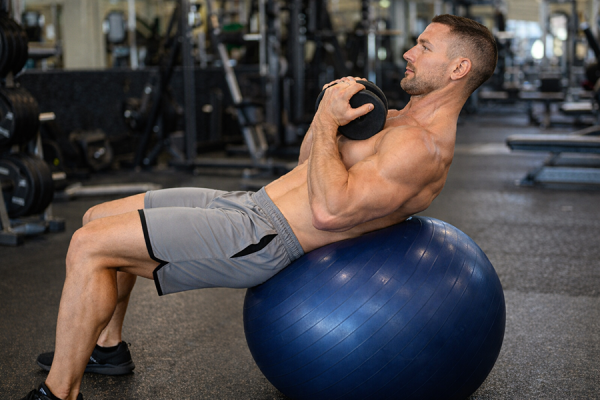
Should You Train Your Abs With Very Heavy Weights?
In theory, if you knew your goal was maximum strength, then it would make sense to do some of your training very heavy. “Very heavy” training is usually considered to be the 4 to 7 rep max range. I imagine there are athletes in some sports where this especially applies.
I hear advocates of heavy ab training say all the time, “abs are muscles just like all your other muscles, so you should train them the same.” There is some truth to that.
However, it’s not appropriate to compare the same training variables for a multi-joint power exercise like the deadlift or squat with an ab exercise like a crunch or hanging leg raise. The mechanics of the exercises are different.
When the goal is general fitness and physique training, the abs are somewhat unique compared to other body parts in ways that make training with very heavy weight and very low reps less practical and less necessary.
Training Abs For Strength, Endurance, Or Hypertrophy?
The abs, while similar to other muscles in most ways, can trained more like the way you might train an isolation or assistance exercise. It makes sense to do very heavy 5 sets of 5 reps workouts for a bench press, but you probably wouldn’t do sets of 5 with max weight on the cable crossover or dumbbell flyes would you? You’d probably do at least 8 to 12 reps, and maybe up to 15 or 20 reps at times.
If one of your goals is increasing strength, then you’d benefit from using very heavy weights at times and training some ab exercises with added resistance when it makes sense for a particular exercise.
The ab muscles are like other muscles in the way that training them with weights will make them increase in size when you train them with weights. This makes the six pack “pop out” more. (This is assuming your body fat is low enough to see them).
The question is, how much weight? How heavy? What rep range? When training so heavy that you can only do 4, 5 or 6 reps, you may fail to get the stimulation you need for muscle hypertrophy.
On some ab exercises (especially sit ups, leg raises and some ab machines), using too much weight can recruit the hip flexors more, and there’s a risk of causing low back strain. This may not apply to everyone equally, but it certainly concerns people like me who have a history of low back pain.
Will Training Abs With Weight Increase Your Waist Size?
Another downside of doing certain heavy ab exercises that it’s possible to go overboard and actually increase the size of your waist. This is most true if you if you overdevelop your oblique muscles (on the sides of your waist) and especially if you have a genetic predisposition for that (some people have a naturally “blocky” midsection).
There are women and men in physique sports where aesthetics and a tiny waist are extremely important, and these athletes are careful to not overdevelop the muscles in their midsection (avoiding exercises like weighted side bends, for example).
Outside of certain strength sports, I’ve found that most people have a primary goal of good looking abdominals (“six pack abs”) rather than maximum strength in the abs. If aesthetics is a bigger priority for you than strength, then you wouldn’t need to do much very heavy, low rep training.
Personally, I see no reason to do 5 or 6 rep sets of ab training and when I tried it, I never saw any advantage that made it any better than 8 – 12 rep sets. For bodybuilding and physique goals, I never saw the point to go so incredibly heavy that you could only do 5 or 6 reps on abs. Again, it’s not like you’re deadlifting or squatting. But if you feel that you benefit from very heavy sets of 5 or 6 reps for abs, don’t let me stop you.
Should You Train Your Abs With Moderately Heavy Weights? (And Ways To Add Resistance)
An 8 to 12 rep max or 10 to 15 rep max poundage is plenty of resistance to get stronger as well as develop better looking abs. An 8 or 12 rep max is not what we’d call a light weight – it’s a moderate weight.
All things considered, here’s the answer to the question: If your goal is aesthetic abs, it’s most practical and beneficial to train your abs with a combination of medium reps (8 – 12, which are “heavy days”) and higher reps (15-25, which are the lighter days).
The amount of reps you can do may also depend on the exercise. For heavier workouts, on some exercises you’d have to use extra resistance beyond your body weight, such as holding a barbell plate or dumbbell on your chest, or using a cable and weight stack.
On other exercises, you could add resistance by progressing to a more difficult version of the movement. For example, you could do a hanging straight leg raise instead of a hanging knee-up.
In some cases you can add resistance both ways. Reverse crunches are a good example. You can do reverse crunches with a small (weighted) medicine ball between your knees, or you could stay with bodyweight and do the reverse crunch up an incline bench.
Also, some exercises are simply more difficult than others across the board. You might be able to do 20 reps of hanging knee ups (bent leg raises), but with the straight leg version, you might only be able to do 10 reps. (Straight leg raises are an advanced and very difficult lower ab movement). So you may or may not need to add weight at all, depending on how hard the exercise is to begin with.
Are High Reps Better For Abs? What About Training Abs With Very High Reps?
There’s one thing you should usually not do in your ab training and that is ultra high reps.
Of course, just like we defined what is heavy, we should also define what is meant by light or high rep ab training. Most trainers and coaches consider the 15 to 25 range as high reps. Anything substantially higher (like 30 reps or more) is ultra high reps.
Doing very high reps gives you no extra advantage when it comes to developing 6-pack abs. Ultra high reps is training for pure endurance.
The abs are a body part that seems to respond well to sets of 15, 20 or 15 reps. Doing some of your ab training with high reps (using body weight or light weights) makes perfect sense. Again, it’s partly because ab exercises are more similar to isolation exercises, not compound exercises.
In addition, research on training for muscle hypertrophy has proven that you get the best results with a combination of low, medium and high rep training. It’s a myth that only low weight and heavy reps builds muscle to the maximum. That’s strength training, not hypertrophy training.
So yes, it’s a good idea to train abs with weight and do some workouts in the 8 to 15 rep range, and some in the 15 to 25 rep range. But it doesn’t make much sense to do ultra high reps. Doing hundreds of reps for abs gives you little more than bragging rights. (It’s an impressive endurance feat when people do hundreds of reps or go for some kind of rep record, but it’s totally unnecessary and does not follow scientific evidence of best practices.
Are Crunches Bad For Your Back?
There is also some research from Dr. Stuart McGill’s lab that too much spinal flexion (as in hundreds of reps crunches) can, over time, cause wear and tear damage to the lumbar discs. The risk may be higher in people with a history of low back disorders who don’t have a strong and stable core. Obviously, risk is also higher if good form is not used.
A study by Brad Schoenfeld published in the Strength And Conditioning Journal found that in healthy populations, crunches performed with good form and proper programming are an effective way to develop the rectus abdominis (“six pack abs“) with low risk. However, as I mentioned above, doing hundreds, let alone thousands, of repetitions is not a good idea.
Experts in spine biomechanics have put a number on it. They suggest for ab exercises involving spinal flexion limiting to approximately 60 reps per workout. This research is telling us that for ab training, the main idea is to think quality, not quantity.
You can increase the quality of a workout by using additional weight. This is training for strength and hypertrophy rather than training for endurance. There is no real functional reason to do ultra high repetitions of for abs, especially crunches.
If you want more endurance in your core, you can also do that by increasing the hold time of static exercises like planks. Use exercises with other movement patterns – static contractions, anti-rotation and so on – to produce balanced development and avoid overworking one movement in one plane.
Does Weighted Ab Work Reduce Belly Fat?
Think about this analogy: Would you do a hundred reps of barbell curls and tricep extensions to burn fat off your arms? Of course not. Doing hundreds of reps or very high reps for abs is an outdated and ineffective approach. It’s also a waste of time.
If this is true, why do so many people continue to do ultra high reps of body weight abs exercises? The high rep ab craze probably got started because so many people thought high reps would burn fat off their belly.
The truth is, high rep ab exercises will do almost nothing to burn fat or reveal abdominal muscle definition. You can’t spot reduce fat off one part of your body with exercises targeting that body part no matter how many reps you do.
What If You Like Very Heavy (Low Rep) Ab Training And You Feel Like It’s Working For You
Everyone is different, not only in their goals, but also in their body structure , so it wouldn’t surprise me if some individuals do better on lower reps than others. I believe them when different people tell me they do better with low reps, and heavy weight, higher reps, or a combination of both – I don’t think there is a single best way.
With that acknowledged, if in doubt, it’s hard to go wrong with a mix. Use both rep ranges and you should get the best of both worlds, while giving your body nice recovery breaks that you wouldn’t have if you always trained heavy.
What Are The Best Ab Exercises To Do With Weights?
Let me leave you with some important points about body weight ab exercises versus weighted ab exercises. Then I’ll show you a few examples of ab exercises that work great with additional resistance, ie, ab exercises using dumbbells, weight plates, cables, elastic resistance bands, or weighted medicine balls).
Here are some important points to know:
Some exercises, like crunches and sit ups, can be done with body weight alone or with added resistance.
Many, if not most, ab exercises are designed to be done with body weight only. This is sometimes simply due to the nature of the movement (there’s no way to hold an extra weight).
However, you can sometimes progress body weight ab exercises to a more difficult version of the movement. For example, you can progress from a hanging bent-knee raise to a hanging straight leg raise. This is the equivalent of adding resistance even though you don’t use weights.
Some body weight ab exercises are so difficult that most people would never need to add weight even if it’s possible to do so. Hanging straight leg raises for example, are rarely if ever done with extra weight because doing them with body weight alone is so hard.
Below you’ll see examples of 6 ab exercises that are incredibly effective when done with extra resistance. There are a variety of core stability exercises where you can use extra resistance (like the Palloff press, woodchoppers, loaded carries and so on), but the exercises below are among the best for developing the rectus abdominis for getting that 6-pack abs look.
1. Weighted crunches
2. Kneeling cable crunch
3. Standing resistance band crunch
4. Resistance band reverse crunch
5. Russian twists
6. Reverse crunch with med ball between knees
– Tom Venuto,
Author of Flexible Meal Planning For Fat Loss
Founder of Burn The Fat Inner Circle
P.S. The cliche, “Abs are made in the kitchen” bears a lot of truth. You must get your diet in order to have any hope of seeing abdominal definition. If you want to learn more about the most sustainable – and scientifically confirmed – diet plan to burn off fat and keep it off CLICK HERE
 About Tom Venuto
Tom Venuto is a natural bodybuilding and fat loss coach with 35 years of experience. He holds a degree in exercise science and has trained hundreds of clients in person and thousands online. He is also a recipe creator specializing in fat-burning, muscle-building cooking.
A former competitive bodybuilder, Tom is now a full-time evidence-based fitness writer, blogger, and author. His classic book Burn the Fat, Feed the Muscle is an international bestseller, first as an ebook and later as a hardcover and audiobook. His newest book. Extreme Fat Loss, which analyzes controversial diet and training programs, became an instant bestseller in 2025.
Tom’s work has been featured in Men’s Fitness, Oprah Magazine and dozens of other major publications. He is best known for his no-BS, evidence based approach to natural fat loss and muscle-building.
Tom is also the founder of Burn the Fat Inner Circle, a fitness support community with more than 59,000 members worldwide since 2006.
More Ab Training Advice:
How Often Should You Train Your Abs
How To Get Six Pack Abs Complete Guide: Fat Loss, Diet, Cardio, Resistance Workouts
Leave A Comment