
Q: “Hey Tom, have you heard about sardine fasting? I think I know what you’re going to say: it’s a fad, a gimmick, a quick fix to drop some weight. Am I right? But I listened to a podcast with some actual experts (doctors) who said that since it’s short term, no more than three days, it won’t do any harm and might even have health benefits. And sardines are loaded with omega-3s and protein, so that should protect muscle if you’re lifting, right?”
A: Yes, I’d call it a fad, a gimmick and a quick fix. Good guess! And always remember that influencers, including some with “MD” after their names, will promote fads for views.
But you might be surprised to hear that I’m not going to trash the idea completely. And I’m definitely not going to knock sardines. They’re one of the best foods you can put in your diet. I just want them in a balanced diet, not as the whole diet.
Let me break down the details of the sardine fasting diet and then what I’d recommend instead if you are really serious and want to drop some weight quicker than usual.
First, It’s Not A Fast
One thing makes me chuckle: if you’re eating something, you’re not fasting. Strictly speaking, fasting means eating nothing.
But “fasting” has become a magic word. Weight loss marketers, biohackers and the longevity crowd have all latched onto it, because the label carries mystique and promise. Fasting may have some benefits, but they’re greatly overstated. And prolonged total fasts do your muscle mass no favors, which strikes me as the opposite of pro-longevity.
The word gets stretched everywhere. If you eat two or three meals and squeeze them inside an eight-hour window, they call it “intermittent fasting,” but you’re still eating. That’s why these days the scientific literature more often calls it time-restricted eating, a far more accurate name. It can be a perfectly legitimate approach with the caveat that calories, protein and nutrients are adequate over 24 hours. But practitioners cling to the “fasting” label because it sells.
Some promoters even admit the stretch by calling these protocols “modified fasting” or “fasting mimicking,” meaning you eat a little something but supposedly get fasting’s benefits without the misery of zero food. The sardine “fast” is one of them.
What The Sardine “Fast” Is And What It Promises
The protocol is simple: eat nothing but sardines, usually for one to three days, with water, black coffee or tea. Some versions run five or seven days. The idea has floated around since the early 2010s, but it went viral in 2023, largely thanks to Dr. Annette Bosworth (“Dr. Boz”), who promotes a 72-hour sardine fast as a “metabolic reset.”
In 2026 it blew up all over again. In just a 20-second scroll through the You Tube thumbnails I saw a half a dozen videos with anywhere between 200,000 to 950,000 views each. One video has racked up 7.5 million views. Meanwhile, ‘eat more vegetables and fish, in a modest calorie deficit’ will never go viral – which is exactly why influencers like to promote novel, extreme, and controversial diet ideas.
The promised benefits are a familiar list among promoters of low carb diets and fasting. You’ll slip into ketosis and lower insulin. You’ll “jumpstart” your metabolism and break a weight loss plateau. Inflammation drops, cravings vanish, blood sugar stabilizes, and you keep your muscle because, unlike a water fast, you’re eating protein.
Some promoters go further, describing a state of “euphoric ketosis,” claiming three days of selenium will rev up your thyroid, or passing along anecdotes about cancer remission.
Here’s the reality check. Cut carbs to zero for a couple of days and it’s not surprising if you go into ketosis and lower insulin. Any very low-carb diet does that. The rapid scale drop in the first few days is often largely glycogen and water.
And whatever real fat you lose comes from the same place it always does: a calorie deficit, made easier because a high-protein, monotonous menu can suppress your appetite. Most of the “benefits” are really the health benefits of sardines, and losing excess weight.
And here’s something sardine fasting promoters don’t emphasize enough: If you’re eating only three of the small-size cans of sardines a day, with 12 to 14 grams of protein per can, that’s only 36 to 42 grams of protein for the entire day. That’s nowhere near optimal for preserving muscle during weight loss, especially if you’re lifting weights. Just because you’re eating protein doesn’t mean you’re eating enough of it.
So what harm does it do if it’s only three days? Honestly, for a healthy person, probably not much. If it helps you create a bigger deficit for the week, you’ll lose a little extra fat, and that counts for something.
People with gout, kidney disease, high blood pressure or a history of disordered eating should skip it. Ask your doctor before starting any unusual diet, especially if you have any health problems.
But even if we can say, “probably harmless for three days” that’s a pretty low bar for a diet.
But I Do Love Sardines: Here’s Why
A lot of people turn up their noses at sardines. They’re not exactly elegant. They’re small, oily, fishy and come with bones. But nutritionally, they’re hard to beat.
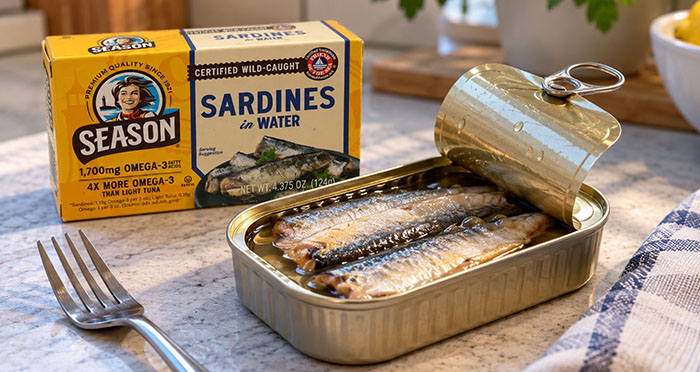
Omega-3s. Whole sardines are one of the richest food sources of the long-chain omega-3s, EPA and DHA. The labels on the cans I’ve been buying list anywhere from 1.7 to 3.7 grams of omega-3 per can. That’s several days’ worth of the commonly recommended intake in one sitting.
Protein. A 4.375-ounce can of Season brand sardines delivers 20 grams of protein, and I’ve seen them for as little as $1.79 a can. That’s cheap, high-quality protein that needs no cooking.
Make a note: Some of the most purchased brands at grocery stores (such as Bumble Bee) are smaller cans (3.75 oz) and may have only 12 to 14 grams of protein. That’s not an optimal muscle protein synthesis inducing dose. I would need two cans to call that a full serving given my goal or at least have extra protein on the side (like a sardine salad along with some nonfat Greek yogurt).
Vitamin D and calcium. Ocean Prince lists 30% of the daily value for vitamin D and 35% for calcium per can. Season lists 15% for vitamin D and 28% for calcium. The calcium comes from the soft, edible bones, so if you buy boneless, you lose most of it. And if you buy skinless, you lose some of the omega-3s, which are in and under the skin as well as in the flesh.
Low mercury. Sardines are low on the food chain, eating plankton, so they accumulate very little mercury. That’s a big advantage over tuna, which I’ll get to in a minute.
I know “superfood” is an overused marketing term, but I’d have no problem calling sardines a legit superfood.
I’m also working on some sardine recipes for you guys, since I’m not saying it’s the greatest thing right out of the can (but it’s better than tuna out of the can… actually you can mash sardines with a fork and use it in recipes just like tuna).
So Why Eat ONLY Sardines?
This is the gimmicky part. Sardines are healthy, no doubt about it. But why eat only one food?
What I’ll never understand is why people go so extreme that they cut out vegetables. If you’re going to eat a sardine-heavy diet for a few days, why on earth wouldn’t you keep the greens? You’d get fiber and a much broader range of nutrients. And the sheer volume of a big salad or a heaping plate of vegetables fills you up for very few calories, which lowers the odds that you go off the rails the minute your “fast” ends (or by dinnertime on day one).
And sardines aren’t the only mono-diet making the rounds. I recently came across the olive oil fast. High-polyphenol extra virgin olive oil is fantastically healthy. But drinking nothing but oil for a day or three?
At about 120 calories a tablespoon, it isn’t even low calorie, and the digestive aftermath of straight oil on an empty stomach is the stuff of legend. Why not just eat the whole Mediterranean diet instead? It’s balanced, tasty, sustainable for life rather than for 72 hours, and consistently rated among the best diets ever studied.
Is It The Worst Crash Diet Ever? Not Even Close
There’s worse. Old-school bodybuilders will remember the tuna and water diet. Golden Era legend Dave Draper wrote about it for years: three days of canned tuna in four to six portions a day, plus all the water you can drink. To his credit, he never pretended it was anything but a harsh, short-term rapid fat loss diet, perhaps as much a test of discipline as a way to drop weight quickly.
Then there’s Sylvester Stallone. Preparing for Rocky III, he says he lived on tuna for his protein and up to 25 cups of coffee a day. He claims his body fat hit 2.9% (I’d love to see how that was measured). He also admitted his memory was shot and that it was a dangerous thing to do. At least he said he also included small oatmeal cookies.
And who could forget the tuna shake from the early bodybuilding forums? Dump a can of tuna in a blender, add water or juice, hold your nose and chug. Part joke, part dare, and yet people actually drank them. You can’t make this stuff up. I visited those early 2000s bodybuilding forums. I saw it with my own eyes.
The tuna-only approach has a problem sardines don’t: mercury. Tuna is a bigger predator and accumulates far more of it, which is why the FDA limits how much it recommends per week. Eat several cans a day and you blow past those limits fast. For my money, a carnivore diet of nothing but fatty red meat, with no marine fats and no vegetables, rates lower than a sardine fast too.
So, as mono diets go, the sardine fast is one of the – how shall I say it – “better bad ones.” Eating one thing is always a bad idea long term. For a disciplined day or two inside a focused fat loss phase, it can work if you can stick with it. One day of nothing but protein won’t kill anyone, and it could crank up your weekly deficit. But going that extreme is rarely worth it, and it’s usually a fad that attracts desperate (or eccentric) dieters.
Where things got truly ugly was when extreme diets became so restrictive, or so dependent on nutritionally inadequate liquid supplements, that people died. The most infamous example is The Last Chance Diet, a 1976 bestseller by Robert Linn, a Pennsylvania osteopath.
Dieters consumed almost nothing but “Prolinn,” a liquid protein drink made from collagen, sourced from the hides and hooves of slaughterhouse animals, for a few hundred calories a day. Collagen is a low-quality protein, short on essential amino acids, so it couldn’t do the one job protein was supposed to be there for.
Around 60 deaths were linked to the liquid protein craze, most from abnormal heart rhythms, likely caused by loss of heart muscle and electrolyte imbalances.
The irony? The book’s subtitle called it a “Protein-Sparing Fast.” A real protein-sparing modified fast, built on complete, high-quality protein, supplemented with essential vitamins and minerals, and supervised by a doctor, is a legitimate clinical tool to this day. Linn’s version “spared” nothing.
That’s the real lesson from the worst of the worst. The danger isn’t just how few calories you eat. It’s what you leave out. Which brings me to how I’d do it.
What I’d Do Instead: Lean, Green and Marine (“The LGM Diet”)
Let’s say I wanted to accelerate fat loss. I would not go on very low calories for an extended period. Almost nobody can sustain a crash diet. But I’m not against a rapid fat loss phase done in a healthy, semi-sustainable way until the extra fat comes off. I’m not even against a very, very low calorie day once or twice a week.
Here’s how I’d build it:
Lean: Mostly lean protein, maybe as much as half your total calories. It protects muscle and it’s the most filling macronutrient.
Green: Vegetables, and lots of them. A wide variety and big servings, not just green but every color. Volume fills you up for very few calories.
Marine: Healthy fats every day, especially fatty fish like sardines and salmon. Fat matters for health and satiety, and a nearly fat-free, all-protein diet is miserable and tasteless.
You can still eat eggs. You can still eat salads. A big bowl of eggs and vegetables is extremely filling. And if you love sardines, throw them on a huge salad. You’ll still run a large calorie deficit, without the gimmick of “Eat this 1 food to transform your health in 3 days” (don’t tell me you haven’t seen ads like that ALL over the internet).
I discuss the Lean, Green and Marine approach in my ebook, Extreme Fat Loss. It’s my version of an aggressive diet that’s still as healthy as it can possibly be for the goal of fast fat loss. And it’s simple. There was no need to fluff it up into a whole book. The instructions fit in one short chapter of a book covering many other topics.
Most extreme fat loss methods work. The question is, at what cost? What’s the risk? Extreme Fat Loss rates 12 controversial approaches, including keto, fasting, HIIT and carnivore, on a science-based risk-to-benefit scale.
Check out my Extreme Fat Loss book to discover which methods actually deliver results, which ones backfire, and why the “best” approach depends on your goals and your tolerance for restriction.
Read this guide before you consider any super-strict diet or training regimen and it could save you a lot of wasted time and money, and possibly save you from illness or injury from doing something entirely too extreme:
==> Extreme Fat Loss: The Risk-To-Benefit Guide
Train hard and expect success,
Tom Venuto
Author of Extreme Fat Loss: The Risk-To-Benefit Guide
Founder of Burn the Fat Inner Circle:


Leave A Comment