
Last week here at Burn the Fat Blog I wrote about one of the oldest debates in fitness: Which is best for fat loss – cardio or weights?
My post also discussed the so-called interference effect – the concern that if you do both – cardio and weights – it will get in the way of strength and muscle gains.
The good news was that unless you’re doing very high volumes of endurance training (especially lots of high impact running), research shows you can successfully combine cardio and weight training. In fact, for most people, doing both will give you the best overall results by far and on every level – fat loss, health, fitness, strength, and body composition.
After I stumbled onto a new research paper earlier this week, I wanted to circle back and stay on this same topic but look at it from a different perspective. Instead of asking whether people who want to gain muscle should also do cardio, let’s ask a different question:
Should People With Obesity Lift Weights?
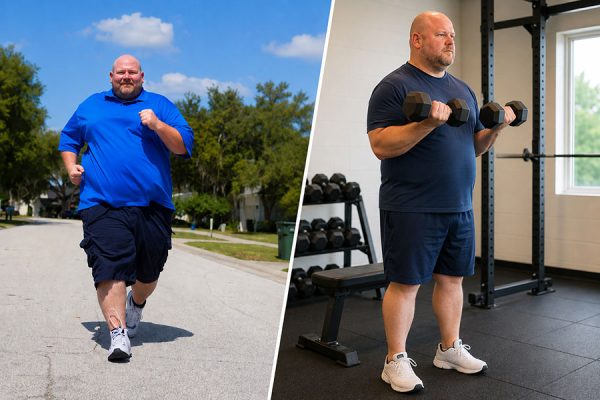
The answer, according to a new review published in the Journal of Sports Science and Medicine, is a resounding yes.
Researchers reviewed 23 randomized controlled trials involving 1,184 adults with both obesity and type 2 diabetes – a combination now commonly referred to in the medical literature as “diabesity.”
For years, many people with obesity have assumed the best prescription was simple: Diet. Do Cardio. Lose weight.
There’s nothing wrong with that approach. No one disputes that diet isn’t the #1 priority for fat loss. And adding aerobic exercise on top of a good diet will increase fat loss along with giving tremendous health benefits.
The newest science has also confirmed that aerobic exercise is more effective than resistance training for improving fasting blood glucose and cardiorespiratory fitness.
The idea that doing cardio is better for cardio fitness than lifting should be obvious. What many people overlook is that weight loss shouldn’t be the only goal.
When people lose weight – especially as they get older – they also risk losing muscle along with the fat. That’s where the resistance training comes in.
Compared to aerobic exercise alone, the research shows that resistance training is superior for preserving fat-free mass and improving body composition.
The idea that lifting is better for building muscle should also be obvious. But again, there’s a point that a lot of people overlook.
Muscle isn’t just something you should build because it makes you look more aesthetic and athletic. When you do resistance training, it actually helps you be more athletic. Lifting makes you stronger and more functional, helping you stay active and independent as you get older.
Building muscle has great health benefits as well. It’s important to remember that muscle is one of the primary tissues involved in glucose disposal, making it especially important for people with insulin resistance and type 2 diabetes.
The bottom line: YES people living with obesity should do resistance training as well as cardio training. In the recent study, the researchers wrote:
“Aerobic exercise and resistance training should not be viewed as mutually exclusive. Rather, both modalities should be combined or sequenced according to patient needs, feasibility, adherence potential, and therapeutic goals… This approach is particularly relevant in diabesity…”
Too often people think in terms of cardio versus weights. That’s the wrong mindset.
Each type of exercise brings something different to the table. Cardio is excellent for improving cardiovascular fitness, increasing endurance, and controlling blood sugar.
Resistance training helps preserve muscle, build strength, improve body composition, and maintain physical function – plus it also has health benefits including helping with managing blood sugar.
Why choose one when the benefits of doing both together are greater than doing either alone?
Does that mean everyone should do exactly the same amount of cardio and weight training? No – and this is where the nuance comes in. Exercise should always be tailored to the individual. You need to customize your weights + cardio program.
If you’re training for a marathon, obviously you have to devote the bulk of your time to endurance training. But you don’t want to completely neglect strength training either. Some of the best endurance athletes do at least two and sometimes three brief lifting sessions per week – and they are better, and healthier athletes for it.
If someone is training for a powerlifting competition, obviously they need to prioritize the lifting. But they shouldn’t neglect cardio training either. Even if it’s as simple as brisk walking, the health benefits are significant.
For the average person trying to lose body fat, improve metabolic health, reduce diabetes risk, and stay healthy for the long term, the evidence increasingly points in the same direction:
Don’t skip the weight training just because you’re carrying excess weight and your primary goal is weight loss. And don’t think of weight training and cardio as competing forms of exercise. Think of them as partners.
Simply adjust the balance based on your goals and priorities, but always remember, the smartest and most effective long-term training plan includes both types of training.
Since day one, the Burn the Fat, Feed the Muscle philosophy has always included resistance training and cardio training. Combined with the other 3 elements, this is the most powerful body transformation – AND health transformation – formula in the world:
1. Resistance training
2. Cardio training
3. Mental training
4. Nutrition
5. Social support
-Tom Venuto,
Author of Burn the Fat, Feed the Muscle
Founder of Burn the Fat Inner Circle
Scientific References
Badri Al-Mhanna S, et al, Comparative effectiveness of aerobic exercise versus resistance training on cardiometabolic health in patients with diabesity: A systematic review and meta-analysis of randomized controlled trials, Journal of Sports Science and Medicine, 25: 637-655, 2026.


Leave A Comment