
Does white rice make you fat? No, white rice does not automatically make you fat. If calories are equal, there’s little evidence that eating white rice leads to more fat gain or less fat loss than eating brown rice. Weight gain is driven primarily by a calorie surplus, not by whether your rice is white or brown.
That said, the white rice versus brown rice debate isn’t completely meaningless. Brown rice has more fiber, vitamins, minerals, and other beneficial compounds than white rice. It may also have advantages for blood sugar control and satiety. But when it comes strictly to fat loss, the difference is much smaller than many people believe, probably non-existent.
So if you’re wondering whether you can eat white rice and still lose weight, the answer is yes. The more interesting question is this: When comparing brown rice versus white rice for weight loss, health, nutrition, and long-term body composition, is one choice clearly better than the other?
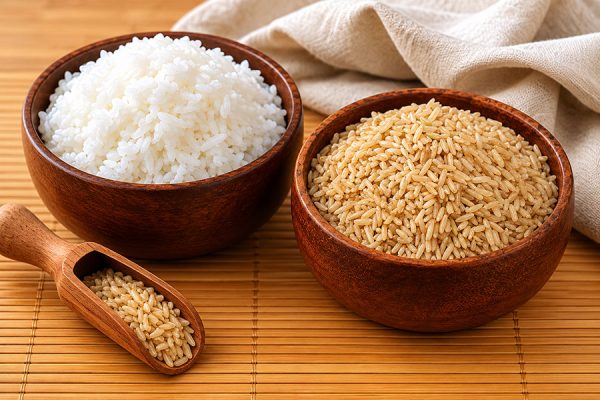
What Science, History, And Culture Say About White Rice Vs Brown Rice
Hiroko Sho, the director of the University of Air Okinawa Study Center wrote a scientific paper in the Asia Pacific Journal of Clinical Nutrition years ago and pointed out that the Japanese eat an average of 2.5 bowls of white rice a day. They are among the longest lived populations in the world, especially the Okinawans.
Rice is a staple food for over half the world’s population. In parts of India, rice provides 73% of caloric intake.
Archaeological evidence shows that rice has been cultivated for at least 9,000 years.
Given these cultural and historical facts, plus the fact that I’ve seen countless bodybuilders get ripped using white rice during pre-competition dieting, makes this an interesting question:
Is white rice really bad for you as some nutritional purists say it is?
Is brown rice healthy? Absolutely! And it has health advantages over white rice. But I don’t believe it’s helpful to look at minimally processed foods like rice in absolute good or bad terms. White rice is not a “white devil” as I’ve heard some people call it.
Barring intolerances and allergies, you can enjoy any traditional food without health repercussions; the key is moderation. It’s how much and how often you eat a food, plus what other foods are in your diet every day that will ultimately determine the effect that food will have on you.
Furthermore, if you ask, “is white rice bad for you” what do you mean specifically? Bad in terms of weight loss, health, or nutritional value? Those are three different questions that should be answered independently.
So let’s start answering them. First let’s look at the difference between white and brown rice and what happens during the processing of brown into white rice.
The Differences Between Brown Rice And White Rice
Whole grain rice contains several layers. The outermost layer, the hull, is removed to produce brown rice. This hulling of the rice doesn’t cause any major nutrient losses.
However, when the brown rice is milled further to produce white rice, the bran and most of the germ are removed. This produces a whiter rice, but also removes some important nutrients.
If the rice is further processed by “polishing,” this removes yet another layer of the grain (the aleurone layer), giving the rice an even brighter white color and silky, highly palatable texture.
Polishing rice can also double the shelf life from 6 months to a year, but the reason is because it removes the nutritious fats that are susceptible to oxidation.
There are 8,000 different types of rice and at least a dozen major categories of rice. The nutrient values and biological properties of each can vary significantly, but according to the USDA food nutrient data base, the milling of brown rice into white rice destroys 73% of the magnesium, 48% of the phosphorous, 45% of the manganese and 24% of the selenium.
Milled and polished rice has lost all of the essential fatty acids, nearly all of the fiber, most of the B vitamins and two-thirds of the iron as well. In the United States, fully milled white rice must be enriched with B vitamins and iron, by adding them back into the white rice.
Brown Rice and Fiber
Brown rice is also good source of fiber. A high fiber diet has been associated with many health benefits. That includes the treatment or prevention of cardiovascular disease, high blood lipids, high blood pressure, obesity, diabetes, gastrointestinal disorders and certain cancers.
High fiber diets have also been linked with better weight loss and weight maintenance. The mechanisms include:
- High fiber foods take longer to eat
- High fiber foods delay gastric emptying
- High fiber foods slow starch digestion or absorption
- High fiber foods increase the feeling of fullness.
- Some of the caloric energy in higher fiber foods is non-metabolizable (a more scientific way of saying “negative calories.”)
In the Nurse’s Health Study from Harvard, weight gain was inversely associated with the intake of high fiber, whole grain foods, but positively related to the intake of refined grain foods.
An increase of 12 grams of fiber per day was associated with 8 lbs less weight gain during the 12 years of follow up. This was most likely due to the refined grain products having a higher starch content but a lower fiber content (a greater energy density).
Since most of the fiber has been removed from white rice, this is a valid reason to choose unrefined brown rice over refined white rice. However, the health advantages of brown rice over white rice don’t end with vitamin, mineral and fiber content.
Brown Rice and Disease Prevention
Researchers from the University of Leicester hypothesized that rice may contain nutrients with anticancer properties. They suspected that these nutrients were mostly in the bran part of the rice grain.
After analyzing rice bran, they identified eight phenolic compounds including protochatechuic acid, caffeic acid, p-coumaric acid, vanillic acid, methoxycinnamic acid, ferulic acid, sinapic acid, and tricin.
Using cultures of human colon and breast cancer cells, these phenolic compounds demonstrated chemoprotective and anti-tumor properties.
The UK researchers concluded:
“These results support the hypothesis that brown rice contains substances with cancer preventive properties and that these substances are present at much lower levels in the white variety. This conclusion is consistent with the general realization that consumption of whole grain foodstuffs, is more beneficial to the maintenance of human health than that of their refined products.”
With authorities recommending that we eat more whole grains, there has been a lot of concern about the effect of these carbohydrate foods on blood sugar. However, research has shown that all carbs are not made equal and different types of carbs have different effects on glycemic response.
A study published in the International Journal of Food Science and Nutrition measured the rate of starch digestion and blood glucose response in both healthy and diabetic subjects for brown and milled rice from the same variety and batch of rice.
They found that the total sugars released were 23.7% lower in brown rice than in milled rice. The blood sugar response to brown rice compared to milled rice was also significantly lower in both healthy and diabetic subjects.
The brown rice contained higher concentrations of dietary fiber, fat, phytic acid and total polyphenol contents than milled rice. Phytic acid and polyphenols, which are more concentrated in the bran layer, may have contributed to the slow starch digestion rate and lower blood glucose response.
Phytosterols, gamma-oryzanols, tocopherols and tocotrienols, which are high in the rice bran and rice bran oil, have also shown hypoglycemic and hypoinsulinemic effects.
The researchers reached concluded that brown rice is a more health beneficial food for diabetics as well as hyperglycemic individuals than milled rice.
Another study, published in the Journal of Nutrition Science and Vitaminology, came to similar conclusions:
“The reason for improved blood glucose management markers with the (pre-germinated) brown rice diet is suggested to be that the physical shape of grains delays digestion and absorption of carbohydrates. Brown rice comprises endosperm, aleurone layer, bran layer and germ. As the endosperm is covered by the bran layer, starches do not come into contact with digestive enzymes as often as they do with white rice.”
Is Brown Rice Better Than White Rice for Weight Loss?
As you can see, there’s a lot of evidence that brown rice contains more nutrients. It may also be more health-promoting than white rice, at least in certain populations.
But what about weight loss? If you replaced white rice with brown rice, would it help you lose more weight, if all else remained equal? The answer, while it may surprise some people, is clear:
There will be little to no difference in weight loss if calories are matched evenly between white and brown rice. A metabolizable calorie is just a calorie from a weight loss point of view.
If there is a difference in fat loss, it will be very small. It would possibly be due to differences in fiber content or effects on appetite.
Some people enjoy the taste of white rice much more than brown rice. If the white rice is more palatable, it’s conceivable that it would be easier to eat more of it.
That means, if you’re one of those people who doesn’t track your portions and you eat ad-libitum, you might eat more calories if you choose white rice over brown. (So it’s not the type of rice per se, it’s the calories).
What About The Glycemic Index (GI) Of Rice?
Does it matter if the white rice is higher on the GI? Well, first of all, the GI of long grain white rice is not that much higher than brown rice. There are a couple exceptions like puffed rice and rice cakes.
More importantly, the effect of GI on weight loss has been re-examined at length for years and there’s a lot of new research proving that there’s no difference in weight loss between high GI and low GI foods if calories are the same.
The GI may be useful for managing blood sugar and diabetes, but according to science, it simply hasn’t panned out as an effective tool for weight loss.
What About White Rice And Insulin Spikes?
If white rice elevates insulin more than brown rice, wouldn’t that contribute to fat storage? As with GI, again the answer is, if you’re in a calorie deficit, no.
Plus, don’t forget the power of pairing and combining foods in mixed meals that are not pure carbohydrate. (Most people don’t eat white rice all by itself anyway).
Eat rice with lean proteins, healthy fats, and fiber-rich vegetables in portion controlled meals. This is the “Burn the Fat, Feed the Muscle” method for building meals. This further slows the absorption of carbs so glycemic control or insluin spikes should not be an issue.
It would be much more helpful to think of blood sugar and insulin control as important health goals rather than causative factors in obesity. Failure to do so may send you down the misguided path of worrying more about carbs than calories.
All of that said, if you are type 2 diabetic or have any blood sugar regulation issues, talk to a registered dietician or a nutrition-savvy MD for advice.
The Bottom Line On White Rice And Fat Loss
In conclusion, Brown rice has more fiber, more nutritional value and more health benefits than white rice. However, if you match calorie for calorie, there will be little or no difference in weight loss if you eat white rice instead of brown rice.
I eat brown rice often because I want the highest nutrient density I can get from my foods.
However, when I dine out, I love sushi and Asian cuisine and I enjoy it with white rice (I’ve tried brown rice sushi – no thanks).
Also, I’m an avid home cook, and when I make stovetop rice recipes and one pot recipes at home I use white rice because it cooks faster, and frankly, these recipes are delicious with white rice.
Whenever I eat white rice I always enjoy it without worrying that it’s going to erase my abs. As long as I keep tracking my calories or at least stay mindful about portion sizes, it never has.
– Tom Venuto, founder of Burn the Fat Inner Circle
PS. To get access to thousands of science-based healthy eating reports like this one, plus over 350 recipes, fat burning meal plans, and over 20 muscle-building training programs, join our Burn the Fat Inner Circle. Click here to learn more
PS. Check out some of my popular rice recipes below:
Indian Coconut Curry Rice For The Calorie Conscious
One Pot Spanish Rice With Ground Beef
Cheesy Mexican Rice And Chicken Casserole (One Pot)
Italian Chicken And Rice Casserole (One Pot)
Healthy One Pot Chicken Thighs And Rice
One Pot Creole Rice With Ground Beef (“Healthy Dirty Rice”)
Scientific References:
Hudson EA, Dinh PA, Kokubun T, Simmonds MS, Gescher A. Characterization of potentially chemopreventive phenols in extracts of brown rice that inhibit the growth of human breast and colon cancer cells. Cancer Epidemiol Biomarkers Prev. 2000 Nov;9(11):1163-70. University of Leicester, United Kingdom.
Hsu T, et al. Effects of Pre-germinated brown rice on blood glucose and lipid levels in free-living patients with impaired fasting glucose or type-2 diabetes. J Nutr Sci Vitaminol, 54: 163-168, 2008. University of Tokushima, Japan.
Lee KW, et al. Obesity (Silver Spring). 2006 Mar;14(3):423-30. The effects of Goami No. 2 rice, a natural fiber-rich rice, on body weight and lipid metabolism. Ajou University School of Medicine, Republic of Korea.
O’Dea K, at al, physical factors influencing postprandial glucose and insulin responses to starch, Am J Clin Nutr, 33: 760-765, 1980, Baker Medical Research Institute, Australia
Seki T, et al. Insoluble fiber is a major constituent responsible for lowering the post-prandial blood glucose concentration in the pre-germinated brown rice. Biol Pharm Bull. 2005 Aug;28(8):1539-41. Nihon University College of Bioresource Sciences, Japan.
Sho H. History and characteristics of Okinawan longevity food. Asia Pac J Clin Nutr. 2001;10(2):159-64. University of The Air Okinawa Study Center, Japan.
Tovey FI, Hobsley M. Milling of wheat, maize and rice: Effects on fibre and lipid content and health. World J Gastroenterol 2004; 10(12): 1695-1696 FI Tovey, Hon. Research Fellow, M Hobsley, Professor Emeritus, Dept. of Surgery, UCL, UK
Trinidad, P et al, Dietary Fiber Characteristics and Mineral Availability from Treated and Non-Treated Brown Rice. Agriculture, Forestry and Fisheries. Vol. 3, No. 5, 2014, pp. 401-404. 2014
Panlasigui LN, Thompson LU.Int J Food Sci Nutr. 2006 May-Jun;57(3-4):151-8. Blood glucose lowering effects of brown rice in normal and diabetic subjects. University of the Philippines, Diliman, Quezon City, Philippines.
Williams PN, et al, Variation in arsenic concentration in paddy rice related to dietary exposure, Environ, sci technol, 39: 5531-5540, 2005, University of Aberdeen, Scotland.



Thank you for addressing the white vs Brown rice conecrns that so many people like myslef struggle with >now i can make an informed decision about rice and enjoy both in moderation.
Hi Patricia. thanks for your post. Glad the article was helpful!
Very informative, thanks Tom!
I’d love to hear your thoughts on white rice vs sourdough bread (from a bakery, few ingredients and no sugar). My research shows the sourdough ahead but I am curious. Thank you
Hi Natasha! I don’t know about a white rice vs sourdough bread comparison as health and as calorie (density) goes, would have to look into that. But sourdough bread is, well, awesome!. I want to learn how to make it at home one day. In any case, anything can be eaten in moderation and anything can be eaten inside a calorie deficit and you still lose fat… and also, food avoidance / fear of food is not good for mental health.