
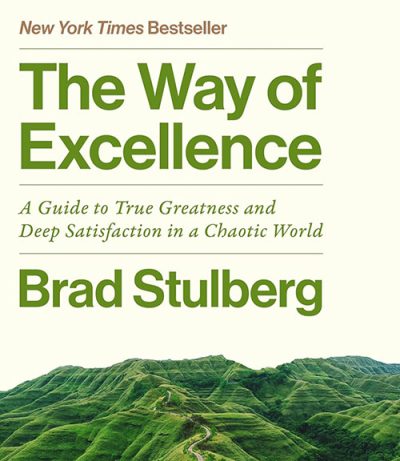
 The inner cover flap of Brad Stulberg’s book, The Way of Excellence, says that it’s “The definitive book on excellence.”
Surprisingly, there aren’t that many books about excellence that use the word excellence.
Older books that do, such as Tom Peter’s Search For Excellence, were about corporate success. They profiled how businesses became successful.
Fewer are about personal excellence, which is what Stulberg’s book is about.
In his classic works, psychologist Abraham Maslow wrote about a similar concept – “actualizing your potential”.
Great books have been written about another related topic – mastery – including George Leonard and Robert Greene.
Excellence also overlaps with stoicism and the development of character.
Spiritual books talk about self-realization.
And the Greeks had a word for it – “arete” – defined as excellence or virtue; the highest moral, physical, and spiritual potential of a human being.
Among all the books that talk about excellence by that name or similar names, Stulberg’s book is unique in the genre.
I heard about him at first when I discovered the book he co-authored with Steve Magness – “Peak Performance.” (Not to be confused with the Charles Garfield classic on mental training for sports).
Peak Performance by Stulberg and Magness was very good, and I recommend it. There’s only one issue I think someone might have with that 2017 book: if they are well-read in the high performance and personal development field, much of the information may sound familiar since it appears repeatedly in other many other books.
By contrast, The Way Of Excellence (2026) is full of new and unique ideas, or fresh takes and perspectives on old ideas.
It avoids pushing hacks or hustle culture, and it’s not about perfectionism either. Stulberg says that excellence is about challenging yourself in worthwhile endeavors, focusing on what matters most, and expressing the unique qualities that make you what you are.
The advice is applicable to all types of endeavors from pushing yourself in the gym, to learning a musical instrument, managing a business, practicing medicine, creating art or honing any other craft.
Stulberg – and his former co-author and current podcast co-host Magness – both come from endurance training backgrounds, but after running injuries sidelined Stulberg, he took up powerlifting. That makes this a great read for fitness enthusiasts across the spectrum from long distance running to pumping iron.
The book is split into two parts. Part one lays out the foundations including the biology, psychology, and philosophy of excellence.
He first explains what excellence is. It’s when we are at our best. When we are:
Working without distraction at something that matters to us. Creating and contributing to the world. Engaging deeply with others. Sufficiently challenged. Using your unique skills. In a state of relaxed productivity. Giving something your all.
He emphasizes that excellence can be expressed in all areas of life – it’s not restricted to professional athletes and artists.
He also points out one of the great truths: We all have an innate drive for progress and growth, and this is why we feel so alive when we channel that drive into meaningful goals.
However, he explains that excellence is less of a destination or achievement of a goal, and more of an energizing process of growth and becoming. It’s an ongoing path.
Stulberg says that excellence combines mastery and mattering. Mastery is developing skills and making progress in activities you believe are worthwhile. Mattering is the sense that what you’re doing has significance. This combination leads to a life well lived and a sense of satisfaction.
I appreciated how Stulberg points out that lasting motivation is intrinsic. Giving a nod to Self-Determination theory, he explains how we thrive over the long haul when 3 needs are met: autonomy, competence, and belonging (social connection). Being intrinsically motivated also means that we engage in a practice for its own sake – because we enjoy it and it’s as satisfying or more satisfying than reaching any end point.
Part two of the book runs through 16 mindsets, habits, and practices of excellence. You’ll see some familiar topics here like goals, consistency, focus, discipline, patience, confidence, and community. But Brad brings unique insights and perspectives to all these topics rather than rehashing what everyone has already said.
Some of these principles are unique and not discussed by other authors, starting out for example with caring. You can have all the talent and knowledge in the world, but if you don’t care about what you’re doing it doesn’t matter. You must have a reverence and deep interest in your pursuit.
Another example is the chapter on gumption. That’s a word I never heard before in the study of excellence. He says it’s a forward inertia, a sense of progress and possibility a strong yet measured enthusiasm.
Some of the other topics in part two include trade-offs, renewal, routine, joy, and completion.
In this book, you will definitely hear new ideas on the pursuit of excellence, and new takes on old ideas. That’s a strength of this book – there’s a lot of originality.
What Stulberg did well, and why his book might really deserve the claim as the definitive guide to excellence, is that he tried to combine performance psychology, sustainable ambition, anti-burnout philosophy, eastern mindfulness, stoicism, and modern neuroscience all into one book with one cohesive theme.
Older books in this genre leaned more toward military-style discipline, hustle and grind mentality, achievement obsession, or just clichéd self-help advice. The Way of Excellence avoids those angles and is more about how to pursue personal greatness without becoming physical or mentally burned out. I think that is unique and very relevant in the 2020s.
In this book I learned new things, and was exposed to new ways of looking at ideas I was already familiar with. The book is conversational and easy to read – it’s not like those psychology books that have valuable information but are overly academic and a slog to finish. I flew through it in three sittings and then listened to the audiobook as well for repetition and reinforcement.
This is an easy 5/5 stars rating. Highly recommended for all my Burn the Fat Blog readers and Burn the Fat Inner Circle members to help you with your fitness journey and all your endeavors outside the gym as well.
The Way Of Excellence has been featured as a Burn the Fat Inner Circle Book Discussion Club Book Of The Month. Join us to chat about this book and about excellence and peak performance at the the link below.
CLICK HERE To Discuss this book in the Burn The Fat Inner Circle forums (members)
-Tom Venuto,
Author of Burn the Fat, Feed the Muscle
Founder of Burn the Fat Inner Circle
Leave A Comment