
Does cardio make you hungry and so therefore cardio doesn’t work for fat loss? It’s a common claim in fitness today. You’ll hear people say that running, cycling, or other types of cardio just make you hungrier – so you end up eating back the calories you burned. “Why bother, right? Just focus on diet.”
I’ve been in the fitness industry for over 35 years. And for most of that career, I’ve had to fight the same battle: Defending cardio against people who insist it’s useless for fat loss – or worse, that it actively works against you by making you hungry and causing you to eat more (or “cardio kills your muscle.”) The truth about cardio and fat loss is a lot more nuanced, as you’ll see in this post.
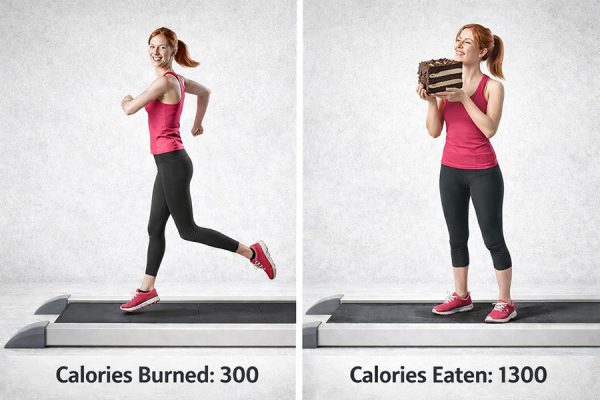
Part of the anti-cardio attitude comes from the bodybuilding and strength community, where some insist you should just focus on lifting and lose fat by dieting. Cardio is sometimes even seen as the enemy – “catabolic,” “muscle-wasting,” something for weak people.
Then, even PhD scientists started saying the same thing – “cardio is great for health, but it’s not very helpful for fat loss.”
Then trainers and so called “influencers” who’d never read a single study in their life started parroting it as settled science.
And now you hear it every day – stated as fact in podcasts, fitness blogs, and gym conversations.
The problem is that the research actually doesn’t support it. And when you dig into why so many people believe it, the story gets more interesting, so let’s untangle this.
Where Did The “Cardio Makes You Hungrier” Myth Come From?
We could start with the bodybuilding community’s longstanding ideological war against cardio. In certain corners of that culture, cardio “eats muscle,” makes you “skinny-fat,” and interferes with your real training – the iron.
The claim that it makes you ravenous fitted perfectly into that narrative – one more reason to avoid the treadmill and stay under the barbell.
The irony, of course, is that any serious competitive bodybuilder knows exactly how much cardio happens during contest prep. We’re talking an hour a day, sometimes two-a-days, for weeks on end – on top of weight training.
Then came social media, which rewards contrarianism above almost everything else. “Cardio is a waste of time” gets clicks. A nuanced discussion of exercise and appetite regulation does not. And so the myth found a distribution engine perfectly designed to amplify it.
Finally – and this is where it gets more complicated – some researchers started making a legit but limited point about exercise and compensation, and that point got picked up, oversimplified, and parroted by trainers who stopped thinking critically about it. Which brings us to the actual science.
What the Research Actually Shows
The most comprehensive body of work on exercise and appetite comes from Blundell and colleagues, who have been publishing on this topic since the early 1990s. Their conclusion, replicated across decades of studies, is what they call “loose coupling” between exercise energy expenditure and food intake.
In plain English: exercise and eating are not tightly linked. Your body doesn’t automatically demand caloric compensation for the calories you burn during a workout. Studies consistently show no immediate, automatic increase in food intake after exercise, even after you burn a significant amount of calories.
In fact, the research demonstrates something that surprises most people: vigorous cardio tends to suppress appetite, not stimulate it. This phenomenon, which researchers have given the slightly odd name of exercise-induced anorexia, has been documented across multiple exercise modes and consistently shows that strenuous exercise at or above 60% of maximum oxygen capacity suppresses hunger during and immediately after the session.
And the intensity finding gets even more interesting when you look at HIIT specifically. A 2023 systematic review and meta-analysis found that both HIIT and steady-state cardio suppressed appetite compared to doing nothing – but HIIT suppressed hunger more than moderate-intensity continuous training in the 30 to 90 minutes post-exercise. If you’ve ever finished a truly hard interval session and noticed you’re not particularly hungry, that’s real, and it’s supported by the literature.
What about longer-term regular training? A large 2021 meta-analysis in Obesity Reviews examined the effects of sustained exercise programs (averaging 12 weeks) on people with overweight and obesity. The findings were nuanced: there was a small increase in fasting hunger with regular training, but actual daily caloric intake barely changed, and – importantly – the tendency toward uncontrolled eating decreased. People became better at regulating their intake, not worse.
The research picture is this: acute vigorous exercise suppresses appetite. Regular training over weeks may slightly increase morning hunger but improves meal-time satiety. And actual food intake in response to exercise is only loosely coupled – meaning your body doesn’t automatically make you eat back what you burned.
The Compensation Argument: Legitimate Science, Overstated Conclusions
Some of the pushback on exercise for fat loss is based on real science. It’s just that the conclusions being drawn from that science go further than the data support.
Herman Pontzer is one of the scientists who suggests things like “do cardio for your health, but it’s not very good for weight loss.” He’s known for his research on energy expenditure in highly active populations, including hunter-gatherer groups like the Hadza.
His “constrained energy” model suggests that the body partially compensates for exercise-induced energy expenditure. That means if a workout should theoretically burn 100 calories, you might only net 70 after accounting for metabolic adaptations.
However, even if that’s true, it doesn’t mean cardio doesn’t work for fat loss, only that there’s small partial metabolic adaptation. The same thing happens with dieting in general – there is adaptive thermogenesis. But that too doesn’t stop fat loss. There’s no such thing as “You’re eating too little so that’s why you’re not losing fat.” Same thing with cardio. No one ever hit a fat loss plateau because where doing too much cardio.
Research has also confirmed another type of compensation: your NEAT (non-exercise activity) might drop after you do intense cardio. You do a burst of fiery exercise but then unconsciously move less for the rest of the day, partially offsetting the burn.
The NEAT suppression effect is also real in some people – particularly sedentary, deconditioned individuals who do a burst of exercise and then crash on the couch for the rest of the day. But it gets overgeneralized to all exercisers universally, which the research simply doesn’t support.
Four Different Problems, One Wrong Diagnosis
Here is the part of the conversation that almost never happens. When someone says “cardio makes me eat more,” there are at least four different things that could be true – and they require completely different solutions.
1. Real physiological compensation. Some people do genuinely increase their food intake after exercise. Research shows this is more common in individuals with higher body fat levels and lower habitual activity. It’s a real phenomenon in a specific population – not a universal response.
2. Metabolic adaptation and NEAT suppression. As I mentioned, these are real reasons you might not lose as much fat from exercise as you would predict on paper. But the effect is small doesn’t mean cardio doesn’t help with fat loss.
3. Simple caloric math ignorance. Some people genuinely believe that 30 minutes on the elliptical earns them a 700-calorie treat but meanwhile, you only burned 200 if you walked and maybe 400 if you ran hard.
4. Moral licensing – the “I earned it” effect. This is the one that almost never gets named, and it might be the biggest actual driver of post-exercise overeating.
Lumping all four of these together under “cardio causes overeating” is a category error. And it produces bad advice because the solution to each is completely different.
The Psychology Problem Nobody Talks About: Moral Licensing
Moral licensing is a well-documented phenomenon in psychology: when people do something virtuous in one domain, they give themselves psychological permission to indulge in another. You were patient in a difficult meeting, so you deserve the cookie. You donated to charity, so you can skip the gym. You ran for 45 minutes, so you can have the larger meal and the dessert.
Exercise is almost perfectly engineered to trigger moral licensing. It involves effort. It involves sacrifice. It carries a clear “good behavior” label in our culture. And food is the most natural reward we reach for.
Here’s the critical point: when someone goes for a run and then overeats afterward, that is not a physiological hunger response. That is a cognitive-behavioral response. If you were to study that person and measure their post-exercise caloric intake, you might conclude that cardio caused overconsumption. But you’d have misattributed the mechanism entirely.
The intervention that person needs is not “do less cardio.” It’s “stop treating food as a reward for exercise.” Those are completely different problems. The first leads you to abandon one of your best fat loss tools. The second actually addresses what’s happening.
Exercise For Weight Loss Maintenance
Even researchers who are skeptical about exercise for weight loss generally concede its value for health. And they should – the list of health benefits that improve with regular aerobic exercise is long: cardiovascular function, resting heart rate, blood pressure, insulin sensitivity, blood glucose regulation, HDL cholesterol, bone density, cognitive function, mood, sleep quality, and multiple markers associated with longevity. Any smart person would do cardio for these benefits alone even if it burned zero extra calories.
But here’s where the case for exercise gets even stronger – and where the critics have the weakest ground to stand on. The data on long-term weight maintenance is among the cleanest in all of nutrition and exercise science.
The National Weight Control Registry, which tracks thousands of individuals who have lost significant weight and kept it off long-term, consistently finds that high levels of physical activity are one of the strongest predictors of sustained success. These are people who’ve kept the weight off for years. And they move – a lot. Diet alone can get the weight off. Physical activity keeps it off.
This distinction matters. If you diet without exercising, you may lose weight in the short term, but you’re removing one of the most powerful tools for not gaining it back. The person who treats exercise as optional is optimizing for initial loss while ignoring the much harder problem of permanence.
Weight training deserves a mention here too – preserving lean muscle during a caloric deficit is critical, and resistance training is non-negotiable for that. But that’s a subject for another article. The point is that physical activity in general – cardio included – is not an optional add-on to fat loss. It’s central to the long game.
How to Make Cardio Actually Work for Fat Loss
Here’s the bottom line about cardio and fat loss:
Cardio works for fat loss when you don’t eat back the calories you just burned. That’s pretty much the whole answer.
The research shows clearly that cardio doesn’t automatically make you hungry, doesn’t automatically trigger compensatory eating, and in vigorous forms actually can suppress appetite.
If you’re eating more after cardio, the question to ask is why – physiology, psychology, or ignorance of the numbers? Each has a solution that isn’t “do less cardio.”
How Much Cardio Do You Need To Do?
I also want to be straight with you about dose and intensity, because this is where a lot of people quietly get disappointed without understanding why.
I got shredded for bodybuilding competitions. I’ve recommended cardio for fat loss for my entire career. And I’ll tell you exactly what I did and what I’ve seen work: 40 to 50 minutes a day, six to seven days a week, with at least moderate intensity – StairMaster, Stepmill, hard stationary cycling.
I even experimented with two-a-days. That’s what moved the needle for maximum fat loss. If you take a 20 or 30 minute walk 3 days a week, don’t expect much.
Casual walking every day is wonderful for your health and worth every step. But if fat loss is the specific goal, either the volume has to be high or the intensity has to go up. A brisk incline walk is better than a stroll. An intense 45-minute cycling session is better than a gentle spin.
The Last Word On Cardio And Fat Loss
Think of your fat loss efforts as having two dials. One is diet – how much you eat. The other is exercise – how much you move, and how intensely. You can turn one or both of those dials differently depending on what’s realistic and sustainable given your schedule and lifestyle.
Some people prefer a more aggressive dietary restriction with less cardio. Others, like me, prefer to eat more and exercise more. That’s called high energy flux. Both approaches can work if the math adds up.
But the one thing you cannot do is use cardio as a license to eat more than you burned and then blame the cardio for not working.
Do your cardio. Control your intake. Don’t eat back what you burned. Watch what happens.
Tom Venuto
Scientific References
Blundell, J & King, N, Effects of exercise on appetite control: Loose coupling between energy expenditure and energy intake. International Journal of Obesity, 22(Suppl 2), S22–S29, 1998.
Blundell, J. E., Stubbs, R. J., Hughes, D. A., Whybrow, S., & King, N. A. (2003). Cross talk between physical activity and appetite control: Does physical activity stimulate appetite? Proceedings of the Nutrition Society, 62(3), 651–661, 2003.
Blundell, J et al, Appetite control and energy balance: Impact of exercise. Obesity Reviews, 16(Suppl 1), 67–76, 2015.
King, N et al, Exercise-induced suppression of appetite: Effects on food intake and implications for energy balance. European Journal of Clinical Nutrition, 48(10), 715–724, 1994.
King, N et al, Individual variability following 12 weeks of supervised exercise: Identification and characterization of compensation for exercise-induced weight loss. International Journal of Obesity, 32(1), 177–184, 2008
King, N et al, The interaction between exercise, appetite, and food intake. American Journal of Lifestyle Medicine, 7(4), 274–285, 2013.
Beaulieu, K et al, Effect of exercise training interventions on energy intake and appetite control in adults with overweight or obesity: A systematic review and meta-analysis. Obesity Reviews, 22(Suppl 4), e13251, 2021.
Hu, M et al, Acute effect of high-intensity interval training versus moderate-intensity continuous training on appetite-regulating gut hormones in healthy adults: A systematic review and meta-analysis. Heliyon, 9(2), e13129, 2023.
Hu, M et al, Acute effect of high-intensity interval training versus moderate-intensity continuous training on appetite perception: A systematic review and meta-analysis. Appetite, 182, 106427, 2023.
McCarthy, S, Exercise-induced appetite suppression: An update on potential mechanisms. Physiological Reports, 12, e70022, 2024.
Deighton, K, Creating an acute energy deficit without stimulating compensatory increases in appetite: Is there an optimal exercise protocol? Proceedings of the Nutrition Society, 73(2), 352–358, 2014
Finlayson, G, Acute compensatory eating following exercise is associated with implicit hedonic wanting for food. Physiology & Behavior, 97(1), 62–67, 2009.
Pontzer, H, Constrained total energy expenditure and metabolic adaptation to physical activity in adult humans. Current Biology, 26(3), 410–417, 2016.
Wing, R. R., & Phelan, S, Long-term weight loss maintenance. American Journal of Clinical Nutrition, 82(1 Suppl), 222S–225S, 2005.
Thomas, J, Weight-loss maintenance for 10 years in the National Weight Control Registry. American Journal of Preventive Medicine, 46(1), 17–23, 2014.
Mullen, E., & Monin, B, Consistency versus licensing effects of past moral behavior. Annual Review of Psychology, 67, 363–385, 2016.


Not LISS ? What level on stair master? I know you weren’t concerned with the fuel source.
Dear Tom, thanks for your ongoing advice. One thing I am wondering about in terms of using cardio for fat loss is the difference the various “zones” have. I am under the impression that zone 2 cardio, where the heart rate averages 105, is better for fat burning that more intense cardio, which will use up glucose (?) For me this means sitting on a static bike that I have fitted with a table so that I can do gentle cycling while reading or indeed while sending an email to you. Is this an effective way to lose fat? Regards, Frank