
Have you ever found yourself elbow-deep in a bag of chocolate chip cookies at night, wondering how you got there?
Or maybe you’ve sworn off the sugar in the morning, only to find yourself desperately unwrapping a candy bar by afternoon?
If sugar cravings have you in their grip, you’re not alone. Chocolate, in particular, consistently ranks among the most craved foods in scientific research. In many studies, it comes in at number one.
Fortunately, there’s a surprisingly simple way to fight back.
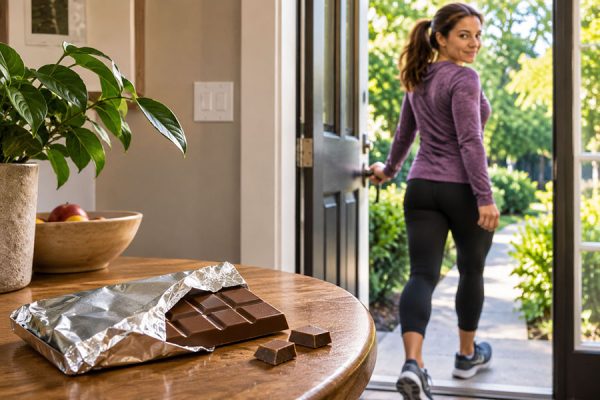
I’ll cut straight to the chase: What if I told you that a mere 15-minute walk could dramatically reduce your cravings for sugary snacks, even chocolate?
Not tomorrow. Not after a week of practice. Not after two months of building a new habit. This can stop sugar cravings instantly.
It sounds too good to be true, but research published in the scientific journal PLOS ONE, along with several other studies, suggests that walking could be your secret weapon against the siren call of sugar.
Why Sugar Cravings Are So Hard to Resist
Many people experience sugar cravings so intensely that they believe sugar is addictive like drugs. While sugary foods are nowhere near as addictive as hard drugs, they do indeed activate some of the same brain reward pathways. And there’s no question that strong sugar cravings can feel like an addiction.
I understand. This isn’t just hyperbole. I’ve read the research and I’ve also surveyed thousands of my readers, and I hear it all the time. Giving in to cravings is one of the biggest problems they say is holding back their heath and weight control goals.
Research confirms that food cravings are extremely common. In a classic study of more than 1,000 college students, 97% of women and 68% of men reported experiencing food cravings.
And what was the single most craved food? Chocolate.
But here’s something interesting. People often say, “I’m addicted to sugar” or “I crave sweets,” but chocolate isn’t just sugar. It’s a combination of sugar, fat, flavor, texture, and other sensory pleasures that make it so appealing.
Think about it. How often do you hear about someone bingeing on plain sugar, straight out of the bag? It’s usually chocolate, cookies, ice cream, or some other irresistible combination of ingredients.
And it’s especially hard to resist these foods when you’re stressed, tired, emotional, or when tempting treats are staring you in the face.
For people trying to manage their weight, cravings can derail even the most disciplined diet plans. They’ve even been cited as one reason people drop out of weight loss programs completely.
But here’s where it gets hopeful…
Can a 15-Minute Walk Reduce Sugar Cravings? What the Science Says
Researchers from the University of Innsbruck, Austria, and Plymouth University in the UK conducted an intriguing study with overweight participants who regularly consumed sugary snacks.
They wanted to know: Could a simple 15-minute bout of moderate exercise reduce sugar cravings?
The results were eye-opening.
After just 15 minutes of brisk walking, the intensity of sugar cravings dropped significantly compared with sitting quietly.
Not only that, but when participants later faced situations that usually trigger cravings, including stress and exposure to tempting snacks, those who had exercised reported less desire to indulge.
Dr. Larissa Ledochowski, the lead researcher, and her colleagues found that this moderate exercise helped buffer against the effects of both psychological stress and exposure to tempting treats – two common triggers for snacking.
And the best part? It didn’t require an exhausting workout, an elaborate exercise program, or even a trip to the gym. Just a short, brisk walk.
The Chocolate Craving Experiment: Putting Walking to the Test
The study design was clever.Researchers recruited 47 overweight adults who regularly consumed at least 100 grams of high-calorie sugary snacks daily.
Participants had to abstain from chocolate and other sugary snacks for three days before testing (torture for chocolate lovers!).
Then, on separate occasions, they completed two conditions: sitting quietly for 15 minutes or walking briskly on a treadmill for the same amount of time.
Afterward, they faced two challenges designed to make anyone crave sugar:
A stressful computer task: The Stroop color-word interference test, designed to increase psychological stress.
Handling tempting sugary snacks: Participants had to unwrap and hold one of their favorite treats for about 30 seconds without eating it. Talk about even MORE torture!
The results? The walkers reported significantly lower sugar cravings than when they sat quietly. Even when handling their favorite treats, they experienced less intense urges to indulge.
In other words, walking didn’t just reduce sugar cravings when everything was calm. It also helped when people were stressed or confronted with tempting food.
That makes the findings particularly relevant to real life.
Walking: The Exercise That Can Stop Sugar Cravings Instantly
The Ledochowski study wasn’t the only experiment to find that walking helps control cravings.
In an earlier study, published in the scientific journal Appetite, researchers Adrian Taylor and Anita Oliver found that a 15-minute brisk walk reduced chocolate cravings in regular chocolate eaters.
But a later experiment went one step further. Instead of simply asking people how much they craved chocolate, the researchers measured how much chocolate they actually ate.
In this study (Oh and Taylor, 2012), 78 regular chocolate eaters were assigned to either a 15-minute brisk walk or a period of quiet rest before performing computer tasks. A bowl of chocolate was available for snacking.
The difference was remarkable:
The walking group: Ate an average of 15.6 grams of chocolate.
The resting group: Ate an average of 28.8 grams of chocolate.
That’s 46% less chocolate eaten by the participants who walked!
This is especially compelling because it wasn’t just a reduction in self-reported cravings. It was a measurable reduction in actual chocolate consumption.
Of course, these were relatively small, short-term experiments, and the results don’t mean everyone will experience the same reduction. But the findings are encouraging, especially since several studies point in the same direction.
Why Does Walking Help Control Sugar Cravings?
You might be wondering: How exactly does a short walk reduce a craving for sugar or chocolate? One possible explanation involves the effect of exercise on mood and energy.
In the Ledochowski study, participants reported two psychological changes after walking:
1. They felt better emotionally (what researchers call improved affective valence).
2. They felt more energized and alert (increased activation).
These changes are interesting because people often turn to sugary snacks when they’re feeling stressed, tired, bored, or emotionally down.
Sometimes we’re not just looking for food. We’re looking for a change in how we feel. And eating something sweet and highly rewarding can provide that change, at least temporarily.
A short walk offers another way to improve your state of mind without reaching for the cookie jar.
The researchers suggested that improvements in mood and activation might help explain why exercise reduces cravings, although the exact mechanisms haven’t been established.
Walking might also help by interrupting habitual snacking behavior, shifting your attention away from tempting food, or giving a craving time to subside. Cravings are like waves – they crest, and then the fall away, often fairly quickly, especially if you are distracted from seeing or thinking about the craved food.
Whatever the exact mechanism, the practical finding is encouraging: A brief bout of physical activity can reduce the urge to eat sugary snacks, even when you’re facing common craving triggers.
Why This Works for Real People in Real Life
What makes this simple stratgegy so valuable is that it tackled challenges people face every day.
These weren’t cyborgs with perfect willpower. They were regular snackers facing situations that often make cravings harder to resist:
Stress: Deadlines at work, financial worries, or a frustrating day.
Temptation: Office donuts, birthday cake, or family members bringing cookies and chocolate home.
Abstinence: Trying to stay away from favorite treats, which can sometimes make them even more tempting.
The walking intervention reduced cravings under these conditions in the laboratory.
And here’s another reason I like this strategy: You don’t have to wait weeks to see whether it works.
Exercise has countless long-term health benefits, but this is one potential benefit you can experience right away.
You can test it for yourself the very next time a craving strikes.
The Bottom Line: Walk Away From Sugar Cravings
The next time you get a strong craving for sugar or chocolate, consider lacing up your walking shoes instead of reaching for the cookie jar.
Take a brisk 15-minute walk. Then see how you feel. You might find that the craving has faded, become less intense, or passed completely.
It won’t guarantee that every craving disappears, and it doesn’t replace good nutrition habits or other craving-control strategies.
But it’s simple, it’s free, it’s backed by scientific research, and it’s great for your health anyway.
Will walking always quell a craving? Maybe not always. But walking and other types of exercise is only one of many solutions for handling the urge to eat.
That’s why I created my new course, How To Beat Food Cravings
This program gives you not one, but 24 research-supported strategies: 10 psychological techniques to help you manage cravings and strengthen self-control, plus 14 behavioral and environmental strategies to make healthy eating easier and more automatic.
If you finally want to get control over your cravings, end over-eating, and achieve the health and ideal weight you want – without cutting our your favorite foods – visit this page to learn more ==> How To Beat Food Cravings – The Complete Course
The course is 50% off during our new release week, until November 7th, then it goes up to the regular price.

–Tom Venuto
Founder of Burn the Fat Inner Circle:
The Support Community For Health-First, All-Natural Body Transformation
Creator of How To Beat Food Cravings – The Complete Course
Related:
How To Stop Snacking At Night
How To Stop Food Cravings (12 Strategies)
How To Control Food Cravings – 5 Scientific Strategies)
Is Food Noise Real?
The Food Noise Test Explained
Food Craving Triggers And Your Brain
Scientific References
Ledochowski L wt al, Acute effects of brisk walking on sugary snack cravings in overweight people, affect and responses to a manipulated stress situation and to a sugary snack cue: A crossover study. PLOS ONE, 10(3), 2015.
Taylor AH, Oliver AJ, Acute effects of brisk walking on urges to eat chocolate, affect, and responses to a stressor and chocolate cue. An experimental study. Appetite, 52(1), 155–160, 2009.
Oh H, Taylor AH, brisk walking reduces ad libitum snacking in regular chocolate eaters during a workplace simulation. Appetite, 58(1), 387–392, 2012.
Weingarten HP, Food cravings in a college population. Appetite, 17(3), 167–175, 1991.
Gilhooly C, et al, Food cravings and energy regulation: The characteristics of craved foods and their relationship with eating behaviors and weight change during 6 months of dietary energy restriction. International Journal of Obesity, 31, 1849–1858, 2007.
Rozin P, Levine E, Stoess C. (1991). Chocolate craving and liking. Appetite, 17(3), 199–212, 1991.





Leave A Comment