
You’ve been eating healthy all week. You’ve stayed on track with your nutrition plan…
But now it’s Friday night, you’ve sunk into the couch, relaxing, and suddenly you’re halfway through a family-sized bag of chips, wondering what happened to your willpower…
You ask yourself, “How do I stop snacking at night?”
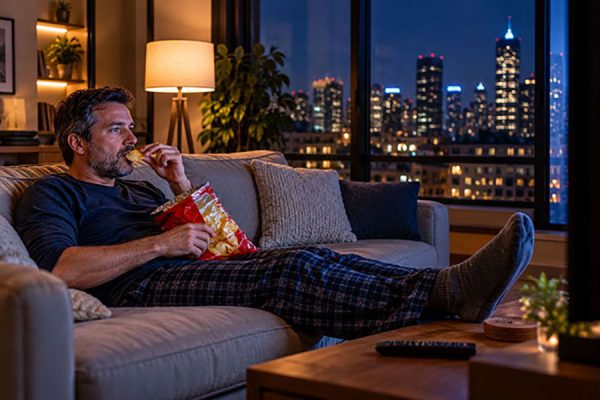
Before we can answer that question, here’s what you might not realize: Six different forces may have been conspiring against you:
You didn’t get enough sleep last night, so you’re tired.
You skipped lunch, so you’re physically hungry.
You’ve had a stressful day at work.
You’re watching TV, which you’ve come to associate with snacking.
There’s a big bag of chips in plain view within arm’s reach.
It’s Friday night, when you’ve developed a habit of relaxing your eating rules
Any one of these triggers might have been manageable on its own. But when all six converge, you’ve created a perfect storm for giving in to cravings and overeating.
And there’s a reason this perfect storm often develops at night – it’s been brewing all day.
You may start the morning feeling fresh, rested, and in control. But as the day wears on, fatigue builds, stress accumulates, and the constant demands and decisions of everyday life can leave you mentally exhausted and your willpower depleted. If you skipped meals or ate too little earlier in the day, physical hunger may be growing too.
By evening, you’re more vulnerable to cravings and temptations that would have been much easier to resist earlier in the day.
If you find yourself in that situation, good luck relying on willpower alone.
You might know every psychological trick in the book for managing cravings. But expecting those techniques to rescue you when you’re exhausted, hungry, stressed, surrounded by tempting food, and following an ingrained habit?
That’s asking an awful lot of your self-control muscle.
Remember the movie The Perfect Storm? That fishing boat didn’t make it home. Some storms are better avoided than ridden out.
The Hidden Danger of Stacked Triggers
I call this the stacked-trigger effect.
The idea is simple: Cravings and overeating aren’t always the result of one trigger. Sometimes multiple factors converge, making it much harder to resist an impulse that you might have managed under different circumstances.
And here’s something important: Not all triggers work the same way.
Some increase physical hunger. Others can heighten the desire for rewarding foods. Some activate learned eating habits, while others simply make eating easier and more convenient.
For example, skipping lunch may leave you genuinely physically hungry late in the day. Stress may increase your desire for comfort food. Watching TV may activate a long-established snacking habit. And having chips right in front of you removes almost every obstacle between wanting them and eating them.
You think you’re fighting one craving cause. In reality, you may be dealing with several different influences at once.
So what’s the solution? Try harder? Man-up and exert more discipline? Summon more willpower? Not necessarily.
One thing you can do is design your environment better. Of all the triggers in the stack, your home environment is the one you have the most direct control over – and it’s also one of the best-researched.
What Science Says About Your Eating Environment
You’ve probably heard the old advice, “Out of sight, out of mind.” Everyone knows that keeping tempting foods out of the house can make it easier to avoid overeating.
But here’s something surprising: Even having to get up from your chair to retrieve food can influence how much you eat.
In a 2019 Cochrane systematic review, researchers reviewed studies about how changing food availability and proximity affected eating behavior.
Across 12 studies involving nearly 1,100 participants, increasing the distance between people and food reduced consumption. The researchers estimated that this could translate into approximately 19% less food eaten during a typical snacking occasion.
Think about that. You don’t necessarily have to ban your favorite foods from the house. Simply moving them farther away can make a difference.
One possible explanation is friction – the effort required to perform a behavior.
Consider the difference between a family-sized bag of chips sitting on the coffee table (or in your lap) and that same bag stored in a kitchen cupboard.
In the first situation, eating takes almost no effort. You don’t even have to stand up. In the second, you have to get off the couch, walk to the kitchen, open the cupboard, and retrieve the food.
If you’re going to indulge as part of your plan, go ahead – and enjoy it. But dole out a single serving and eat slowly and mindfully. (I mean, why scarf it down mindlessly and not even taste it?)
And if the chips aren’t in the house at all? Even better because now you’d have to drive to the store if you really want them.
People sometimes argue that keeping tempting foods out of the house won’t work because they’ll simply go buy them. But the research on proximity suggests that even small increases in effort can reduce consumption.
Every extra step you have to take to eat creates another opportunity to stop and reconsider whether you really want or need the food.
And proximity isn’t the only factor. Research also suggests that increasing the number of food options available can increase consumption.
Think about the difference between keeping one favorite snack in your kitchen and having six different kinds of chips, cookies, candy, and ice cream readily available.
This doesn’t mean you should limit your variety of nutritious foods, especially fruits and vegetables. It means being deliberate about how many tempting snack foods you routinely keep around.
Your Environment Can Influence Your Snacking Without You Realizing It
Here’s another fascinating insight from the research: Much of our behavior can be cued by things in our surroundings, without much conscious thought or deliberation.
That means you might reach for the chips while watching television without ever making a deliberate decision to eat them. It’s just habit. Automatic pilot. Mindless eating.
But there’s good news…
Researchers use the term choice architecture to describe how the arrangement of an environment influences people’s decisions.
Some environmental changes are called nudges because they can steer behavior without eliminating choices.
You can become the architect of your own eating environment.
How to Prevent Nighttime Snacking: Manage Your Craving Triggers
An architect doesn’t start building without a blueprint. Yet many people approach their day of eating with no plan at all.
They simply wing it, then hope they’ll make good decisions when temptation strikes. But why leave everything to chance?
Start by thinking about your last episode of uncontrolled nighttime snacking. How many triggers were present? It all starts with awareness. You can’t solve this problem if you don’t know it exists (it’s totally mindless) and you don’t know what causes it.
Next, ask yourself which causes you could have prevented or weakened earlier in the day.
If poor sleep is part of your pattern, make sleep a priority, not an afterthought. And on the days you do come up short, be aware and on guard that you’ll be more vulnerable to craving and snacking at night. That’s the day to be extra careful about the other triggers and be sure to eat regular meals, keep tempting foods out of reach, and prep healthy foods to keep in reach.
If skipping meals leaves you ravenous at night, eat regular, satisfying meals in the morning and afternoon.
If stress is a major trigger, plan a way to decompress after work that doesn’t automatically involve food. You can’t remove all stress in your life, but you can have a plan for stress management and stress relief that doesn’t involve food.
If the TV has become linked with snacking, change that routine or decide whether you really need to eat. You may not even be physically hungry. Watching TV may simply trigger an ingrained snacking habit. If you think you’ll want something to eat, plan a healthier snack or calorie-free drink in advance.
If tempting foods are always within sight and within reach, move them somewhere less visible. If mindless overeating at night is an ongoing problem, make a commitment to keep trigger foods completely out of the house.
If Friday night has become your automatic night off from your eating rules, decide in advance what a reasonable Friday will look like. There’s nothing wrong with planning a more relaxed meal or a treat. I’m a strong believer in not banning foods and allowing some discretionary calories for treats.
Friday can be a fun meal night when it’s built into your plan. The problem is when “it’s Friday” becomes an open-ended license to eat whatever is in front of you in unlimited quantities. A planned indulgence is a choice. An unplanned free-for-all is a habit running the show.
And remember that choice architecture works in both directions. You can make less desirable choices harder while making healthier choices easier.
Leave fresh fruit on the counter where it’s visible. Keep prepared vegetables at eye level in the refrigerator. Prep healthy high-protein treats and snacks in advance and keep them accessible.
Keep your tub of chocolate protein powder out where you can see it to remind you that a chocolate protein smoothie or protein ice cream might satisfy your craving while supporting your muscle-building goals at the same time.
You don’t have to ban any food forever, but there are healthier, lower calorie alternatives you can swap for the older unhealthier choice. Replacement, not removal is often the best strategy.
You can do the same thing at work. Meal prep your lunch and pack it with you. If you snack mid morning or mid afternoon, pack your own healthy snacks and keep them – along with a bottle of water – visible and within easy reach.
Win The Craving, Snacking, And Overeating Battle Before It Starts
In The Art of War, Sun Tzu suggested that every battle is won before it is fought. That principle applies to nighttime overeating as well.
By the time you’re sitting on the couch at 8 PM, tired, stressed, hungry, and surrounded by tempting food, the conditions for overeating may have been building all day.
The smartest strategy isn’t always to fight harder when the craving hits. It’s to control the things you can control before temptation strikes.
The goal isn’t to eliminate every trigger. You can’t. It’s to prevent six of them from stacking up against you at once, to increase your awareness (mindfulness), and to plan, plan, plan.
Knowing What Causes Cravings And Nighttime Eating Is Only The Beginning
Understanding what’s triggering cravings is important. But when it’s nighttime, you’ve already eaten a big dinner, and yet you’re standing in the kitchen thinking about the cookies in the cupboard or ice cream in the freezer, understanding the psychology isn’t always enough.
You need strategies you can actually use. That’s why I created my new course, How To Beat Food Cravings
This program gives you 24 research-supported strategies: 10 psychological techniques to help you manage cravings and strengthen self-control, plus 14 behavioral and environmental strategies to make healthy eating easier and more automatic.
You’ll get two downloadable manuals, nearly 2.5 hours of audio instruction, quick-reference guides, and additional practical tools to help you put everything into action.
If you finally want to get control over your eating, stop nighttime snacking and achieve the health and ideal weight you want, learn more here:
==> How To Beat Food Cravings – The Complete Course
Train hard and expect success!
Tom Venuto
Author of Burn the Fat, Feed the Muscle – “The Bible Of Fat Loss”
Creator of How To Beat Food Cravings – The Complete Course
Founder of www.BurnTheFatInnerCircle.com
Related:
How To Stop Food Cravings
5 Science-Backed Ways To Control Food Cravings
Leave A Comment