
If you’ve ever struggled with intense food cravings, you know how hard they can be to resist. But here’s something important to understand about how to stop food cravings:
You don’t have to eliminate every craving you experience. And you probably couldn’t even if you tried. You just have to stop giving in to them most of the time.
A craving isn’t the same as physical hunger you feel growling in your stomach. It’s an intense desire for a specific food. Cravings can have biological origins, but they can also be psychological – sometimes it’s simply a mental desire to eat something even when you’re not hungry.
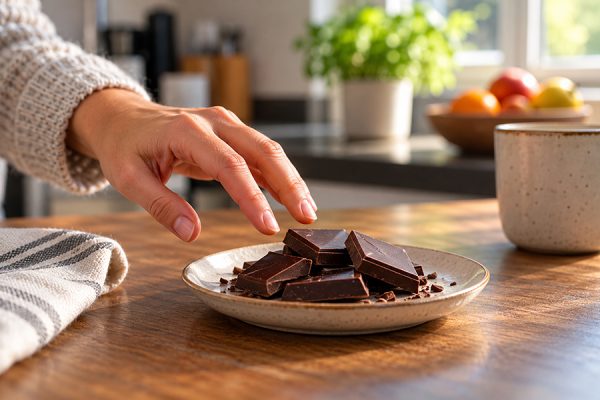
Ever have a craving? If so, you’re far from alone. Research from Tufts University (the CALERIE study) found that 94% of the subjects were cravers. (All women).
Another study published in the scientific journal PLOS ONE confirmed with a similar statistic: 97% of women were cravers.
Men didn’t get off the hook completely either: 68% were cravers.
Number one most craved food: Chocolate.
Other highly craved foods: salty snacks, ice cream, brownies, cookies, muffins, bread, pasta, steak/fatty meat, and pizza.
In the Tufts study up to 94% of women were identified as cravers, but NOT all of them gained weight or the same amount of weight.
See, real question isn’t “have you ever had a craving?” Almost everyone has. The real questions are:
- Did you ever give in to a craving?
- Do you give in to cravings often, and you know it sets back your progress?
Many of the research subjects craved stuff like crazy but stayed their usual lean selves. And many who lost weight and had cravings did not regain.
What was the difference between craving and giving in and letting a craving pass?
It’s simple. Researchers discovered that people who had cravings often but didn’t gain weight stayed lean because they had coping skills and strategies to beat cravings.
That’s how you crave, but don’t give in.
So now you might be wondering, “Ok Tom, exactly what skills and strategies are you talking about?
Here are 12 practical, research-supported strategies to help you control food cravings, resist temptation, and stay on track with your fat loss goals:
1. Keep trigger foods out of the house.
Be RUTHLESS about keeping highly processed foods out of your house. You can’t always control your external environment, but you can always control your home environment. If you struggle with giving in to cravings or you struggle to manage your weight, it’s crazy not to take total control over your home environment
2. Manage environmental triggers as much as you can
They say the best way not to give in to temptation is to not expose yourself to temptation in the first place. Granted it’s easy at home and difficult outside in the built and social environment. But as much as practically possible, avoid exposure to people, places, and things that prompt you to eat when you’re not physically hungry.
3. Identify emotional triggers
We’re conditioned to associate certain foods with comfort or celebration. The emotional connection can be so strong that simply feeling sad, bored, stressed, angry, or anxious can trigger food cravings. Even feeling happy or accomplished can do the same thing – your brain tells you, “I deserve a reward.” (Careful with that one – it’s sneaky).
4. Develop coping strategies that don’t involve eating
Awareness comes first – once you know your triggers, you can plan ways to ride them out. Bored? Do something engaging. Sad? Call a friend. Angry? Go run or lift. Anxious? Listen to music or journal. Celebrating? Choose non-food rewards like new clothes or a good book. Stressed? Try deep breathing.
5. Develop a comprehensive stress reduction plan
Stress is one of the biggest triggers for cravings and bingeing, so a stress management plan is as important as a nutrition and training plan. Remove yourself from stressors when possible. build daily rituals like meditation, and have quick “in the moment” stress-relievers ready, so you can calm down before cravings take over.
6. Manage blood sugar with proper nutrition and exercise
When blood sugar drops, willpower may drop with it, making cravings harder to resist. Eating balanced meals with protein and fiber helps, but so does regular exercise. Physical activity – both cardio and weight training – improves insulin sensitivity, which means your body clears sugar from the blood more efficiently and keeps levels steadier.
7. Avoid excessive calorie restriction
Don’t let yourself become ravenously hungry or you’re simply setting yourself up for a potential huge binge on your most craved foods. Use a moderate calorie deficit and eat as many high satiety foods as you can, including protein and fiber with every meal.
8. Decrease your intake of ultra-processed foods and foods high in sugar, salt, and fat
Eating these once in a while isn’t the end of the world if the portion is small and the frequency is low. But the more you eat them, the more you’ll crave them, because they light up your brain’s reward systems (dopamine, etc). Keep them occasional, and those cravings lose their grip.
9. Avoid complete restriction of specific foods or entire food categories
Research shows that when you label foods “off limits,” cravings for them grow stronger. The smarter strategy is to allow those foods occasionally, in sensible portions. In fact, planned indulgence can be one of the best self-control tools – as long as it fits within your calorie and macro targets. (See a real-life case study at the end of this post)
10. Use the replacement strategy, not removal or resistance
Sitting there fighting a craving without doing anything is like leaving a vacuum – and vacuums beg to be filled. Instead of resisting or going without, swap in a better choice. For example, grab fruit when you want something sweet, or Greek yogurt in place of ice cream. Keep these replacements planned and ready, so cravings get satisfied without derailing your progress.
11. Recruit social support
A friend, partner, or training buddy can give you strength when your willpower runs low. Sometimes just knowing someone else is in it with you makes it easier to stick to your plan. Share your goals, ask for accountability, or team up for workouts and meal prep—the encouragement and accountability you get from others can make cravings a lot easier to manage.
12. Change your mental focus and internal dialogue
Cravings often shrink when you change the way you talk to yourself. CBT research shows that thoughts drive feelings and actions, so changing your self-talk can change your response to cravings. Instead of “I can’t have this,” say, “I choose not to.” Affirmations and even simple visualization, like picturing yourself saying no to the craving can redirect your focus and strengthen your resolve.
Those are the 12 major craving control strategies supported by science. But…
Let me add one more specific strategy to crush cravings.
Why? Because not only is it scientifically proven, it’s also ridiculously easy.
If you have a craving for any highly processed calorie dense food, and you don’t want to give in to it, do this:
Tell yourself you’ll wait at least 15 minutes as you go for a walk, then see if you still crave it. The craving will usually be always gone and forgotten because a craving is often just “head hunger” not real physical hunger.
According to the research, the “wait and walk” trick works especially well for stress cravings and chocolate.
Managing Food Cravings Is A Skill You Can Learn
You don’t have to eliminate every craving to lose fat and keep it off. You just need the right strategies to manage cravings when they strike, and better habits that make cravings less frequent and less intense in the first place.
The 12 strategies you’ve just learned are a great place to start. But if you want to go deeper and develop a complete system for managing food cravings, I created a course specifically for that purpose.
Beat Food Cravings includes 24 research-supported strategies: 10 psychological techniques to help you manage cravings and strengthen self-control, plus 14 behavioral and environmental strategies to make healthy eating easier and more automatic.
You’ll get two downloadable manuals, nearly 2.5 hours of audio instruction, quick-reference guides, and additional practical tools to help you put everything into action.
Train hard and expect success!
Tom Venuto
www.BurnTheFatInnerCircle.com


Leave A Comment