
In a recent Burn the Fat Blog post, I wrote about new research suggesting that aerobic exercise can help keep your brain younger than your chronological age. If you missed it, read it here. The takeaway was simple: cardio isn’t just good for your heart – it’s good for your brain too.
For a “meathead” like me, that naturally raises another question: What about strength training? Can lifting weights also help protect your brain, preserve memory, and reduce the risk of cognitive decline?
According to a new study, the answer is yes. But before I show you what the research found, let me tell you why I’m writing about this.
Screenshot
How You Think About Training Can Change With Age
As someone about to turn 58, healthy aging is something I think about more than ever. I must say however, I’ve thought about muscle and age ever since I was a teenager and saw Albert Beckles in Muscle And Fitness magazine. He was the oldest man to ever win an IFBB pro bodybuilding contest at 61. He just recently passed away at 95.
I’ve also spent the past six years helping my now 89-year-old mom as her dementia has gradually progressed. The last two years have been pretty much 24-7 care. When you watch the effects of this disease up close, believe me, it changes the way you think about exercise (and diet, and lifestyle, and everything!)
But whether you’ve had to care for elderly parents or not, when you get past 50, and surely around 60, most people still start to think differently just from hitting those chronological milestones alone.
Do I still care about building and maintaining muscle, and looking like I lift? Of course. Even though I gave up the standing on stage posing stuff years ago, I’ll always identify as a bodybuilder. I think having bicep veins, seeing some abs, and still being able to bounce your pecs is cool.
Do I still care about being strong? Of course. But not so much in a “What’s your max bench press” sense. I gave up that lifting mentality years ago as well. Now I lift more for muscle and for functional strength, not maximal strength. I want to be strong enough to be 100% independent, and to do any physical activity I want to do, right up to my last day.
But at this point, I think equally or even more so about preserving a sharp memory and being able to think clearly. Will I still be able to write a blog post right up to my last day?
Fortunately, a growing body of research suggests resistance training benefits both your muscles and your brain.
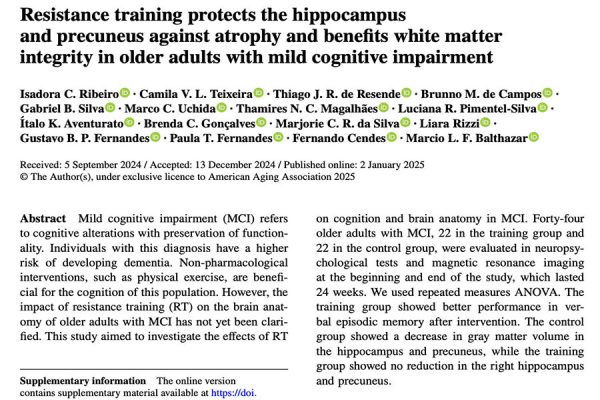
A new study published in GeroScience adds to that evidence in a particularly fascinating way – It didn’t just measure improvements in memory. Researchers actually looked inside the brain using MRI scans to see what changed after six months of strength training.
The Weight Training For Your Brain Study
Researchers recruited 44 older adults (all over 55, average age 68) who had been diagnosed with mild cognitive impairment (MCI).
MCI is a condition where memory and thinking ability has declined more than expected with normal aging but not enough to be diagnosed as dementia. People with MCI have a significantly higher risk of developing dementia in the future.
Half the participants completed a supervised resistance training program for 24 weeks, while the other half continued their usual lifestyle without strength training.
The workouts were practical and realistic – they weren’t doing my bodybuilding competition-style lifting with 5 to 6 high-intensity sessions a week.
In this study, the older subjects trained just twice a week on non-consecutive days, performing ten machine exercises that worked all the major muscle groups. They did three sets of ten reps using challenging weights that were progressively increased as they became stronger.
Before and after the study, researchers evaluated memory with cognitive tests and they examined participants’ brains using MRI scans.
The Results: Physical And Cognitive Improvements
The results were impressive. Not surprisingly, the resistance training group got stronger – significantly. But that was only the physical side of things. They also improved their memory compared to where they started.
Maybe even more interesting, MRI scans showed that the strength-training group preserved the volume of two important brain regions – the hippocampus and the precuneus – while the control group experienced greater shrinkage in those same areas.
The hippocampus plays a critical role in learning and memory and is one of the earliest brain regions affected in Alzheimer’s disease. The precuneus is also involved in memory and other higher cognitive functions.
Why This Brain Health Research Matters
No single study proves that lifting weights prevents dementia. But this study adds to a convincing body of research suggesting that resistance training may help reduce the risk of cognitive decline and dementia as we age.
One reason I find this study compelling is that the researchers looked at both function and structure.
In other words, the researchers didn’t simply see better scores on memory tests. They saw what was going on inside the physical brain. These results gave us evidence that resistance training helps protect brain structures that are especially vulnerable during neurodegeneration.
This is exciting to me, and I hope it is to you too, because we’re no longer talking only about getting stronger or looking more muscular. We’re talking about building a stronger brain too.
How Does Strength Training Help The Brain?
Scientists are still doing research to more fully understand how resistance training improves brain health, but several mechanisms are likely involved.
Strength training improves insulin sensitivity and overall metabolic health, reduces chronic inflammation, improves blood flow, and stimulates the release of naturally occurring compounds produced by working muscles, such as myokines.
Strength training may also increase brain-derived neurotrophic factor (BDNF), which helps brain cells survive, grow, and form new connections.
It’s unlikely that any one of these mechanisms explains all the benefits. More likely, they work together to support healthier brain aging.
Strengths of This Study
All research has limitations. In this case, it was a fairly small number of participants, plus everyone already had mild cognitive impairment to begin with rather than starting out cognitively healthy. Even so, this was a strong study.
Researchers used MRI scans instead of relying only on questionnaires or memory tests. They measured actual changes in brain anatomy, not simply changes in how people did on cognitive testing.
The resistance training program followed well-established strength-training guidelines and used progressive overload. It was a practical and realistic routine that any able-bodied older adult could do.
In addition, this wasn’t the only study on this subject. The results here were consistent with an already large and growing body of research.
That includes systematic reviews and meta-analyses which suggest that the weight of the evidence agrees that resistance training supports cognitive health and may help reduce the risk of dementia as we age.
Keep Lifting – For Your Body AND Your Brain
I’ve been saying for decades that resistance training is one of the best investments you can make in your long-term health. Forget about all the weird “biohacking” and “longevity” protocols you see on social media…
Lifting is the closest thing to the fountain of youth that we have.
Lifting builds muscle, preserves strength, protects bone density, improves function, and helps you stay active and independent throughout life.
And on top of all the physical benefits, now we have yet another reason to make it a priority.
If you’ve been struggling to stay consistent with your strength training, remember this as motivation. When you get those workouts done, you’re working toward much more than stronger muscles or a leaner physique. You’re investing in your long-term brain health.
Of course, resistance training isn’t the entire answer. As I talked about in my previous article, cardio has its own unique benefits for healthy brain aging and physical fitness.
The evidence today continues to suggest that the smartest long-term strategy isn’t choosing one or the other. It’s doing both – cardio training and resistance training – for both physical health and cognitive health.
Don’t let your body atrophy. Don’t let your brain atrophy either. GO LIFT!!!!
–Tom Venuto,
Founder of Burn the Fat Inner Circle
The community for all-natural No BS Body Transformation

Leave A Comment