
Q: Tom, yesterday I did the first day of your Level 1 Primer Program (beginner’s resistance training) from Burn the Fat, Feed the Muscle book. Today I can hardly move! It that because it’s all so new? That’s what I’m thinking. Any tips on feeling better? How long until it’s not so awful?
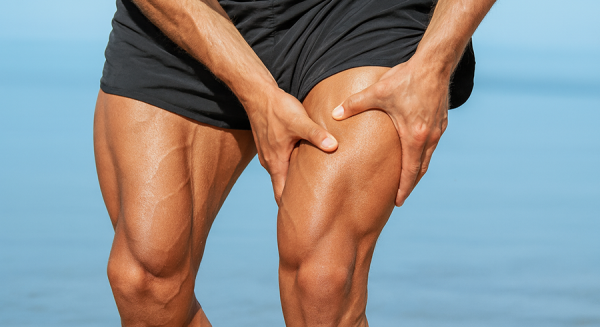
A: Ouch! Sounds like you’ve discovered “delayed onset muscle soreness (aka DOMS). Almost everyone experiences DOMS when they start strength training, change exercises, or suddenly increase training intensity. Even advanced lifters get noticeably sore when a workout is new or unusually challenging.
But DOMS can hit beginners especially hard, and sometimes by surprise. Why do beginners get more DOMS? The reason is indeed because their bodies are completely unaccustomed to resistance training. Something similar can happen to someone who trained for years, but stopped. When they restart, essentially their bodies respond like newbies all over again.
Even when you’ve been training consistently, there comes a time when your body adapts to an old workout or you get bored, and either way, you want a new workout. The day after you start that new workout with brand new exercises, the soreness is back in full force!
DOMS DEFINITION: DOMS (Delayed Onset Muscle Soreness) is the muscle pain and stiffness that occurs 12-48 hours after exercise, especially when starting a new workout program or trying unfamiliar exercises. It’s caused by inflammation triggered by microscopic muscle damage from unfamiliar or intense workouts.
What Causes DOMS (Delayed Onset Muscle Soreness Explained)
There are several explanations for what causes DOMS after a workout, but the most accepted theory is that when resistance training is a new stimulus to the body, or when a new type of resistance training is introduced for the first time, there is inflammation and muscle damage.
This is not bad muscle damage like an actual tear or strain (which is really bad and can knock you out of the gym). We are referring to “Exercise-induced muscle damage” aka EIMD. These are microscopic tears in muscle cells that repair and rebuild stronger after you recover. (If the associated soreness is not debilitating, this is actually good, because it’s part of the muscle growth process).
How do you tell the difference between DOMS and an injury is an important question. Make a note that this kind of EIMD and DOMS occurs in the soft tissues (muscles). If you feel pain directly in your joints, that is different and can be a red flag indicating an injury or the onset of what could become chronic pain (some kind of “itis”) if you don’t address it quickly.
After resistance training, the onset of soreness is delayed. It’s usually felt at least 12 hours after training, and it often doesn’t peak until 24 to 48 hours after the workout. It can catch people by surprise the first time, especially beginners.
Many people go to bed feeling fine, wake up the next morning and are shocked with what they feel after those first steps out of bed! (Not to mention the slog down and back up the stairs). Plus it may get worse as the day goes on.
The soreness may even continue to increase after the first day. How long does DOMS last? Usually it starts to subside in another day and fades from there. So DOMS could be light and only last 1 or 2 days after onset. However, it sometimes lasts 3 to 4 days, and if the workout was extreme or it was far above what you’ve ever done before, it can last 4-5 days or even longer.
Most people experience DOMS for 24–72 hours, with peak soreness around the 48-hour mark.
Individuals have difference tolerance levels to DOMS. Some people get it more often than others, even after they are out of the beginner stage and it lasts longer. Age may also be a factor. Older adults often find themselves getting more muscle soreness (with slower recovery time) and at the same time feeling more joint niggles, which can be doubly frustrating.
Is DOMS Good Or Bad And Does It Always Mean Muscle Growth?
Usually, DOMS only becomes a negative when you are still so sore when the next workout date rolls around that it decreases your performance in that workout. It’s definitely a negative if you’re hobbling around and having trouble getting up and down the stairs. If you can barely walk, it’s kind of hard to squat or lunge again.
Leg day memes and jokes abound online, but it really is possible that DOMS can hit the point of debilitating. You don’t want that, nor should you ever consider it proof of a good workout.
If you have a small amount of DOMS, that’s perfectly normal and you should not interpret it as a bad thing. It’s more like a badge of achievement. Welcome to the club! A lot of people even like it. Even though it is soreness, when it’s mild, some individuals feel like “they worked out,” and feeling their muscles were worked provides some satisfaction.
Is soreness necessary for muscle growth? Absolutely not. It’s possible to have no DOMS at all and it was still a successful workout, so don’t fall into the trap of thinking that if there’s no soreness it wasn’t a good workout. That is a myth. If you’re improving your performance in the gym (more strength, more reps, more volume, etc) or if you are seeing visible changes in muscularity, it was a successful workout.
If you have severe DOMS, you can assume it was too much too soon, and or too much new, too soon. For example, if you’ve never done a squat or lunge or Romanian deadlift with weight before in your life, and you do too many sets or train with too much intensity in the first workout, you can be in a world of hurt for a few days.
How To Prevent Severe DOMS When You Start A New Workout
The most important way to prevent severe DOMS is don’t try to rush anything. Start with slow and easy workouts. Hold back your effort level on purpose during your initial workouts, especially the first workout. Instead focus on mastering the exercise form.
In addition, pay attention to how your body reacts to resistance training after each session, especially the first week on a new routine.
If you feel no DOMS or only minor DOMS, the training effort level was just right. If you feel extreme soreness, then you should take a step back. Adjust the workout volume, weight, reps and intensity to a lower level of effort. Then make a plan to build back up gradually with very slow progression.
Specifically, you could try the following:
1. Reduce the weight.
Build the weight back up slowly over multiple workouts. Use this time training with lighter weights as a great opportunity to concentrate on mastering the exercise technique.
2. Stop the set a little further away from failure.
Failure means the point in a set where you can no longer complete a full rep with good form. Training to failure is intense, causes more muscle damage and is more likely to cause severe DOMS. We recommend that beginners avoid training to failure and even advanced trainees must do it with caution and not on every set.
Usually we recommend stopping a set 1 or 2 reps from failure (a hard effort where the last couple reps are difficult, but you could have done 1 or 2 more if you pushed to the max). If you’re suffering from DOMS, you can even stop your set sooner, at 3 or 4 reps short of failure. This is another way of making the effort easier.
For example if you estimated you could do 12 reps, you could stop the set around rep 8 or 9 when its just starting to feel a little hard; don’t go until you can’t budge the weight and the veins are popping out of your neck. It’s a myth that you have to train all-out to failure to grow muscle. All you need is a hard effort.
3. Decrease the volume.
Volume is how many sets you do. (An alternate method of quantifying volume is the sets X reps X weight, which is called volume load or tonnage). Many resistance training programs call for 3 sets of each exercise. This is a standard recommendation.
However, in most of my beginner program training instructions I offer this advice:
On your first workout, do only 1 set. It may not seem like you’re doing much, but feeling like you didn’t do enough on day 1 is better than limping on day 2 to 5.
After that workout, see how you feel. If you’re not really sore, go up to 2 sets. See how you feel, and again if you’re not severely sore, only then go up to 3 sets.
An even more conservative method is week one do only 1 set, week 2 two sets and week 3 three sets. Or simply take it a day at a time adjusting sets (volume) based on how you feel.
What if you already have DOMS? People ask me all the time, “Should I work out if I have DOMS? It depends.
If you have light DOMS, you can go ahead and work through it. You may find that it feels better once you are warmed up and have some blood in your muscles. If you have severe DOMS, you may want to allow an extra recovery day or two before you hit the gym again.
How Your Body Adapts to DOMS: Understanding the Repeated Bout Effect
EIMD and DOMS decrease after you perform the same workout over and over again on a consistent basis. This is called the “repeated bout effect.” This is simply a type of adaptation in the body where muscles get stronger and more efficient.
This can happen quickly. So quickly in fact, that even your second workout may not trigger as much DOMS as your first one, if the workout was the same.
Almost everyone feels more DOMS when they first start training. But it still happens to experienced trainees when they’ve taken a layoff with zero training and then they start up again. It happens if an experienced lifter switches to a completely new routine they’re not accustomed to, or even just changing one exercise.
DOMS can also continue to happen if you keep pushing the volume and intensity of the same workout higher, especially if you progress too quickly. Progressive overload is vital for continued strength and muscle gains, but must be done slowly to avoid overtraining and excessive EIMD and DOMS.
So even after you’ve got some experience under your belt, if you try a new exercise or completely new routine for the first time, always take it intentionally easy on the initial workouts, especially the first workout. If you increase your training volume (adding exercises and sets), do it slowly.
Also keep in mind that certain types of exercises, especially ones with a strong eccentric component (the part of the rep where you lower the weight), can lead to more soreness than others.
Remember that DOMS can be more unpleasant or debilitating in certain body parts than others. I’ve never heard anyone say that their biceps or triceps were so sore they couldn’t get through their day. I have heard people complain that their legs were so sore, they couldn’t walk, squat or bend over. (Sometimes a figure of speech but sometimes almost literally).
How to Reduce DOMS and Relieve Post-Workout Soreness
There are all kinds of theories on how to reduce delayed onset muscle soreness after you’ve got it. You’ll hear all kinds of ideas like static stretching, mobility exercises, active recovery exercise, low intensity exercise like walking, hot exposure, cold exposure, topical balms, supplements, post workout nutrition, foam rolling, massage, NSAIDS, and so on.
I’m sure some people experience various amounts of relief from interventions like these, and I don’t discourage anyone from trying. However, DOMS is the kind of thing that won’t be completely eliminated except by recovery time.
In fact, surprisingly, recent research showed that static stretching did not reduce DOMS like most people think. (If it works, it could be a placebo effect. Ie, people have heard so many times that stretching after lifting reduces DOMS, they believe it, and thus get some kind of actual, albeit psychologically-induced benefit).
Massage therapy, foam rolling and active recovery seem to have the most scientific support. Cold water immersion has been promoted a lot but was recently shown to have potential negative effects on the muscle building (anabolic) process post-exercise, and so have NSAIDs.
Best Tips for Managing DOMS and Avoiding Severe Soreness
If there’s one thing to remember, it’s this: The best thing you can do to avoid debilitating DOMS is to take it really easy in the beginning.
First time trainees – “rank beginners” – should keep in mind that even a very small amount of weight lifting can get you pretty sore if you’ve never done any before.
Never abruptly jump into any aggressive workout plan on the first workout. Start easy when trying new exercises for the first time, especially leg exercises, and keep the volume and the intensity low.
Once you’re off and running, use gradual progressive overload, very slowly pushing yourself with harder workouts over time.
Even after you’ve got months or years of experience under your belt, also keep in mind that you can still get really sore if you start a new workout and especially with new exercises. So always start slowly on new programs and you’ll never have to worry about soreness so awful you can’t walk.
-Tom Venuto

 About Tom Venuto
Tom Venuto is a natural bodybuilding and fat loss coach with 35 years of experience. He holds a degree in exercise science and has trained hundreds of clients in person and thousands online since 1999. He is also a recipe creator specializing in fat-burning, muscle-building cooking.
A former competitive bodybuilder, Tom is now a full-time evidence-based fitness writer, blogger, and author. His classic book Burn the Fat, Feed the Muscle is an international bestseller, first as an ebook and later as a hardcover and audiobook. His newest book. Extreme Fat Loss, which analyzes controversial diet and training programs, became an instant bestseller in 2025.
Tom’s work has been featured in Men’s Fitness, Oprah Magazine and dozens of other major publications. He is best known for his no-BS, evidence based approach to natural fat loss and muscle-building.
Tom is also the founder of Burn the Fat Inner Circle, a fitness support community with more than 53,000 members worldwide since 2006.
Scientific References
Clarkson PM et al, Muscle function after exercise-induced muscle damage and rapid adaptation. Medicine and Science in Sports and Exercise. 24: 512-520. 1992.
Ebbeling, CB and Clarkson, PM, exercise-induced muscle damage and adaptation. Sports Medicine 7:207-234, 1989.
Fleck SJ, Kraemer WJ, Designing Resistance Training Programs, Third edition. Human Kinetics, Champaign, IL, 2004
Frieden J, et al, Myofibrillar damage following intense eccentric exercise in man. International Journal of Sports Medicine 4: 170-176. 1983
Schoenfeld, Brad, The Max Muscle Plan, Human Kinetics, Champaign, IL. 2013.
Schoenfeld, Brad, Does exercise-induced muscle damage play a role in skeletal muscle hypertrophy? J Strength Cond Research, 26(5): 1441-1453, 2012. Exercise science Dept, CUNY Lehman College, Bronx, NY.
Talag, TS, Residual muscular soreness as influenced by concentric, eccentric, and static contractions. Research Quarterly 44:458-461, 1973.


Leave A Comment