
If you’re searching for the best split routine workout plan, you’ve probably seen dozens of conflicting opinions.
Some lifters swear by full body workouts. Others insist that a 2, 3, 4, or 5 day body part split is the only way to build serious muscle. And with so many influencers pushing different training schedules, it’s easy to feel confused about what actually works.
The truth is, there isn’t one universal “best” split routine. You can build muscle with a 2 day split, a 3 day program like push–pull–legs, a 4 day upper-lower variation, or a classic 5 day body part “bro split.” The key is choosing the right structure for your goals, recovery capacity and schedule.
In this guide, I’ll compare the most popular split routine workout plans – 2, 3, 4 and 5 day splits – and you’ll learn how to decide which one fits you best. Here are the splits we’ll look at:
2 Day – Best for busy and recreational lifters
3 Day – Balanced and popular muscle building
4 Day – Advanced specialization for bodybuilding
5 Day – High-volume per workout ” bro” split
Full Body Workouts Versus Body Part Split Workouts
I received an email recently which perfectly summed up the vibe there is about body part split training in the fitness scene today. This is also what prompted me to write this new detailed and definitive guide to body part workout splits. A subscriber wrote:
Dear Tom, I’ve been doing a lot of reading and watching a lot of videos online about lifting routines and I’ve heard more than once where experts claim that body part split routines are not the most effective way to build muscle, especially if you just do a one body part a day bro split (like having an arm day, a chest day, a back day, and so on). They said that full body training or at least breaking it up only 2 ways (like a 2-day upper-lower split) are the best way for most people to train. I know you use split routines and I’ve seen you recommend all these different types of training to other people in your Inner Circle, so I was wondering if you could comment on how we are supposed to know which is really the best program?
Here’s how I see it, and my perspective is supported by a combination of research with decades of experience and observation:
What Research Says About Body Part Split Routines
Body part split routines are designed for a specific purpose: Namely, hypertrophy specialization for bodybuilding (gaining muscle right where you want it, so you develop a symmetrical and aesthetic physique). Nearly 100% of competitive bodybuilders use split routines as their primary training schedule.
A 2013 study of 127 experienced male bodybuilders (Hackett et al) found that 67% of them used 2-day or 3-day split routines. The other 33% split up their body parts even more with 4-day or even 5-day (“bro”) splits. Not one of the athletes used a full body workout.
This was observational not experimental research, but the results are still striking and significant to me, considering these were successful bodybuilders who placed high in their competitions. I don’t ignore research, but I never ignore real world results either.
In another well-done study (Bartolomei 2021), the researchers found that the group that did full body training had better strength gains, while the split routine group had better muscle size gains.
Anecdotally, this matches what we see in the real world: strength athletes often lean toward full body training, or simple 2-way splits, while physique athletes lean toward body part split routines.
Body part splits are ideal for advanced bodybuilders, especially at the competitive level where details matter and appearance matters more than performance. Advanced bodybuilders also need more volume than beginners and split routines make that easier to do.
Full body workouts are good for aspiring bodybuilders when they are beginners, and also for the average recreational lifter. They are also good for general fitness and fat loss.
Experienced bodybuilders might do full body training occasionally for time efficiency, variety, or simple back-to-basics strength training. But usually, as our observation and the research above confirms, bodybuilders stick with split routines.
What If You Want To Do A Body Part Split, But You’re Not Sure Which Split Routine Is Best?
If you want to know the pros and cons of each workout split, and how to choose a split routine, then you’ve come to the right place because this is the definitive guide.
However…
If you’re looking for the absolute best body part split workout, I’m sorry to disappoint you, but there’s no such thing as one best split routine for all purposes and all people.
Many splits can work, and it’s vitally important to choose a training program that fits your goals, experience level, time available, recovery ability, personal preferences and other individualized factors.
People have favorites, and it’s easy to see which body part split workouts are most popular just by paying attention to industry trends and sales. But to say any split routine is the best, you would have to give a specific context:
If you ever hear an absolute proclamation that one split is “the best” for everyone, this expert is probably just expressing a bias in favor of his own preferred style or system, or he is simply misinformed about high-level bodybuilding as it compares to strength training or general fitness.
So, I’m going to do something even better than naming a single best split routine. I’m going show you all of the best split routines – there are several, and there are also many variations on the main categories.
Having more than one option gives you the best of all worlds. You can choose the one that sounds like it fits you best or even rotate between different splits throughout the year. Some smart bodybuilding science experts believe that’s one of the best ways to do it rather than stick with only one split for life.
What You’ll Learn In This Guide To Split Routines
In the rest of this post, I’ll briefly talk about the full body workout first so you can see how this compares to split training. Then I’ll go on into details about all the best split routines including 2-day, 3-day, 4-day, and 5-day splits.
I’ll show you a weekly workout schedule for each of these splits and I’ll talk a little about the advantages and disadvantages of each (workout split pros and cons) and who they are each ideal for.
Maybe the best way to help you choose and use a body part split routine is to describe the evolution of muscle building training programs from the viewpoint of a beginner bodybuilder progressing into an advanced bodybuilder.
The Full-Body Workout Routine
The first workout most beginners use is full body training, which means there’s no split routine at all – your goal is to train every major muscle in your body at every workout.
To do this, you need at least 3 to 5 compound exercises for a bare bones minimalist routine, or for optimal all-around muscle hypertrophy, you would work every muscle directly and that would take about 8 or 9 exercises in one session, including exercises for the small muscles.
A full-body weekly schedule is this simple:
Monday: Full body
Wednesday: Full body
Friday: Full body
Note: This could be done any three non-consecutive days a week, such as Tuesday, Thursday, Saturday, or Monday, Wednesday, Saturday, and so on.
Full body weight training workouts are ideal for beginners for a lot of reasons. One is the fact that advanced routines may use as many as 20 to 30 exercises spread over 3, 4, or 5 day splits. That’s a lot to remember for a newbie.
The experienced physique athlete already knows how to perform dozens of exercises. The rank beginner doesn’t know how to do any yet. Starting off with fewer exercises and patiently learning how to do them the right way is more practical and less intimidating.
The beginner’s body is also unaccustomed to exercise. Because weight training exercises done for multiple sets in the hypertrophy rep range break down muscle tissue and stress the body’s central nervous system and recovery ability, doing multiple exercises would lead to acute exhaustion or burnout over time.
Advanced bodybuilders need more volume to keep gains coming. But the capacity to do a large volume of lifting needs to be built up over time, just like a runner would need to build up mileage. If you wouldn’t try a 26-mile marathon on your first day jogging, then you shouldn’t try a pro bodybuilder routine on your first day lifting.
Choosing a beginner-appropriate workout when you’re a beginner should be common sense, but it’s dismaying how many newbies try to follow Mr. Olympia high volume split training routines just because they saw them on social media, in muscle magazines or in Arnold’s bodybuilding encyclopedia.
Why Not Stick With Full Body Workouts? Why Switch To Split Routines?
In the next section, you’ll see the four primary split routines. But why not simply stay with a handful of the most important exercises and stick with full body workouts?
Some people do, and that type of simple, “just the basics” or “minimalist” routine has its place, especially for busy people. Basic fitness and strength workouts don’t require a lot of exercises or a big time investment.
But there’s a big difference between training for basic strength or general fitness and training for maximum muscle gain and serious bodybuilding.
Comparing Split Routines vs Full Body Routines
That brings us to another advantage of the split routine. Training for muscle size and bodybuilding requires more volume than training for strength. That means bodybuilders do more exercises per muscle group to achieve complete and aesthetic muscular development, including the addition of isolation exercises and small muscle exercises.
Strength on the other hand, can be developed to a significant degree with lower volume workouts – just hit the basic exercises hard in the lower rep ranges with heavier weights, use progressive overload, and strength will increase.
You might be surprised with the strength gains you could achieve with just a push exercise, a pull exercise and a squat exercise, trained heavy, three days a week. But what most people notice on those lower-volume, heavier-weight routines is they gain strength, but not as much size.
Of course, weight lifters, powerlifters and other strength athletes are often huge and muscular in addition to being strong, but not always. They usually have a very different look than bodybuilders as well. Part of that is the low level of body fat that bodybuilders maintain. But another part is the difference in training style. Strength training and hypertrophy training are really different goals that require different methods.
Strength Building vs Muscle Building: They Overlap, But Are Not The Same
The idea that “If you just get stronger you will get bigger” is promoted heavily in the general weight lifting community today. There’s a lot of truth to that, but it’s an oversimplification of the muscle growth process. Increasing the amount of weight lifted is only one factor in building muscle size.
Your physique is unlikely to achieve the ultimate in aesthetic development just by getting strong on the basic lifts. Physique training requires not only more volume, but also a wide variety of exercises that work every part of every muscle from every possible angle as well as an internal focus on feeling the muscle contract, not just lifting the weight (mind-to-muscle connection). Split routines facilitate that goal.
As Olympic weight lifting methods and powerlifts have become more popular and filtered into the mainstream fitness gyms, many people have become more concerned with how much they can lift than how well their physique is developing. That’s fine when the primary goal is strength, as long as you remember that strength and physique are different goals.
You don’t have to choose one or the other – muscle building or strength building. You can develop both. But at some point in your training evolution, if you want to be the best you can be at one of them, you have to choose a priority: strength and function (performance) or physique and bodybuilding (aesthetics).
If the priority you choose is bodybuilding and physique, then you’d be making a good decision to choose a split routine. So let’s take a closer look at them.
The 2-Day Workout Split
If you’re fairly new to bodybuilding, but you have at least a few months of lifting under your belt, you’ve built up some work capacity and you’ve learned all the basic exercises, you’re ready to advance to the next level.
One way to do that is by adding more exercises and thereby, also more volume (exercises X sets X reps). The problem is, the more exercises you add to a full body routine, the longer your workouts will take.
For example, if you did two exercises for every muscle instead of just one, and tried to cram it all into a single workout, you could be in the gym for two hours. That’s not practical (or fun) for most people. It’s also less effective because the longer your workouts, the more your energy falls toward the end, and whatever you do last gets the least effort.
This is where the first split routine comes in. By dividing your workout into two parts, such as upper body on day one and lower body (plus abs) on day two, now you can perform two exercises per muscle group without worrying about exhausting, overly-long sessions.
A 2-day split training schedule might look like this:
Monday: Upper body
Tuesday: Lower body and abs
Wednesday:Off
Thursday: Upper Body
Friday: Lower body and abs
Saturday: Off
Sunday: Off
Note: There are a variety of scheduling options such as Tuesday, Wednesday, Friday, Saturday, or Monday, Wednesday, Friday, Saturday, and so on. However, it’s ideal not to train more than two days in a row if you want to optimize recovery.
On this split, there are 4 workouts a week, and each muscle gets trained exactly twice a week.
This is probably the most popular muscle building split for general fitness, for the average recreational bodybuilder or for experienced lifters who don’t want to train more than four days a week.
An example of a 2-day split with 4 workouts a week is “The New Body” (T.N.B.) workout. This was made popular in my book Burn the Fat, Feed the Muscle (revised edition).
The T.N.B. Turbo workout is the most popular 2-day split workout plan on our site for busy people because it also only requires 4 workouts a week and the training time can be cut in half using supersets (only 30 to 40 minutes compared to 60 to 75 minutes for traditional set training (click here to learn more about how superset training works).
The 3-Day Workout Split
When you’ve reached the point where you can call yourself advanced, (at least a year of consistent training), this is a good time to split your routine up even further – into at least 3, or even 4 separate workouts. This lets you train multiple exercises for every muscle and you can still get done in a reasonable time with full mental focus and physical energy.
With a 3 day split, instead of having to train your entire body, or even your entire upper body in one workout, now you can concentrate on just a few muscles at each workout, which – for an advanced bodybuilder who wants muscle size and aesthetics – is the most effective way to train.
Why? Because to develop an entire muscle from every angle for the most impressive visual impact and to allow for specialization training, this is when you start adding even more exercises and sets.
when using a 3-day split, you have time to choose multiple exercises for each muscle to thoroughly work that muscle from every angle. Plus, you can do it without running out of physical energy or losing mental focus either.
For example, instead of doing only one chest exercise, such as the popular barbell flat bench press, you also work the incline bench for the upper or clavicular portion of the pecs, and you use dumbbells in addition to barbells for more variety. Then you might finish with isolation exercise like cable crossovers.
You’ve now got 3 exercises, 3 angles and 3 different training tools (barbell, dumbbell, cable). This is what a bodybuilding-style split routine like this allows you to do.
The most well-known 3-day split is the push-pull-legs routine. Although I still call it a body part split, the program is arranged based on the movement patterns of pushing and pulling done on their own separate days, and legs also having their own day.
The body part groupings for a 3-way split push-pull-legs program looks like this:
Day 1: Chest, shoulders, triceps, abs (push day)
Day 2: Back, rear delts, traps, biceps, forearms (pull day)
Day 3: Quads, hamstrings, glutes, calves (leg day)
Some notes about push-pull-legs splits:
1. Abs are not a pushing muscle but it makes the most sense to put them on push day for equal allocation of volume across the three days.
2. Some people put rear delts and traps on push day with shoulders, but both are technically pulling exercises. Some people don’t train them directly at all, depending on priorities (some people don’t do direct forearm work either).
3. Hamstrings are a pulling muscle but it makes the most sense to keep them on leg day.
4. Some people change the order. For example, it might be arranged pull-push-legs for day 1, 2, and 3 respectively.
The 3-day push-pull-legs weekly training schedule, with 5 workouts a week would look like this:
Monday: Chest, shoulders, triceps, abs
Tuesday: Back, rear delts, traps, biceps
Wednesday: Quads, glutes, hamstrings, and calves
Thursday: Off
Friday: Chest, shoulders, triceps, abs
Saturday: Back, rear delts, traps, biceps
Sunday: Off
Most people train 5 days a week on this routine, as seen above. The 5 training days are always the same, and the 2 rest days also stay the same. You simply continue training these 5 days a week, rotating the 3-day cycle (so you’d pick up with leg day again on Monday.
A handful of advanced physique athletes might run this program 6 days a week Monday through Saturday, but you would need good genetics and recovery capacity to keep that up for long without burning out.
You could also run this split 3 days on 1 day off and simply continue to rotate that cycle. However, some people don’t like this variation because it means you have different training days and different rest days every week.
I’m not saying this is the best split routine of all time, but most people would agree that this is probably the most popular if we judge based on trending workouts, search frequency, sales, and online discussion.
A fantastic new version of this program that was recently released that I call Tom Venuto’s PUSH-PULL-LEGS 2.0. (Click here to learn more)
Push-pull-legs is super popular, but it’s not the only way to do a 3-day split. Another option is the one I call 3-day classic muscle.
On the 3-day classic muscle split you divide the body parts like this:
Day 1: Back, chest and abs
Day 2: Shoulders, biceps, triceps
Day 3: Quads, Hams and calves
I was using this 3-day split with great success as far back as the early 1990’s when I first started competing. But the 3-day split pre-dates me – it has been popular since at least the 1960’s and was a favorite of Arnold Schwarzenegger and Mr. Universe Dave Draper.
Best 3-day split for bodybuilding and muscle building – details and sample workout
The 4-Day Workout Split
Highly experienced bodybuilders who want even more body part focus and specialization may go to the next level and split up their body parts 4 ways.
With this even more advanced 4 day split, you can easily do as many as 4 exercises on a big muscle group and 3 on smaller groups.
Each muscle is trained thoroughly from every possible angle and the workouts are rarely longer than 60 to 75 minutes because all the exercises are spread out across 4 different workouts.
The weekly schedule for a 4-day split routine might look like this:
Day 1: Chest, Biceps, abs
Day 2: Quads, Hams
Day 3: Shoulders, Triceps
Day 4: Back, calves
This body part grouping is popular, but there are many variations on this split. For example, if you wanted it more like a push-pull split you could do chest and triceps together and back and biceps together.
Just like the 3-day split, most people train 5 days a week on this program, so the weekly schedule looks like this:
Monday: Chest, biceps, abs
Tuesday: Quads, hams
Wednesday: Shoulders, Triceps
Thursday: Off
Friday: Back, calves
Saturday: Chest, biceps abs
Sunday: Off
On the following Monday, you would pick up where you left off, which would be quads and hams again. This is known as a fixed schedule because you train the same days of the week and have the same off days every week.
An alternate option is to use a rotating schedule like 4 days on 1 day off, 3 on 1 off, or 2 days on 1 day off. (Training no more than 2 days in a row can help some people who want to optimize recovery).
Some highly advanced bodybuilders may train 6 days a week, but as I mentioned above when talking about the 3-day split, most people who don’t have elite-level recovery ability will burn out quickly training 6 days a week. (Some people could handle it for a short period of time for specialization or peaking though).
A strength of this 4-day split is how customizable the body part arrangements are as well as how many options there are for setting up the weekly schedule.
4-day splits might not be the most popular of all time, I think the 3-day Push-Pull-Legs split wins that distinction. However, a 4-day classic bodybuilding split is the personal favorite of mine and I’ve used it with tremendous success for much of the second half of my competition career to help me reach the best peak condition of my life.
I still use this type of 4-day advanced split to this day, most of the time, even though I retired from the competition side of bodybuilding a long time ago. Mainly that’s because I simply enjoy it the most compared to other splits. Every so often I’ll switch to one of the 3-day splits for variety.
Best 4-day split for bodybuilding and muscle building – details and sample workout
The 5-Day Workout Split (Aka “Bro Split”)
The 5-day split is not used as often as the others, but it does have a cult following.
This is, almost literally, the “one body part a day routine.” Not only do you focus on only one major muscle per workout (two muscles total at most), this workout extends recovery time to the point where you may be training each muscle group only once every 7 days. This is considered a very low frequency
This is sometimes referred endearingly, or critically, as the case might be, as a “bro split.” It is controversial because there’s some research suggesting that working each muscle only once a week is not optimal.
Other research however, says that working each muscle only once a week can produce similar muscle gains as twice a week under one condition: The weekly volume (number of sets or volume load) is equal.
This remains a topic of debate, but if you look at top level bodybuilders, you’ll see many examples of winning athletes who use this split. It’s always worth looking at both the what the science says and what the real world says before jumping to conclusions.
5-day splits are a viable option and many people enjoy these programs a lot. If you enjoy your training, you’re more likely to stick with it, and put more effort into it.
However, based on research and experience, here’s my opinion: it’s probably true that at least a slightly higher frequency, like working each muscle a minimum of once every 5 to 6 days, will be somewhat superior to very low frequency training splits where each muscle is worked only once every 7 days.
That said, there are winning pro bodybuilders who use bro splits, and it’s always worth trying to see for yourself how well it might work for you. People who need lots of recovery often like programs like this.
Just keep in mind that these 5-day splits are used the most by advanced bodybuilders who respond well to a high volume in a single session, with larger amounts of recovery time before the same muscle is trained again.
These types of routines are not optimal for beginner or intermediate bodybuilders, recreational lifters, or for general fitness or sports conditioning. Most advanced bodybuilders don’t even split their routines to this level, preferring to stay with 3 and 4 day splits. (It’s hard to go wrong with 3 or 4-day splits).
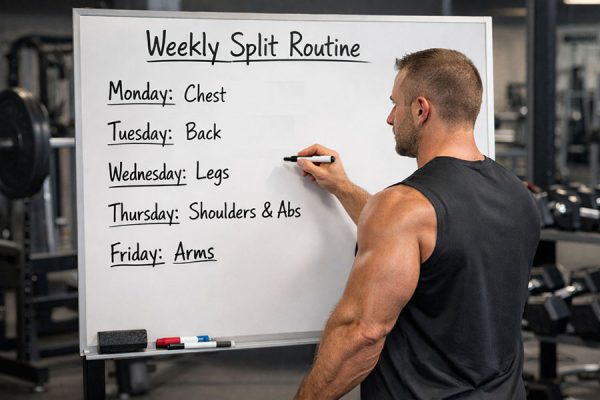
A 5-day split routine weekly schedule might look like this:
Monday: Shoulders, abs
Tuesday: Legs (quads and hams)
Wednesday: Chest, calves
Thursday: Back
Friday: Arms (biceps and triceps)
Saturday: Off
Sunday: Repeat cycle picking up where you left off.
If you repeat this cycle 5 days on 1 day off, you’ll work each muscle once every 6 days. Some people only run it 5 days a week with weekends off (or any two days off), then the frequency drops to only once every 7 days (which is most commonly known as a “bro split.”
Abs and calves can be placed anywhere in the 5 day cycle but are usually done with shoulders, chest, or back.
Concluding Thoughts About Split Routine Workouts
You’ve now seen the entire spectrum of weight training splits from the perspective of a physique athlete’s evolution.
Even though I called this a definitive guide, it was only definitive in covering all four of the major split routines. In the bigger picture, this was only an overview of split routine training.
That’s because each of the body part split schedules I mentioned has a large number of additional variations.
There are also unique hybrid split routines that combine all the other splits in the same week such as a 2-day split on Monday and Tuesday and a 3-day split on Thursday, Friday, and Saturday (2/3 Hybrid Split).
In addition, detailed discussion of all the training variables (sets, reps, advanced techniques etc), plus exercise selection for each one of these splits could fill an entire training course.
In fact, that’s why I developed the exercise instruction, and muscle building technique departments at our Burn the Fat Inner Circle and why I create complete dedicated, multi-month programs for every type of split routine.
 Check Out The Most Popular Split For Maximum Muscle Gain And Advanced Bodybuilding…
I’ve made what I think is a strong case that there’s no single split routine workout that’s the “best” for everyone and fits everyones goals, preferences, genetics and schedule.
But if you asked me which routine is most popular in the bodybuilding community today, I’d have to say Push-Pull-Legs– a 3 day split
I also get asked all the time: “What is YOUR personal favorite split routine Tom? No question about that. It’s 4-Day Classic Bodybuilding.
You can learn more about 4-Day Classic Bodybuilding at the page below:
==>Tom Venuto’s 4-Day Classic Bodybuilding
Train hard and expect success
Tom Venuto, Founder of Burn the Fat Inner Circle
PS. Burn the Fat Inner Circle members have access to 4-Day Classic Bodybuilding free (it’s already included with the Inner Circle membership). Members can visit the members-only area workout program department to download instantly HERE. Non members can learn how to join the Inner Circle HERE
 About Tom Venuto
Tom Venuto is a natural bodybuilding and fat loss coach with 35 years of experience. He holds a degree in exercise science and has trained hundreds of clients in person and thousands online. He is also a recipe creator specializing in fat-burning, muscle-building cooking.
A former competitive bodybuilder, Tom is now a full-time evidence-based fitness writer, blogger, and author. His classic book Burn the Fat, Feed the Muscle is an international bestseller, first as an ebook and later as a hardcover and audiobook. He is also the author of Meal Prep For Fat Loss, a practical guide to smart shopping, batch cooking, and kitchen strategies that make healthy eating simple and sustainable.
Tom is also the founder of Burn the Fat Inner Circle, a fitness support community with more than 59,000 members worldwide since 2006.
Tom’s work has been featured in Men’s Fitness, Muscle & Fitness, Oprah Magazine and dozens of other major publications. He is best known for his no-BS, scientific approach to natural fat loss and muscle-building.





Leave A Comment