
Q: Hey Tom, I was wondering if you could talk about artificial sweeteners and dementia/Alzheimer’s. I know there is some new research out on artificial sweeteners and their impact on brain health in the last month or so (I have seen posts on social media) and I would like your input. I feel like you always bring a balanced perspective and sound interpretation of data.
A Personal Answer To A Personal Question
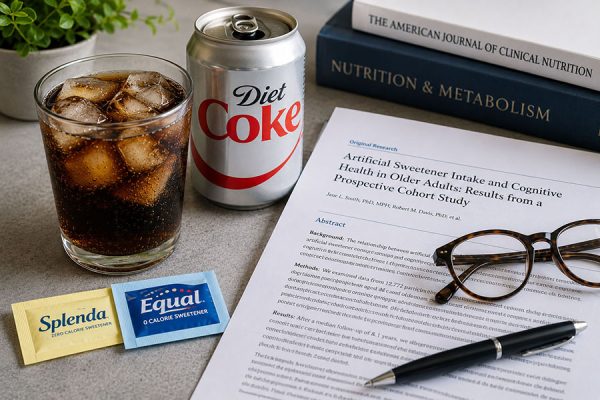
A: For decades, I’ve been seeing fear-mongering over artificial sweeteners. The sentiments have ranged from assuming it causes cancer, to disrupting gut health, to making you fat (seriously, people actually say that), and yes, now that they might be linked to cognitive decline.
It’s been a national pastime for some people to bash artificial sweeteners, it seems.
But based on decades of research and hundreds of studies, virtually all the fear mongering has turned out to be just that – fear mongering. Occasionally someone consumes a specific sweetener and has a reaction, like getting headaches, but the science shows that artificial sweeteners consumed in normal quantities causes no harm.
If you drink two six packs a day of diet soda, I’m not going to vouch for the safety of that, and obviously there is no nutritional “plus” value. But everyone needs to remember the basic premise of toxicology – it’s the dose that makes the poison.
With that said, when I hear that something that is widely consumed – and which I am consuming myself – is associated with dementia, I don’t say, “Oh the fear mongers are at it again,” I stop and really look into it.
Why? Because it’s personal. I’m currently in my sixth year as a caregiver for my 89-year old mom, who has late-stage dementia, and since she fell and broke her arm in the fall of 2024, I’ve been caregiver pretty much 24-7.
My aunt passed with dementia earlier this year. My uncle passed with dementia three years ago. Both of them lived long, full, productive lives – my uncle was 95, my aunt was 98 – and God bless them for that. But they faded at the end, and watching cognitive decline happen more than once, up close, changes the way you look at research like this.
So when someone asks me about dementia, I don’t dismiss it offhandedly. I go read the actual research. That’s exactly what I did here, and what I found is a perfect lesson in why internet headlines almost never tell the whole story.
Yes, There Is New Research – And Here’s What It Actually Says
The study behind a lot of the recent social media posts was published in September 2025 in Neurology, the journal of the American Academy of Neurology. It’s a legitimate peer-reviewed scientific publication. This wasn’t some fringe paper or blog article.
The study tracked 12,772 people over approximately eight years, measuring their consumption of seven different artificial sweeteners while testing memory, language, and thinking skills at multiple points throughout the study.
The headline finding: people who consumed the highest amounts of artificial sweeteners showed cognitive decline roughly equivalent to 1.6 additional years of brain aging compared to the lowest consumers. The six sweeteners associated with the decline were aspartame, saccharin, acesulfame-K, erythritol, sorbitol, and xylitol.
I understand why that generated alarm on social media. But here’s what almost no one reported…
What the Researchers Actually Found
Dr. Claudia Kimie Suemoto, the lead author of the study said: “The study is only observational – I cannot say to you that artificial sweeteners cause cognitive decline. We do know, however, that these sweeteners are associated with worse cognitive trajectories.”
The scientist who ran the study said it clearly: association, not causation. And as I’ll explain in a minute, that distinction is everything.
Correlation vs. Causation: Why So Many Health Headlines Get It Wrong
Every study linking artificial sweeteners to cognitive decline – including this one – has been what’s called an observational study. Researchers watched what groups of people ate and what happened to their health over time. No one was randomly assigned to consume artificial sweeteners or avoid them. That type of study, called a randomized controlled trial or RCT, is the gold standard for establishing cause and effect. For this question, no such trial exists.
Observational studies can show that two things happen together. They can’t tell you which one caused the other – or whether something else entirely caused both. This is the difference between correlation and causation, and it’s where most health scares go wrong.
Here’s a great illustration of how absurd this can get:
Go to Google and search “spurious correlations.” You’ll find a website full of charts showing that per capita cheese consumption correlates strongly with people dying by becoming tangled in their bedsheets. Or that the number of Nicolas Cage films released in a given year correlates with the number of drowning deaths in swimming pools.
These statistics are real. But the relationship is obviously nonsense. That’s what a correlation without causation looks like – and it’s more common in health research than most people realize.
The Diet Soda Example – Reverse Causation in Action
Here’s a real-world example that’s directly relevant to people in our Burn The at Inner Circle community and illustrates the problem perfectly.
For years, some researchers and a lot of “natural health” influencers claimed that diet soda makes you fat. Which is, when you think about it, completely absurd – diet soda has no calories. You can’t gain fat from something that contains no calories.
So how did this claim get traction? Observational studies showed that overweight people tend to drink more diet soda than lean people. And people who don’t understand the distinction between correlation and causation looked at that finding and concluded: diet soda causes weight gain.
But think about it for two seconds. Why do overweight people drink more diet soda? Because they’re overweight and they’re trying to cut calories. They’re switching from regular soda to diet soda specifically because they want to lose weight. The excess body fat came first. The diet soda consumption followed. The causation runs in the opposite direction from what the alarming headlines implied.
That’s called reverse causation. And my guess is that this is what’s happening in the artificial sweetener and dementia research as well.
Why This Matters for the Dementia Research
Ask yourself: who consumes the most artificial (non-caloric) sweeteners? The answer: People who are overweight and trying to cut calories. People who were diagnosed with diabetes or pre-diabetes and told by their doctor to reduce sugar. People managing metabolic conditions.
Now ask yourself: what are the strongest known risk factors for dementia and cognitive decline? Obesity, type 2 diabetes, insulin resistance, and cardiovascular disease are all near the top of the list.
So when an observational study finds that high artificial sweetener consumers show faster cognitive decline, the most obvious explanation isn’t that the sweeteners are damaging the brain. The most obvious explanation is that we’re looking at people who were already sick – and those underlying conditions drove both the diet product use and the cognitive decline.
The 2025 study tried to statistically control for factors like BMI, diabetes, and diet quality. The association persisted after those adjustments. But observational studies can never fully eliminate confounding. The researchers themselves listed “residual confounding from co-occurring health behaviors” as a limitation of their own work.
A Detail That Doesn’t Fit a Simple Causal Story
Here’s something almost no media outlet mentioned: the association between artificial sweeteners and cognitive decline was found only in people under 60. In people over 60, there was no significant effect.
If artificial sweeteners were directly damaging the brain in a way that leads to dementia, you’d expect the strongest effect in the people closest to dementia risk age – people in their 60s, 70s, and older. Finding the opposite is a major red flag that something else is driving these results.
The “Natural” Health Crowd Has Had It In for Artificial Sweeteners for Years
I want to say something that might sound blunt but I think needs to be said. Artificial sweeteners have been a favorite target of the alternative “natural health” community for decades, and this latest research will absolutely be weaponized by that crowd.
The word “artificial” alone is enough to make a lot of people lose their minds. “Natural is good. Artificial is bad.” That’s the assumption baked into most of these claims, and it’s a logical fallacy with a name: the naturalistic fallacy. The idea that something is safe simply because it’s natural, or dangerous simply because it isn’t, doesn’t hold up to five seconds of scrutiny.
Many natural things can harm or kill you – certain mushrooms, certain plants, certain molds. You could even die from drinking too much water (look up hyponatremia). Meanwhile, many artificial compounds consumed in small quantities have zero measurable ill effect on the human body. “Natural” and “safe” are not synonyms. “Artificial” and “dangerous” are not synonyms. The chemistry doesn’t care about your adjectives.
This doesn’t mean artificial sweeteners get a free pass on scrutiny. It means the scrutiny should be applied based on the actual evidence, not on the word “artificial” and not on the preferred narrative of influencers who have been pushing this angle for years regardless of what the research says.
By the way the most commonly used term for these sweeteners today in science and regulatory literature is “non-nutritive sweeteners.” But the fear mongers keep using the word “artificial.”
“Artificial” does a lot of emotional work that “non-nutritive” doesn’t. It triggers the naturalistic fallacy automatically – you don’t even have to make an argument, the word does it for you. It’s the same reason that crowd says “chemicals” as a pejorative when everything, including water and oxygen, is a chemical. The language is chosen to provoke a visceral reaction before the reader has engaged their critical thinking.
So Where Does This Leave Us?
Here’s my honest assessment: the research is real and worth knowing about, but the findings aren’t strong enough to justify alarm. What we have is an observational association that the study authors themselves say cannot establish cause and effect. We have no RCTs.
What we do have is a plausible alternative explanation in the form of reverse causation. And we have an odd age-specific finding that doesn’t fit cleanly with the idea of a direct causal mechanism.
Here’s what I think is the rational response to this research: interesting signal, keep an eye on it, don’t go crazy with panic.
Should You Stop Using Artificial Sweeteners?
If you use them in moderation – a packet of stevia in your coffee, the occasional diet beverage – the current evidence doesn’t support eliminating them. If you’re consuming them in very high amounts every single day across multiple products, this kind of research might be a reasonable nudge toward pulling back a bit. Not because it proves harm, but because moderation is generally a sensible policy when a signal exists.
Interestingly, the lead researcher herself said that it’s wise to limit consumption, ideally avoiding heavy daily use. That’s a reasonable, evidence-proportionate recommendation – and coming from the person who ran the study, it’s worth considering while not overreacting to it.
Focus Your Energy Where the Evidence Is Strongest
Given everything I’ve just shared – and given that dementia is something I think about with more than just professional interest – I want to end with what I think actually matters most.
If you’re genuinely concerned about your long-term brain health, your energy is best directed at the factors with the strongest evidence base.
- Regular aerobic exercise is probably the most powerful modifiable factor we know of. If you don’t believe me, go look it up yourself. I love lifting and I come from a bodybuilding background, but if you’re just lifting and not doing much cardio, then you’re not optimizing your brain health and reducing your risk of dementia.
- Sleep quality is a huge factor. You’ve heard about how good sleep hygiene supports fat loss (especially through hormone optimization and appetite control), but don’t forget that chronic sleep disruption is one of the clearest dementia risk factors in the literature.
- Controlling blood pressure and blood sugar also matter significantly.
- Staying socially connected is another big factor.
- Protect your hearing. This is a little known but surprisingly strong risk factor
- Don’t smoke; don’t drink in excess. If you drink, keep your intake low.
- Keep your brain engaged. Read a lot, play mentally stimulating games, do puzzles, or learn a new language. I just started learning German. (Well, I’m trying, lol – es ist nicht einfach!)
These are the levers that move the needle based on decades of research. Artificial sweetener consumption, even if there turns out to be a real effect, is a much smaller factor than any of the above.
The Bottom Line
Yes there is new research on this subject. It’s real. The association it found is worth monitoring. But association is not causation, the researchers said so themselves, and the history of the “artificial sweeteners are dangerous” narrative should make you appropriately skeptical of the loudest voices amplifying these findings on social media.
Read the research. Understand what kind of study it is. Know the difference between correlation and causation. And the next time you see a headline that makes you want to throw out everything in your pantry, ask yourself: is this what the study actually said, or is this what someone wanted me to think it said?
Almost always, it’s the latter.
-Tom Venuto
Founder of Burn the Fat Inner Circle,
The community f0r all-natural No BS Body Transformation
Not a current member? Join us in the Burn the Fat Inner Circle Members Area HERE
Featured p rogram of the week: The Guide To Meal Prep For Fat Loss
Scientific References
Gonçalves N et al. Association Between Consumption of Low- and No-Calorie Artificial Sweeteners and Cognitive Decline: An 8-Year Prospective Study, Neurology, 105(7), 2025.




Leave A Comment