
If you’ve been wondering if you have a food noise problem and you’ve searched for a food noise questionnaire lately, you’re not alone.
And until very recently, nothing worth finding existed. There was no formal definition of food noise, no clinical criteria, and no validated way to measure it. That recently changed.
Researchers recently published the first scientific definition of food noise along with a 29-item food noise test – the RAID-FN Inventory – built specifically to measure how much food noise someone is dealing with. Here’s the full breakdown.
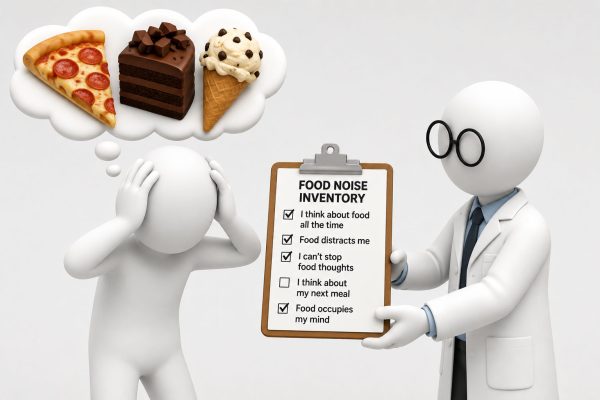
Many who try to explain food noise get it confused with cravings (food noise is not the same).
Not their fault – until just recently, there was no formal definition of food noise and no way to measure it.
It was a phrase that exploded in popularity because people on GLP-1 meds kept describing the same experience – the sudden, almost eerie quiet in their head where constant food thoughts used to live – and “food noise” was the name that stuck.
But a name isn’t a definition, so researchers have now addressed that.
In 2025, a research team (Dhurandhar and colleagues) published the first formal definition of food noise in the journal Nutrition & Diabetes, along with something hardly anyone in the fitness and nutrition space has talked about yet:
A 29-item research questionnaire called the RAID-FN Inventory, built specifically to measure how much food noise someone is dealing with.
A caveat before you look at this questionnaire below: This is still not an official diagnostic test. The researchers themselves said there’s no validated cutoff score – nobody has yet established what counts as “a lot” versus “a little” food noise.
What this IS, is a window into exactly what scientists are now tracking when they study food noise. It’s the most detailed, research-grade look at this phenomenon that exists anywhere right now.
THE OFFICIAL DEFINITION
Here’s how the researchers define food noise:
“Persistent thoughts about food that are perceived by the individual as being unwanted and/or dysphoric and may cause harm to the individual, including social, mental, or physical problems.”
The researchers add that it’s not characterized by thoughts about food alone. A dysfunctional level of food noise is more similar to rumination than simple hunger or cravings.
Rumination is defined by the American Psychological Association as:
“Obsessional thinking involving excessive, repetitive thoughts or themes that interfere with other forms of mental activity.”
Cravings are something different and I’ll talk about that in upcoming articles.
For now let me say that a craving is a sudden desire for a specific food such as pizza, chocolate, chips, or ice cream. Cravings are mental, and often prompted by cues in the environment, so – unlike physical hunger – they usually fade, and often in a matter of minutes.
Food noise is something else – a near-constant background hum of food-related thinking that doesn’t shut off, regardless of whether you’re physically hungry or not.
THE NEW RAID-FN FOOD NOISE TEST
Researchers have now identified exactly what is being measured when we talk about food noise…
The full inventory has 29 items / questions.
As I read through the food noise test questionnaire, I noticed that that every item fell into one of four groups. The researchers didn’t mention this, but I took the liberty of organizing them by category which is why the items aren’t in the original order they appeared in in the study.
I’m including the complete list of 29 items – not because it’s a test you pass or fail, but because seeing every one of the items is the best way to understand what this research is really getting at.
PREOCCUPATION – FOOD THOUGHTS SHOWING UP UNINVITED
FN01 – I think about food all the time, even when I am not hungry or eating.
FN03 – For me, thinking about what I want to eat is not typically related to being hungry.
FN06 – After driving by a good restaurant, it is hard to get the thought of foods I like from there out of my head.
FN09 – When food I am interested in is nearby, it is hard to concentrate on anything else until it is gone.
FN10 – It is frequently hard to focus on daily activities because I am thinking about food.
FN24 – I often have intrusive thoughts about food that are unexpected, hard to control, and unwanted.
FN25 – When I start thinking about food, I find it difficult to stop thinking about it.
FN28 – Even if I want to, I can’t stop thinking about food.
FN29 – When I push thoughts of food out of my mind, I can still feel them tickle the back of my mind.
PLANNING AND ANTICIPATION – FOOD THOUGHTS RUNNING AHEAD OF YOU
FN02 – When I am eating a meal, I am already thinking about what my next meal will be.
FN04 – If I know I will be eating a large meal in the future, I plan carefully and change what I eat before or after that meal.
FN05 – In between meals, I think about what I should eat next.
FN07 – I think about food at social gatherings for a long time leading up to the gathering, and after the gathering.
FN08 – Every day, I wonder if I have some of the foods I might want to eat later.
FN11 – I spend more time than I would like on planning what I am going to eat next.
FN26 – If I have been thinking about a specific food that I want for a while, I will make a special trip to go and get it.
MENTAL AND EMOTIONAL LOAD – THE COST OF MANAGING IT
FN12 – It takes a lot of mental effort to balance what I want to eat with what I should eat to be healthy.
FN13 – It is emotionally draining to balance what I want to eat with what I should eat to be healthy.
FN14 – Thinking about my food takes up too much mental energy.
FN20 – Thinking about food all of the time makes me happy.
FN21 – I would give anything to stop thinking about food.
FN22 – I often eat to get relief from thinking about food for a while.
FN23 – I hate that I always have food on my mind.
FN27 – During meals, I often have an argument with myself about whether I am done eating.
SELF-JUDGEMENT – HOW IT AFFECTS SELF-PERCEPTION
FN15 – I hide that I think about food so much, because I am worried that people will think less of me for it.
FN17 – I hate myself for not being able to control my thoughts about food.
FN18 – I know it is my fault that I think about food all the time.
FN19 – I would be able to stop thinking about food so much if I were a stronger person.
FN16 – I feel less than most other people because of how much I think about food. (Editor’s note: “less than” is a common expression meaning inferior to, or not as good as, other people.)
If you found yourself nodding your head and saying “yeah, that’s me” to a lot of the items on this questionnaire, especially that last section on self judgement, I want to point something out:
Food noise is not a character flaw. It’s not a willpower failure. The fact that researchers are now building clinical tools to study it is itself evidence that it’s a real physiological and psychological phenomenon – it’s not a personal failing. Self-blame doesn’t quiet a noisy brain. The right strategy does.
Among all the strategies to calm food noise, I believe that flexible dieting is one of the best. I’ve written about it extensively on this blog and you can use the blog search feature to look up the numerous posts. You can also learn more about flexible meal planning at www.BurnTheFat.com
If going through the checklist made you realize you’re dealing with major food noise yourself and you want to do something about it without medication, I put together a full breakdown of 8 all-natural strategies that go after food noise directly at Burn the Fat Inner Circle here: ==> 8 Ways to Reduce Food Noise Without Drugs (members only)
Keep your eyes out for upcoming blog posts about hunger management and craving control – the difference between hunger/cravings and food noise – plus solutions to beat cravings and minimize hunger.
Train hard and expect success!
Tom Venuto
Founder of Burn the Fat Inner Circle
The Community For All-Natural, No-BS Body Transformation




Leave A Comment