
If you’ve ever wondered why cardio doesn’t work for weight loss – even when you’re doing a ton of it – you’re not alone. I hear this question all the time: “Why isn’t my cardio working?”
One reader told me she’d been doing cardio almost every day for weeks. Not only that, she had even increased the duration of her workouts. But the scale barely moved.
When that happens to you, that’s when frustration sets in. You start wondering what you’re doing wrong, or worse, what’s wrong with you.
The truth is, there’s more than one reason why cardio for weight loss doesn’t work the way people expect. In another article, I explain a major reason: you can’t out-train a bad diet. Differently stated – you’re eating back the calories you burned (oops!)
But there’s another, lesser-known reason behind this problem that I want to show you today, and it has to do with something called N.E.A.T.
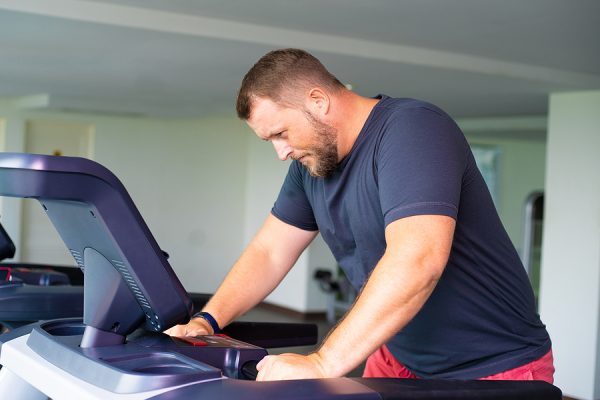
Why Doing a Lot of Cardio Doesn’t Guarantee Weight Loss
Question: How is it possible that some people do tons of cardio and still don’t lose weight?
Answer: Because weight loss is a function of a calorie deficit, not how much cardio you do.
Cardio is just one tool you can use to help create that deficit. It’s not a guarantee.
Endurance athletes are a perfect example of the error in thinking that “an hour a day” (or whatever amount) of cardio will make you lose weight.
They might train one, two, or even three hours a day – yet many of them aren’t trying to lose weight at all. In fact, they have to eat huge amounts of food just to fuel their training and keep their weight stable.
It’s not unusual for a cyclist to burn 4,000 or even 5,000 calories per day and still maintain their weight.
With all that cardio, why doesn’t the weight come off?
For the same reason you might be doing a lot of cardio and not losing weight: There’s no calorie deficit.
Calories coming in are simply matching calories going out.
That’s why it’s a mistake to focus on hitting some magic amount of cardio time. The real prerequisite for weight loss isn’t hours on the treadmill – it’s a sustained calorie deficit.
If your calorie intake stays exactly the same and you add cardio or other activity, you will create a deficit and you will lose weight. That part is simple.
But here’s where most people get tripped up…
When we talk about cardio and training, we often forget about all the activity that happens the rest of the day – outside the gym.
That activity has a name:
Non-Exercise Activity Thermogenesis, or NEAT
NEAT is all your physical activity throughout the day, not counting your “formal” workouts.
NEAT includes all the calories you burn from casual walking, shopping, yard work, housework, standing, pacing and even little things like talking, chewing, changing posture, maintaining posture and fidgeting. Walking contributes to the majority of NEAT.
It seems like a bunch of little stuff – and it is – which is why most people completely ignore it. Big mistake! At the end of the day, week, month and year, all the little stuff adds up.
For most people, NEAT accounts for about 30% of physical activity calories spent daily, but NEAT can run as low 15% in sedentary individuals and as high as 50% in extremely active individuals.
I’m always telling people to exercise more – to burn more, not just eat less. This is not only for health, fitness and well-being, but also to help increase fat loss.
Some people say that increasing exercise doesn’t always work for weight loss and they quote from research to make their case. It’s true that some studies paradoxically don’t show better weight loss by adding exercise on top of diet.
Why Adding More Cardio For Weight Loss Often Doesn’t Work
If you add training into your fat loss regime but you don’t maintain your diet discipline and keep your food intake the same, you remain in energy balance.
If a study doesn’t monitor this type of compensation, or if the researchers trust the subjects to accurately self-report their own food intake (hahahahahaha!), it will look like the exercise was for nothing.
In studies where the food intake was controlled when exercise was added… surprise, surprise, weight loss increased!
Stated differently, all these “experts” who keep saying that exercise doesn’t work for weight loss are ignoring or not accounting for the concepts of calorie deficit, energy compensation, or both.
Why Exercise “Doesn’t Work” for Weight Loss – A NEAT Explanation
So a handful of people exercise and then eat more than they were eating before and then scratch their heads and wonder why they aren’t losing. Duh!
Or, they go on some idiotic crusade against exercise, usually while simultaneously promoting their latest diet fad. “See!” they proclaim, “Exercise is a waste of time! All you have to do is avoid these 3 evil foods and eat these 3 magic foods!”
Wrong. Dieting alone is not a good idea, because without resistance training, even if you lose weight, a higher percentage of the weight loss comes from muscle, which is how people end up “skinny fat.”
And without cardio training, you won’t be fit (picture the person huffing and puffing just going up a flight of stairs). You won’t be healthy either. Being sedentary is terrible for your health.
Want to lose weight, be healthy, and avoid skinny fat syndrome? If so, the prescription is nutrition, then weight training, then add in and manipulate the cardio as your results dictate. That’s the order of priority.
There’s another type of calorie compensation that researchers have recently been studying…
When people increase their training, especially high intensity training, sometimes they also compensate by moving less later in the day and even in the days that that follow.
For example, you work out like an animal in the morning, but then instead of your usual walking around and doing housework the rest of the day, you crash and plop your tired body in your Lazy Boy for a nice nap and a marathon session of Netflix.
The next day, the delayed onset muscle soreness (DOMS) sets in and then you really don’t feel like moving!
Research on NEAT is extensive. It tells us that NEAT plays a major role in obesity and fat loss. Finding ways to increase NEAT combined with formal exercise can be a great strategy to increase your total daily calorie burn and thus, increase fat loss.
The flip side of that equation is finding ways to avoid decreases in NEAT that we might not have noticed. Because NEAT is so completely off most people’s radars, most people miss this.
NOTE: For a real eye-opener, try a using a step tracker every day for a while.
Previous studies confirmed that many people compensated and decreased their activity (NEAT) during the remainder of the day or on rest days after formal training sessions. This led anti-exercise pundits once again to spit out their party line, “See, exercise doesn’t work! You might as well just diet.”
However, a study published in Medicine and Science in Sports and Exercise found no negative effect on NEAT on the day of exercise or on the following 2 days.
In fact, there was a delayed reaction and NEAT actually increased 48 hours after the exercise session (60 minutes of treadmill walking at 6 kph @ 10% grade with 5 minute intervals at 0% grade).
Why the conflicting findings? Scientists aren’t 100% sure yet, but they have discovered that part of it has to do with exercise intensity.
Moderate vs High-Intensity Cardio: Effect On NEAT
You sometimes hear certain trainers claim that only high-intensity exercise is worthwhile and everything else is a waste of time or at best inefficient. That’s not always true, on many levels, and one of them involves NEAT.
It looks like higher intensity training has more potential to decrease NEAT later on than low or moderate intensity training.
You burn a lot of calories during the workout when you train with high intensity. However, the calories burned during the formal training can be at least partly canceled out by a decrease in NEAT outside the training session.
Differently stated, high-intensity training really tires you out, and the fatigue can linger.
It also appears that moderate intensity exercise may be better tolerated than high intensity exercise by some people, especially beginners and the obese.
The low or moderate intensity workouts don’t wipe them out so much, so they don’t become fatigued, sluggish and sore later in the day…. and there’s no drop in NEAT.
Am I Saying You Shouldn’t Do High Intensity Exercise? Not At All
High-intensity training can be very effective and time efficient, and a mix of high and lower-intensity training might be ideal.
But if you do a lot of high-intensity work, you have to be aware of how OVER-doing it might affect your energy and activity level outside the gym – on the day of training, and even in the days that follow the intense workout. Otherwise, you might end up with fewer total calories burned at the end of the week, not more.
If you don’t understand the calorie balance equation and the calorie deficit, and if you don’t understand the compensatory effect of NEAT on energy out, and the effect of compensatory eating behaviors on energy in, then you can do cardio until you’re blue in the face and you’ll still be in energy balance… and your body fat will stay exactly the same.
If you control your diet and if you can keep your NEAT levels up, then cardio of all levels of intensity can help with your weight loss – lower intensity exercise like walking, moderate intensity steady state training and also high intensity interval training.
Using a fitness tracker with a pedometer to count your steps can be one of the BEST ways to make sure you keep your NEAT up.
At Burn the Fat, we try to help you with this mission by sponsoring walking challenges throughout the year. These events give you motivation and the social connections and accountability that a fitness tracker device alone may not give you. You can learn more here.
Important Points (30-Second Summary):
1. The study I mentioned in this blog supports the role of exercise for weight loss and debunks the idea that exercise doesn’t work for weight loss, provided all else remains equal when exercise is added on top of diet.
2. Exercise intensity can affect NEAT for days after a workout is over. Too much high-intensity work might zap your energy and activity outside the gym, resulting in a lower level of NEAT. You have to keep up your habitual activity level outside the gym after pushing yourself hard in the gym.
3. This information supports the role of low to moderate intensity exercise (like 40-60 minutes of treadmill walking) based on the effect this has on your activity outside the gym. It is not true that only high intensity training is worthwhile. There are pros and cons of training at various intensities. Not zapping your NEAT is one of the pros of lower intensity exercise.
4. If you can keep up your NEAT while you add formal cardio, you can increase your weekly calorie expenditure and increase your fat loss.
5. Before you take any research at face value, it’s important to look beyond short-term results (during a single workout or a study that only lasts 24 hours, etc), and also consider longer term effects. We should all keep our eyes out for studies that go beyond 24 hours to get some idea of the long-term impact exercise is really having.
Post in the comments below if this finally clears up the ‘exercise doesn’t work for weight loss’ nonsense. I’d love to hear what you think.
Tom Venuto,
Founder, Burn the Fat Inner Circle
Author, Burn the Fat, Feed the Muscle
Author, Flexible Meal Planning For Fat Loss
PS. Another major reason cardio “doesn’t work for weight loss” is because you out-eat your exercise – you exercise but then put all the calories you burned right back. Read more here: Why you can’t out-train a bad diet
PPS. Some people think cardio doesn’t work for weight loss because your body (metabolism) adapts to the cardio and you stop burning as many calories. A major study suggested that. There’s a sliver of truth here, but it’s highly overblown. Trust me – as long as you don’t out-eat your exercise, increasing your cardio will burn more fat. Learn more: Does metabolic compensation cancel your cardio?
Scientific reference:
Exercise Intensity Influences nonexercise activity thermogenesis in overweight and obese adults. Alahmadi MA et al, Medicine And Science In Sports And Exercise, 43(4): 624-631.
 About Tom Venuto
Tom Venuto is a natural bodybuilding and fat loss coach with over 35 years of experience. He holds a degree in exercise science and has trained hundreds of clients in person. He is also a recipe creator specializing in fat-burning, muscle-building cooking.
A former competitive bodybuilder, Tom is now a full-time evidence-based fitness writer, blogger, and author. His classic book Burn the Fat, Feed the Muscle is an international bestseller, first as an ebook and later as a hardcover and audiobook. His newest book. Extreme Fat Loss, which analyzes controversial diet and training programs, became an instant bestseller.
Tom’s work has been featured in Men’s Fitness, Oprah Magazine and dozens of other major publications. He is best known for his no-BS, science-based approach to natural fat loss and muscle-building.
Tom is also the founder of Burn the Fat Inner Circle, a fitness support community with more than 59,000 members worldwide since 2006.



The free info I get from you is worth 10x what I pay to subscribe to publications. I’m going to try your approach. I am confident I will be successful now. You are the Zeus of health and fitness.
Tom. Why do people want to go after all the complicated convoluted ideas and fads and argue against the obvious? It’s the math and the numbers don’t lie. calories in/calories out. I don’t care what diet promises ‘all you can eat…” if you take in more than you burn up…you get fat! ANd the opposite is true.
With the very principles you outlined I started a program in mid February. I found a free calorie counting site to help track calories in. Because of joint issues I do most of my cardio on an elliptical. I do HIIT cardio. 2 min walk, 2 min jog, 1 min sprint for 30 min. I eat SENSIBLY!!! I do 3 days of cardio nad 3 days of weight training. I do circuit training and go for reps and sets vs, weight. (ending up with a total of 50 reps of each of 6 exercises)Since February I’ve gone from 198 lbs abd 32% BF to 184 and 24& BF and I’m continuing. You’ve sumed it up simply and perfectly/
Awesome read. NEAT is so true and its crazy how we dont realize it but every little activity we do outside the gym really does add up and it ALL counts to the goals we are trying to achieve. I have been trying to get my clients to realize this for over 2 years thanks so much. I will use this article as a reference to get them to understand the point you make here. All due credit to you of course :) Thanks again
Wow – this was meant for me today.
I am totally that person who works out incredibly hard
In the gym and then crashes at home later doing little activity.
Thanks for the NEAT wake up call!
Very true Tom, I have always wondered why people make things more complicated than it is… There is so much confusion out there, I feel I’m repeating myself to clients because they go away and come back to me with another argument, ive now incorporated mental focus into my programmes with clients… I’m a strong believer in getting your mind right and the weight loss will follow.
I don’t think it’s this simple for all people. For one, exercise makes us more hungry and doing cardio to lose weight can be a big waste of time. Its not just a simple forumla of calories in and amount of exercise/energy out. So many factors play into our weight – genetics, gender, age, hormones, and, some of us are much more sensitive and process things like the beloved complex carbs much differently. Maybe this person really needs to look at WHAT she is eating. I used to buy into the low fat diet and ran an hour each day and ate baked potatoes with only salsa in them and I stayed fat. Trust me, I had a calorie deficet. Now I eat a very low carb diet the majority of the time, focus my workouts on weight training, and I have transformed my body at 53 years old. Never again will I beleive that doing more cardio and just eating less calories will do it. I eat so much more food and dont count calories and this works GREAT for me.
I’m guessing you’re a Low carber?
You wrote: “for one thing exercise makes us more hungry”
As an overall generalization, that statement is incorrect and I covered all the research in a previous blog
What you are correct about, and this is EXACTLY what I said in the article, is that SOME people compensate and eat more when they exercise more. Where most of the anti-exercise pundits are mistaken is that they think this is an obligatory response. It is not. Eating more than normal after exercise is called a NUTRITIONAL MISTAKE!
you wrote:
…I stayed fat. Trust me, I had a calorie deficet. “
If you had a calorie deficit and “stayed fat” it sounds like youve discovered how to reverse the laws of nature. yeah. And I have cold fusion… plus a pet bigfoot… and I was abducted by aliens who implanted me with special genes which is why could look so muscular without steroids… did I mention I can levitate?
Levitation us one reason body composition is so important. You obviously weigh less the more you levitate. Astronauts have to worry about this too. I always suspected thar astronauts were more likely to be abducted by aliens. What I did not realize was the possibility of benevolent gene therapy to assist spacemen in maintaining great body composition despite remaining weightless. But now everything makes sense… Assuming you are an astronaut…
Hey Tom
Definitely a low carber after trying EVERYTHING else, including your program, and finding its what works best for ME. I think Atkins gets a bad wrap. His program says cut the refined carbs and sugars for two weeks, and then start reintroducing complex carbs and see how much you can tolerate because we are all different and you start with nuts, fruit, sweet potatoes, brown rice. I could never eat as much of those foods as others can and be lean, like I am now. I am speaking from MY personal experiece. And when I ate low fat and hi carb and did cardio, I was eating less calories. I tracked it in a journal and counted my calories and measured everything. I was puffy and not lean at all, like I am now. Atkins also encourages organice nitrate free meat, and organic dairy, if you eat it, and organic produce. What laws of nature are you talking about? We arent simple machines. As long as I eat low carb I can eat more food than I want. If I want to eat higher carb, then I have to be sure I don’t eat very much. Its that simple. And cardio made me starving. I would wake up at 5 am to hit the gym and do 60 minutes of fasted cardio, then want to eat like crazy after. I could have stayed asleep and skipped the oatmeal and fruit and protein shake altoghter and waited to eat until I was hungry.
im not against low carb at all, keto or original atkins are not my favorite ways to approach it, but Im very much in favor of certain types of low carb diets, particularly higher protein, diets with moderate carb restriction… i use low carb, hi-protein for contest prep myself… unfortunately, what pervades much of the low carb world still today, is this belief that calories dont matter or calories dont count or what you alluded to, that you can have a calorie deficit and not lose fat… whats really happening is that low carb/ higher protein can be a very good way to automatically control appetite and calorie intake, and is also often important for some peoples health given their metabolic status (not very carb tolerant, etc)… its also unfortunate that many in the low carb community are among the ones to suggest that exercise is a waste of time, etc etc, which is also not true and does great disservice to many who listen… low carb doesnt work due to some voodoo or because the law of thermodynamics doesnt apply… it works mainly because it controls calories and for some people, helps them achieve calorie deficit better than other diets… when folks show up here and suggest “i was in a calorie deficit but wasnt losing” or “exercise doesnt work” thats when we cant help but grimace… or chuckle…
Tom, what you say above sounds completely sound and reasonable to me. I exercise consistently and have for years and it is a lifestyle for me. It absolutely does make me more hungry though! Just had to add that in.
And, what transformed my body was when I added in weight training about 15 years ago. Eating hi-carb, low fat, and yes, counting calories in a journal and measuring everything, and doing long cardio workouts, did not do it for me. Changing what I eat and adding in weight training made the difference. And now my cardio is 2 – 3 times per week and its sprints for 30 minutes, or jump rope, or running in the hills. I think exercise is what shapes and tones my body and makes me feel and look good, but I believe it is my eating that keeps me slim more than my exercise. My weight training builds my muscle, and my way of eating helps me lose excess fat. That is what works for me after LOTS of trial and error. And I thank you for your work and articles and I use lots of your workout tips and borrow diet ideas from your pre-contest plan =)
It is not a simple mathmatical equation, less in more excercise. I eat nutritionally dense high protein lower carb gluten free foods and eat on average 800 to 900 calories a day. I have had my Resting BMI tested and I come up at 1200 calories needed to just survive. My metabolism is functioning at 25% lower than the average person of my height, weight and gender. So mathematically I am already at a deficit. I then go to the gym 5 days a week, do cardio for 30 minutes and weight train for another 30 minutes. currently I am doing 320 pounds, three reps of 15 on the leg press which must mean I have muscle mass. Why isn’t this raising my metaoblism as the “they” suggest it does. On the weekends I walk for 30 minutes and work out on my total gym for 30 minutes. I do not usually become hungry and most of the time I eat because I know I need the nutrition to function. I eat on a schedule of about every three hours. I am five feet and weight between 180 and 190. I fluctuate quite frequently between these. I look fat and all of my exercising does not show at all. I don’t even want to think what I might look like if I did not do what i do do. Do you have any suggestions for me?
youre right, its not a simple mathematical equation – its a very complex equation… yet, there is still a math equation involved with weight loss. Its just that what looks simple on paper is not so simple in the real world – it is hard. But fortunately difficult does not mean impossible. if you are weight training and doing cardio – you are on the right track on the exercise side. keep after it and remember that even very slow progress is still progress. Many women who are short or petite (or both) already have lower total daily calorie expenditure than others men or other women who are larger. So you cant copy their programs or eat as much as them. however, 800 to 900 is on the very low side. You might be surprised what eating a little more – at least on training days – while still being cognizant of needing a calorie deficit – could do for you. Keep after it and remember that the training is for health and fitness and strength too as well as for fat loss
It’s hard to trust anybody claiming to be in a calorie deficit while not losing weight when all we know is that they eat baked potatoes and run an hour a day. Of course weight training is important and one should do both weights and cardio to maximize healthy fat loss, preservation of muscle, and a strong cardiovascular system.
The only way to know you are in a healthy calorie deficit is to count the calories, measure your results, and adjiust accordingly. Otherwise you could be in a severe deficit, your body cannibalizes your muscle for energy instead of fat, and further slows your metabolism.
That you are getting great results now without counting calories is AWESOME. Being satisfied with your results is most important. Consider counting those calories for a few weeks and see if you learn anything from your resulting body composition.
David, I did count calories, and kept track in a journal. I did it for weeks, off an on over about a 2 year period. I have tried everything. Eating low carb the majority of the time, and doing intermittent fasting, and weight training is what works for me. Because I love being physical and the weather is better, I sometimes do sprints barefoot on the beach, or run on trails in the hills, or ride my bike. I love being active, and I like eating healthy, but what works for me is different than what works for Tom or you. I am a 53 yr old woman with very different hormone things going on, and I look and feel better than I did when I eat hi carb, low fat and did way more cardio.
And exercise ALWAYS makes me hungrier, I dont care what the study says. I know my body by now.
You forgot to mention another factor…and that is the tendency for folks on low-fat diets to significantly underestimate calories consumed.
thats a HUGE factor and under reporting of food intake could be a whole separate article…. combine under-reporting of food intake with over estimation of calories burned, plus unconscious compensatory behavior and it explains the “mysterious” weight loss plateaus almost every time…. not to mention it leads the uninformed to those bizarre beliefs about calories not counting, etc etc.
Another great article, Tom. I love reading these… I, firsthand, can attest to this. I can write a lot supporting your article and how to the point and accurate it is, but you have done that very well. Great job. Keep ’em coming.
Loved the artical!
I have found that high intensity cardio blunts my appetite. It makes it easier for me to eat less over the course of a day and thus create a calorie deficit. On the days that I don’t do any heart-pumping cardio my hunger is much more difficult to manage. I have yet to experience the “obligatory” increase in hunger following high intensity exercise…
Now low-intensity cardio is a different story. Low-intensity cardio stimulates rather than suppresses my appetite. So for me the solution is quite simple in regards to cardio. Bump up the intensity so that I burn more calories both during and after the workout in addition to being able to more readily manage my diet.
agreed. the only increase in appetite I can say ive noticed for sure from cardio is doing it fasted in the morning (generally low or medium intensity – I prefer to be fed for all intense training) – I just tell myself “its the feeling of fat cells shrinking”! I also notice that after weights, particularly leg day, its actually tough to eat afterward as there is sometimes a rather nauseous feeling — on weight gaining programs, i have to force myself to eat. for a lot of people its just a quick light post workout drink then the big meal an hour later…. so there is no increase in appetite there.
Im not in favor of things that exacerbate hunger – quite the opposite – but heres the thing: you can feel hungry and not eat more than you’re supposed to. thats called discipline.
Funny you should mention leg day. I just finished my leg day a few hours ago and felt the exact same nauseous feeling you mentioned. Not sure why I feel like that after leg day, but there it is. It doesn’t normally affect my appetite, so no problem with my post-workout meal.
Your article was excellent, as always. I never really thought about NEAT before, so it was an eye-opener. Thanks.
Hi Tom
I am a newcomer to Burn the Fat. I began your program about 3 weeks ago after reading your book. I started with a bag, loosing 2 pounds a week for 2 weeks. I increased my calories to 2300 eating about 240 grams of carbs/day. I am an Endomorph. However, in the 3rd week, without changing anything, I began to gain weight again.
I am totally confused! I have been weight training for 25 years. I think I am carb sensititive.
Should I cut out some carbs? After reading some of the comments here, I see there are a lot of endomorphs like me that can’t eat too many carbs and loose weight at the same time.
thanks!
dont get too concerned about one week (or one day) weight fluctuations – it can be lean body mass and even water weight can register a weight gain. Pay more attention to the trend over time. If your weight is increasing in a trend, then you are in a calorie surplus. Period. reduce your calories and or increase how many you burn from training. Weigh in and test body fat again in a week… repeat if necessary. Doing the calorie cut by removing carb calories while keeping the protein constant IS helpful in most cases. Keep after it. Never quit. Ever.
excellent article tom. thanku very much
Another excellant post, Tom. In my book, you are the only real expert writing fitness/fat-loss e-newsletters. The other “experts”, and they know who they are, are just like the researchers to whom you referred; they only focus on a small part of the issues. You, however, see the entire picture. I could go into detail, but, not now. Everything I have read from you over the years is spot-on. It is extremely rewarding to read emails from one who is so thorough and sound in their research and conclusions.
Rich, I concur 100%!
Excellent. I’m a crazy HIIT person. HIT for lifting and HIIT for floor work (sports training) to the point my legs want to fall off. But… I have to admit that I need to do a better job of cycling off my HIIT addiction and move down on intensity because ever 12 weeks I feel utterly exhausted and need a complete re-build. I usually push past the fatigue and think I’m just being soft.
More rest and lower intensity I thought would hurt, now I’m going to lower my intensity and see if it helps crack my 177lbs plateau, by re-building a bit of NEAT I may have lost.
Tom, I just LOVE you! FINALLY someone is telling us to eat right and exercise and that there’s no magic pill. It’s some tough love, but we all need it!
As to this post in particular, NEAT is sooo important!!! How else do we already burn our “recommended daily intake”. Just being alive burns calories! Why most people disregard NEAT? Its impact is too slow to show. That is increasing your NEAT will make you burn let’s say 200 more calories a WEEK or something. Of course, as part of your lifestyle, it will help you maintain your weight, but it’s hard to see it as a “fat burning machine”!
One last point, from a personal point of view, doing sport actually give me MORE energy. After a gym session, I walk home, I run up the stairs, I jump around, I’m full of energy for the rest of the day!
Continue posting!!
Thanks Tom, another hightly informative and clearly explained article. Makes complete sense…
Pls tell me in one ans. How I can lose my fat?
burn more calories than you eat… every day… if a week goes by and you dont lose any… burn more and or eat less
I’ve been exactly doing the opposite. An eye opener. Good article.
Been following a program where i do a high intensity workout either on the stationary bike, treadmill or elliptical. Its designed to get the super fast muscle fibers into play. It takes only about 20 minutes to do and “they” say it increases the growth hormone aspect because your doing a sprinting type of workout with rests between sprints. My question for you is does this hold any water? Have you ever heard of super fast muscle fibers?
Thanks for your input.
Sincerely
Vince Lauletta
NEAT: move to Holland and you will be encouraged to do practically all your local traffic movements by bike. I’m not a ‘cylist fan’ by any means, it’s just the way a move about…
Or if moving to Holland is impractical, the San Francisco Bay Area offers opportunities to stay out of the car. I do most of my transportation by bike or walking, occasional train or bus, and for the rare but beloved hike, the car (though if I was determined, I could sometimes do this by bus and bike). The housing is quite expensive, though, especially if you want to live close enough to cycle around.
Tom,
I know I am in a small group but I have found my weight loss stopped because I was not eatting enough. I was wrong to think if a small deficit of 500 cals was good 1000 to 1500 was better. I would eat 1500 to 1800 cal a day and run for 5 to 7 miles then work out. I was tired but thought, I’ll dump a buch a weight fast. Not at all. I stayed the same weight for over a month.
Great article on weight loss and cardio..
I agree that you must follow a healthy diet AND an exercise plan to lose weight effectively. You can use supplements to help you but you still must eat well and get some daily physical activity for real results. Nice post.
Hi Tom,
My job is mainly at a computer,but I work out 5 days a week made up of the following,
1)30 minutes run at 9.5 Kilometers per hour then,
2)3 sets of 2 minutes at 6.5 Km per hour followed by 1 minutes at 10 Km per hour.
3)30 minutes of weight training
I also try to keep to a diet of 1,200 calories to 1,450 calories per day.
My present weight is 70 Kg and my height is 5 feet 6 inches and my goal is to reach 65 Kg and build lean muscle but develope a better body with very little fat which is seems to be around the belly area.
Will my above programme get me there or can I imporve on the above.
Regards
Denzil
Oh, do I so agree with this article! Last year, I worked out very hard — a mix of cardio and weightlifting (relatively low weight). But I didn’t get my eating under control, so while I built muscle, I didn’t lose much fat, or weight. (I do understand about toning being important, but I weighed 280+ … I don’t want to be a football lineswoman!:) )
After I lost my job about a year ago, I lost access to the gym, and, sadly, interest and backslid pretty badly. Now I’ve started up again, and this time, I’ve got my eating under control. Most days I’m in the 1500-1600 calorie range (I’m female, 50, 5’9″, truly large framed) and I’ve started seeing results. But the problem this time is that while I’m losing weight, I’m not seeing much in the muscle-building category. The cardio definitely helps, and I’m watching everything I put in my mouth (on fitday.com). I hope that once I’m sure of my food choices (kind of “mediterranean diet”, more whole grains, fresh fruit and veg and lean protein) I can work things out so that I do both.
But yes, not eating with some awareness of what you are doing to yourself calorie-wise is counterproductive. I was shocked, when I started really keeping track, of how much I was putting away. It didn’t seem like much, but I’d made a lot of bad choices and had issues with portion control. Knowing makes all the difference in the world.
Janet,
To lose fat and gain muscle at the same time requires you to alternate between a calorie deficit and a calorie surplus, respectively. To lose fat you must burn more calories than you consume which will negate muscle building. To build muscle you have to take in more calories than you burn. The calorie requirements of both activities are on opposite ends of the spectrum.
If I was you, I would concentrate on one endeavor or the other. Possibly work on your fat loss first then when you’ve reached a healthy and desirable weight/body fat percentage, you can make that transition into muscle building. Have your current goal be to maintain the muscle mass and strength you do have NOW while losing the fat. Put all your eggs into this one basket and then you can focus all of your energy on building muscle at a later date.
This is just a suggestion of course. It worked for me so I’m assuming it would work for you, as well.
Thanks for the helpful comments, Mike! I guess I was wondering about cycling up and down calorie-wise … going from two weeks of relatively low calories (say, 1400 or so), to a week of slightly higher calories, (say 1600) and then a week of 2000 and then back down to 1600 and back to the two weeks of 1400. With consistent exercise, and probably more weight training in the higher calorie weeks.
I would prefer not to have to wait until my weight got down, one, because I’ve got a lot to lose, and it’s going to be tough without new muscle and two, because it helps to firm skin (and at my age, that’s going to be hard enough anyway) to have muscle backing it.
Thanks again.
Tom, do you buy into the argument that if you consistenly eat way under your calorie burn (like over 500) for extended period of time and stop losing weight that it can be due to damaged metabolism (starvation mode). I lost over 100lbs. 10+ years ago and have kept it off, but still would like to lose another 10. I workout 6-7 days per week, and according to my bodymedia fit I usually have 600 minimum defecit average each day. I am religous about weighing/measuring portions, etc. I have been told to increase my calories to help fuel metabolism and lose weight…I generally eat about 1800-2000 calories per day and burn 2500-2900 via running, and p90x. Thoughts?? (I am 5’8, 162 pounds).. Thanks!!!!
500 calories under maintenance is actually somewhat conservative; thats not a big deficit. But there is absoltuely an adaptive reduction in metabolic rate with prolonged dieting there is no debate, this is proven and Ive listed many many of the studies in previous posts.
Very informative post. Thanks for taking the time to share your view with us.
am an endomorph who started muscle building about a year ago i have a little improvement though but a friend told me i have to do cardio to burn the stubborn fat before i can see more increase in muscle pls i need your help.should i do cardio together with weigh training and if yes which type of cardio should i do plssssssss i need your help
Definitely cardio on your training days. If you’re not powerlifting or training to do a specific event which would require you to be at an optimal training level – cardio after your workouts is the best plan of attack.
I would recommend a speed of 3.5 and an incline of 5.0- Long Slow Distance or “LSD” in the morning is the best for eliminating fat storage. If you want to tighten up, incorporate some sprints on your non training days, or if you have free time in the afternoons of your training days. Just make sure you are eating to “feed your muscle” and leaving the sugar and beer where it should be- non existant ;)
Hope that helps
thanks for the reply!! I am at 164 pounds and have consistently had 500-900 calorie defecit for 6 months and have lost and gained the same 5 pounds. I am doing p90x week 8, and also run 2-3 days per week and thought maybe if I increased my cardio that would help but I dont want to damage my metabolism. Thanks again!!
Absolutely true calories deficit is the real key to weight loss. Once you realize that, then are other factors that obviously are important in this matter, even every person needs to test on their own about different foods, trainings, schedules, etc… Good definition of the neat . You simplify the question and that’s important to go forward
This article only explains the obvious. . . If you decrease caloric intake and add excercise you lose weight. Wrong! I was on a low fat 1500 calorie diet exercising 4-5 days a week and taking adipex. In 2 months I lost 8 pounds. End result–still over 250 pounds. My question is simply “Could it be that I am meant to be fat?” I dont have any health related problem such as diabetes, high blood pressure or high cholesterol. Both sides of my family are basically made up of small people.
It should be obvious, but total daily magnitude of NEAT is not only totally counter-intuitive, most people dont even know what NEAT is so it doesnt even cross their minds. Miracle of miracles, when it becomes a part of their conscious awareness, and doubly so when they start using fitness trackers with pedometers, the new awarness alone is enough to initiate behavior change and weight loss.
no one is meant to be fat. But, some people do have genetic predispositions toward obesity or lower energy expenditures and all progress in the right direction – even very slow weight loss – should be rewarded and celebrated. You’ll get there if you keep after it…. but also dont write off the little things like NEAT or potential under-reporting of food intake and over-reporting of calories burned… the majority of people who claim “genetics”, “thyroid” or “slow metabolism” – are still making some correctable mistakes
Great article Tom, I like to revisit these for your pearls of fitness wisdom. It is very interesting that some folks still contend that there is something uniquely fat loss friendly about a low carb diet. Some people can just stick to these diets (for whatever reason) in the long term better than a higher carb diet, period. Despite the claim of being meticulous to the calorie, cardio an hour every day, weight training, etc, weight loss just did not happen, “i’ve got the food journal to prove it!!!”. Nothing personal against them, but it’s more a reflection on the mistaken belief they created a huge calorie deficit when they didn’t.
I Wouldn’t have mentioned anthing at all except the first couple posts a successful fitness enthusiast posted some claims suggesting the above. Dieters will get absolutely NOWHERE if they try and follow the low-carb/calories don’t matter mantra. I have the before and after pics to prove the calorie law holds true when i used to scoff at it (high carb/low carb, blah–they both have their place). Tom’s BFFM instruction manual is tops and can work for everyone because the principles of weight loss/getting lean ARE the same for everyone. Excellent cardio article by the way
PS: Tom i can send you my before/after pics, just let me know where to send them. I don’t want a vacation to maui or anything, just to give credit where it’s due.
Hello Tom,
I’ve been off line a few days because of my odd work schedule. It’s hard to catch up and find time to read up on days gone by. But I do have a question for you. On days when I can’t get to the gym, I use resistant bands. I also try to workout three to four days then alternating with a interval sculpting/aerobic video. About two weeks ago when I started going to the gym, although I used light weights, I didn’t realize that I overworked myself and was sore for at least five days. I continued to work out only for a shorter amount of time.
I finally overcame the soreness and continue to use my resistant bands when I can’t make it to the gym. I’ve noticed that for the last ten days, however, I have developed insomnia. So, I laid off of coffee for three days although I do not consume much at all. I’m still experiencing short amounts of sleep. I am still working out in spite of it because I do not want to go back to day one and loose the momentum. Now I’m starting a new job where I work with horrible hours; anywhere from 4:PM to 11:PM which is going to further interfere with my newly found insomnia because should I at times (casual worker), I”m not going to be able to unwind until at least one or two in the morning.
I’m going to give this new position until next May and then see if I can change my hours to no later than nine. I’m concerned because lack of sleep produces cortisol. Now I’m finding out that aerobics and body building create cortisol. How can I achieve levels of fitness, reduce stress and insomnia, and prevent cortisol from increasing fat and reducing muscle mass? I like my new found strength and what I’ve accomplished in less than three weeks. How can I juggle my new schedule, working out and reduce the possibility of increasing cortisol. Are there certain foods one can eat or other ways to reduce cortisol from sabotaging my workouts. Thank you Tom for all your free info. Again, I’ve fallen behind with my new work hours, and perhaps my answer is in something you’ve already sent me.
I look forward to hearing your response. I know that I have a bit of body fat, but I am also well proportioned and have a lot of definition. Once I can master how to burn the fat by applying all of your techniques, I will well be on my way. I also know that I’m well a head of the game but I’m becoming concerned with this cortisol and insomnia I’ve heard so much about. Thank you for everything. Noreen Wilkins : )
To Cardio, or not to Cardio… that is the question.
[LOL]
Seriously, thanks again Tom for this excellent article. It answers a ton of questions I had about when to, or not to, include cardio in a weight loss program.
And that’s not to mention the cortisol connection. I’ve never gained weight faster on restricted calories than when I was doing the Insanity workout. I got a lot bigger, gained fat, and my hair was falling out like crazy. From my own experience, stress hormones are also a big culprit in cardio not helping weight loss. As soon as I went back to brisk walking, even though I was burning half the calories, my hair grew back and I lost weight.
About endurance athletes – Yes they do tons of cardio and they don’t lose weight. But they also have very little body fat because of all the cardio they do and consume between 5-12k calories a day to make up for all the calories they burn during the exercise. This tells me that someone doing cardio it burning more calories so if they stick to the same diet they will lose weight and they will lose even more weight if they go into a calorie deficit.
On high intensity cardio – yes it’s more intense and you won’t want to do much after, but don’t forget that you burn more calories AFTER HIIT training than you do from normal slow going cardio. Not to mention it takes less time to do. Additionally, many people go home after the gym and sit around regardless of what kind of training they did.
As for obese people doing slow steady cardio acts similarly to smaller individuals doing high intensity cardio. This is because it is much more difficult for them to do certain movements so it pushes them just as hard.