
For over 25 years, I’ve signed off my newsletters with the same words: Train hard and expect success. I didn’t choose those words casually.
After reading many personal development authors, and through experience, I became convinced that expectations matter.
But I also deliberately paired expect success with train hard – the latter put first. Positive expectations are powerful, but they’re no substitute for action – expecting success is meant to be combined with action and grit.
Screenshot
How I Discovered This Book
I recently finished Nir Eyal’s excellent book on beliefs and wanted to learn more about the science behind belief, including placebo effects so I did a Google search.
David Robson’s book The Expectation Effect kept appearing in my searches. I’d never heard of him before – probably because even the most outstanding British authors don’t always get the same attention here in the states. I looked him up.
His bio said he’s an award-winning science journalist specializing in psychology, neuroscience, medicine, and human behavior. He studied mathematics at Cambridge, then became the youngest-ever features editor at New Scientist before spending five years as a senior journalist at BBC Future. He’s also written for The New York Times, The Atlantic, and Men’s Health.
Between my long-time interest in the power of expectation and the author’s credentials, I knew I wanted to read the book.
A Book About Mindset But Not “Just Think Positive”
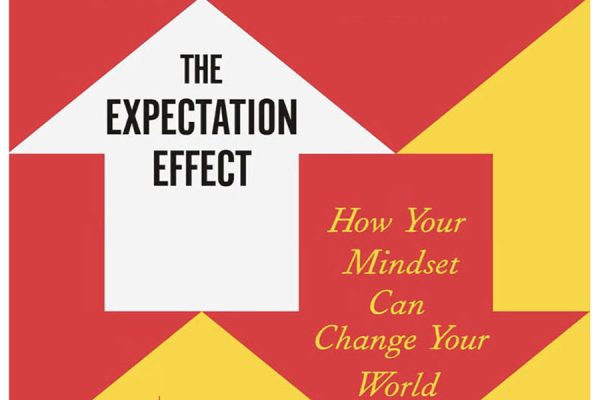
The subtitle on the cover is, How Your Mindset Can Change Your World. By page four of the introduction, it’s clearly confirmed that the book is about the true science behind the power of the mind, including the placebo effect.
It’s not a book claiming that you can “just” think yourself richer, fitter, or younger without taking action and facing difficulties that must be overcome. There’s nothing Pollyanna or paranormal.
Robson’s central message is far more nuanced: while we can’t always control what happens to us, our expectations shape how we perceive events, how we respond to them, how resilient we are, and ultimately the results we get, especially as it pertains to health and aging.
You might say the book is about optimism or positive thinking in one sense, but it’s really a book about predictive thinking.
Throughout the book Robson repeatedly describes the brain as a predictive machine. That phrase struck me as odd at first, but by the end it made perfect sense.
Based on past experience, cultural upbringing, and personal associations, our brains are constantly making predictions about what’s about to happen. Those expectations influence our results in ways most of us never imagine. Robson embraces the concept of self-fulfilling prophecy, but expands on it.
Through each of the 10 chapters, he explores how the power of expectation affects you in a wide variety of ways:
He covers how it can affect perception (what you see), recovery from illness, placebo and nocebo effects, social influence, exercise adherence, healthy eating, stress, willpower, intelligence, memory, and aging.
I won’t do a full summary of every chapter, but let me share some of the points I thought were most impactful.
Placebos, Nocebos, And The Bidirectional Power Of Belief
Robson explains that “Inert sugar pills (placebos) can often reduce symptoms and accelerate recovery through the patient’s mere belief that they will heal the body.”
While the effect originates in belief, it’s not just “all in your head.” Taking placebos can coincide with measurable physiological changes involving blood circulation, hormone balance, and immune function.
But the familiar sugar pill is only the beginning. Robson explores different kinds of placebos like pills of different size and color, injections, and even sham surgery, which is mind blowing when you realize it actually works.
He explains the open label placebo, which bizarrely still works when people know it’s a placebo. And he shares how the words of a doctor may be a powerful part of the effect.
Equally important is his discussion of the nocebo effect – the placebo’s darker twin. Just as positive expectations can improve outcomes, negative expectations can worsen them. Patients warned about drug side effects, for example, are often more likely to experience them, even when receiving an inert substance.
Throughout the book, you see how beliefs and expectations work in both directions. Just as I could say, “expect success and youre likely to succeed,” I could say, “expect failure and you’re likely to fail.”
Seeing Isn’t Believing, Believing Is Seeing
One of the early chapters explores how our expectations don’t simply influence what we think. They influence what we literally see.
Whether it’s seeing faces in random patterns, animals in clouds, disputed calls in sporting events, or countless other examples, our brains are constantly interpreting incomplete information according to what they expect to find.
This reminded me of hiking through the desert on the Pacific Crest Trail. More than once I was convinced I saw water caches waiting in the distance. As I approached, I realized they were just rock formations.
Exercise: The Brain As The Limiter, Not The Body
As a fitness coach, naturally I was interested in the exercise chapter and I wasn’t surprised to see a sports placebo example.
In Robson’s story, a Tour de France cyclist was given a “magic potion” before a time trial and told it would dramatically improve his performance. He had the ride of his life.
Later he discovered the potion was nothing more than a glucose solution. The magic wasn’t in the injection – it was in his expectation.
The book goes far beyond sports folklore, reviewing a growing body of sports science showing how expectations influence performance. Many of the studies involved elite athletes, but the lessons apply just as well to recreational exercisers.
Robson makes the case that our brains often place limits on performance long before our bodies reach their true physiological maximum.
That doesn’t mean expectations override physiology. It means our perception of our physiological limits is often more flexible than we realize. We almost always have more in in the tank than we think.
Healthy Eating Without Food Guilt
The nutrition chapter has some practical, evidence-based advice – eat slowly, avoid distracted eating, limit liquid calories. Also, don’t feel guilty about occasional treats – fit them into your calorie budget and you’ll do better, not worse.
For me, this wasn’t quite as compelling as some of the other chapters, largely because it leaned less heavily into the expectation theme that ties the rest of the book together.
That said, I saw some parallels with the important subject of flexible dieting. One of the central ideas in flexible dieting is that eating for health and weight loss doesn’t require viewing foods as either “good” or “bad.” You can include indulgent foods intelligently and end up with greater weight loss and better health and this chapter explains some of the lesser known reasons why.
One caution: readers shouldn’t come away thinking expectations can override energy balance. I don’t believe that’s Robson’s message. He mentions how expectations may affect digestion and even hormones, but emphasizes the importance of expectations about food to impact hunger, satiety, behavior, and food choice. That I believe is the important part.
Stress, Willpower, Intelligence, And Aging
The remaining chapters continue building the same central idea.
The chapter on stress points out the irony that after a century of hearing about the harmful effects of stress, many people have become stressed about their stress, creating a vicious cycle of real physical consequences. But that may be almost entirely due to their expectations.
Drawing on the latest research, he explains that our interpretation of stress often matters as much as the stressor itself.
Athletes, actors, and students who reframe pre-performance anxiety as being excited or ready usually perform better, and reduce biological stress responses. Even various stress-management techniques ranging from apps to mindful breathing become more effective when people genuinely expect them to work.
The chapter on willpower was outstanding. Robson traces the history of Roy Baumeister’s influential ego depletion theory – the idea that self-control is a limited resource – then explains how later research added an important missing piece: our beliefs about willpower itself.
People who believe sustained effort energizes rather than drains them show more self-control and persistence, not less. Robson presents this not as a rejection of the earlier work, but as a more complete understanding through what has become known as the unified theory of willpower.
He applies the same framework to intelligence, creativity, and memory, showing how our expectations about our own abilities, and even how the expectations other people hold about us can subtly influence learning, performance, and potential. The implications for teachers and educators is enormous.
My favorite chapter, however, was the final one:
The Super Agers: Why You Really Are as Young Or Old as You Feel
Early in the book Robson hinted that the most astonishing expectation effects concerned aging, and he delivers on that promise. Drawing together decades of research, he argues that our expectations about aging influence not only how we feel as we grow older, but also how we function and, to some extent, perhaps even how long we live.
As he concludes:
“The fact that your beliefs could add or subtract years from your life is, in my opinion, the most striking and important consequence of this new understanding of the brain as a prediction machine.”
Given that so many readers here are over 50 – and that Alzheimer’s disease has touched my own family – I found this chapter especially relevant and extremely important.
Final Thoughts
You’ve surely heard about the power of the power of mindset and the placebo effect, but some of the case studies in this book are so remarkable they almost seem miraculous. It might be enough to make some readers skeptical.
A cool thing about Robson is that he consistently anticipates the reader’s skepticism. He comes right out and says that extraordinary claims require extraordinary evidence, and then proceeds to give you all that strong evidence. The scientific references section has nearly forty pages.
Make no mistake, this is a science-heavy book and 258 pages long, but the way the studies, historical accounts, case studies and anecdotes are strung together in a cohesive narrative makes this a fascinating, and even fun book to read.
If you’re interested in evidence-based psychology and mindset books about health, medicine, aging, fitness, behavior change, and human performance, you will enjoy The Expectation Effect. I will be reading it more than once and digging deeper into the studies referenced throughout it.
You can Get This Book At Amazon here: https://amzn.to/4yLJcBl
Train hard and expect success!
-Tom Venuto
Disclosure: Burn the Fat Inner Blog book reviews may use affiliate links to third-party websites and online stores such as Amazon. When readers book, we may earn a small commission at no additional cost to the reader, which helps support our website. We only recommend and link to books or products we have reviewed and recommend.
Leave A Comment