
When people struggle to lose fat, it’s rarely because they’re doing nothing. It’s usually because they’re doing the stuff that matters the least.
In nutrition, not all factors matter equally for fat loss. Some are non-negotiable requirements – fulfill them or there is zero fat loss. Some have a major impact – get them right and you capture the majority of your results.
Others make only a small difference – and that’s where the problem lies: most people are focusing on the minutia… the details… the trivial many at the top of the fat loss pyramid, while missing the most important fundamentals at the bottom of the pyramid.
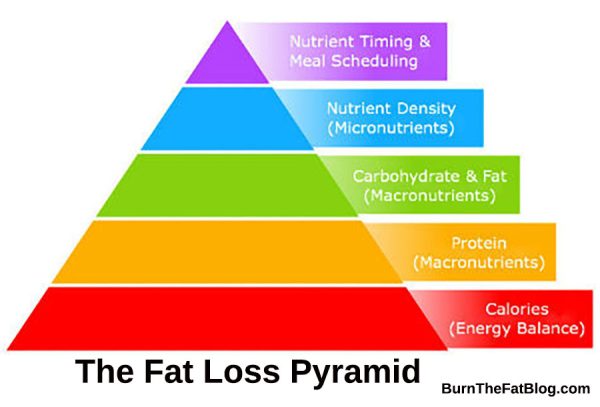
The Fat Loss Pyramid: It’s All About Priorities
Setting priorities is a valuable concept that has been around for a long time in many forms, including the famous 80-20 rule or Pareto Principle. When you have several priorities and you put them in order, that’s known as creating a “hierarchy,” which is often shown graphically in the form of a pyramid.
I first heard about the hierarchy of fat loss concept almost 20 years ago. Lately there’s been a resurgence of interest because people are more confused and overwhelmed than ever about fat loss in today’s online social media world.
Good coaches today have started giving greater attention to teaching their clients to put their priorities in order. And that’s a good thing – because the bad coaches and so-called “influencers” have their followers sold on minutia, and worried about stuff that matters little or not at all.
Before I explain my fat loss pyramid in more detail, let me emphasize an important point:
My pyramid is unique because it’s focused on DIET priorities for fat loss. In my pyramid, I won’t be talking about lifting, cardio, NEAT, lifestyle factors like sleep or stress reduction, or mindset or behavior factors like adherence.
These things all matter – a lot. You could even argue that adherence should be the base of the pyramid, because if you can’t stick to your diet, you’ll never lose fat.
However, making a priority hierarchy of every fat loss factor in every realm would be too big and complicated. And just imagine trying to put everything in order.
That’s why I wanted to create a fat loss pyramid focused only on diet – to keep it simple.
Why Create A Pyramid Of Fat Loss Priorities?
Having a hierarchy of fat loss helps remove the confusion about what matters most and answers two key questions:
1. What are the most important strategies and steps to take first to succeed at fat loss (the “vital few?”)
2. What ideas and tactics are the minutia (the “trivial many?”)
Every coach may have his own version of the fat loss pyramid. That’s easy to see on a Google search when all the infographics pop up. But if it’s built on science and logic, they all look fairly similar, especially the number one item at the base – calorie deficit.
That’s the good news – most people have gotten the number one priority right, at least in principle. Putting it into practice is a little harder, of course.
So if fat loss pyramids have been done many times before, why do another one?
Well, first of all, I originally published the pyramid of fat loss infographic and the first version of this post before there was social media – I’ve been blogging since the early to mid 2000s.
So it’s actually not another one – it’s the original one. I recently updated this page because as I mentioned above, people are more confused and struggling today than they were back then.
Second, at the time of original publication, there were no fat loss pyramids focused only on diet. They all blended exercise, diet, lifestyle and so on.
Third, among the few that existed back then, and right through this day, many diet pyramids contained misinformation – stuff that didn’t belong on a list of priorities at all.
And fourth, most pyramids – also to this day – neglected to include nutrient density and food quality for health in the discussion. The old stereotypical fat loss pyramid that was diet focused included things like calorie deficit, macronutrients, nutrient timing, and supplements.
Making Fat Loss Simple
I also believe that most fat loss programs today, even ones that identify the right priorities, are still not simple enough. Fat loss is not easy – it’s hard to achieve and harder to sustain – but it is simple.
We’ve got to simplify everything, and move away from complicated plans and convoluted theories – which are often one part marketing, one part eccentric guru.
Simplifying – and getting more results with less stress – starts with setting priorities, or as Stephen Covey wrote, “Putting first things first.” After you’ve made the main thing the main thing, only then move on to number two, and number three and so on.
That’s what we mean by hierarchy: Set priorities, put them in order and be sure the vital few pieces are in place before sweating the small stuff.
You’ll find that this hierarchy covers all the bases: it’s simple, flexible and includes health in the equation. So with that preface complete, here’s my take on the fat loss diet pyramid from the bottom up.
1. Calorie Deficit (Energy Balance)
You can apply this hierarchy to Burn The Fat, Feed the Muscle or almost any fat loss nutrition program you follow, with the exception of philosophies that promote calorie denialism…
We understand that calorie calculating is not a perfect science, that tracking calories is difficult, and a calorie deficit is a moving target. Yet the fact still remains:
You need to consistently maintain a calorie deficit over time to lose fat (you must eat less than you burn aka achieve negative energy balance). A deficit is non-negotiable – it’s a required condition for fat loss.
We also must agree that there’s more than one way to achieve a calorie deficit.
- You can eyeball (estimate) portion sizes
- You can set calorie and macro goals in advance, then use a mobile app to track the food you eat meal by meal.
- You can simply cut back on calorie-dense foods or food groups.
- You can practice mindful eating and stop when you’re only 80% full
- You can create a meal plan at your ideal calorie level, print it out and simply follow the plan.
There are also all kinds of “tricks” that diet gurus use to get you to eat less (ironically, sometimes in the same breath that they tell you not to count calories).
If you really think about it, almost every weight loss diet is trying to accomplish the same thing. Directly or indirectly, consciously or unconsciously, the goal is to get you to eat less.
Whatever method you use to try losing fat, the bottom line is this:
If you don’t get your calorie balance right, you will not succeed, no matter what foods you eat, no matter what macros you eat, no matter how healthy you eat.
Getting calories right is the top priority for fat loss.
Calorie Deficits Made Ultra Simple
2. Protein (Macronutrition)
The root of the word protein, translated, means “of first importance.” It may not be first on our list of priorities, but protein is first in importance among the macronutrients.
Protein is an essential nutrient, and ongoing research continues to confirm how important protein is when you’re dieting:
- Protein helps stop muscle loss when you’re in a calorie deficit.
- Protein has the highest thermogenic effect
- Protein helps make you feel fuller or suppress your appetite more than any other macronutrient
And that’s on top of the muscle building benefits.
Because of the support protein gives to your fat loss efforts, it’s the highest priority macronutrient for body composition goals. In fact, if you get your protein right and your calories right, you’re probably 80% of the way there toward setting up a fat loss plan that works.
That’s why you should calculate your protein needs and be sure you have your protein covered, and only then nit pick over the exact amounts of carbohydrate and fat.
How much protein is enough? That question will be endlessly debated, but if you’re weight training (and you should be), Here’s the popular recommendation:
1 gram per pound of body weight per day, give or take .1 to .2 g (0.8 to 1.2g per lb of bodyweight), depending on your goals, preferences, current body fat level, and dieting status. For the average recreational lifter, 0.8g/lb/per day is a good goal.
Note: People with high body fat should calculate protein based on pounds of goal bodyweight, not total bodyweight, otherwise they will over-estimate their protein needs.
3. Carbohydrate and Fat (Macro-nutrition)
For all the attention given to high carb diets and low carb diets (these two macros have been in the forefront of the “diet wars” for years), I have what some might consider surprising news: When it comes to fat loss, the importance of fat and carbs are both lower than calories and protein.
Some people fuss over macronutrient ratios on a meal plan spreadsheet for hours, or get in lengthy debates on forums about low carb versus high carb diets, but both are a waste of time if you’re eating too many calories.
There’s no magic percentage or gram amount of carbs or that makes you burn fat faster.
Lets assume you’re not one of those “calories don’t matter for weight loss” weirdos. But, you do think reducing carbs helps you lose weight better. Great. Have at it! Preferring a low carb diet doesn’t make you weird, it’s knowing your body. And if you think that cutting high fat foods and or eating a lot of plants helps you lose weight, that’s great too! Go for it!
Let me assure you that the weight of scientific evidence today says that over the long term, low carb and low fat diets both work. Go ahead and pick a side and stay in the diet war battle if you want to keep wasting time or raising your stress levels, but it’s a fact that thousands of people have succeeded using both types of diets.
What they had in common is they achieved a calorie deficit, they consumed adequate protein and their choice of diet was based on knowing they would enjoy their plan and have no problem sticking with it long term.
Do I have ideas about what’s optimal for carb and fat intakes or recommendations for best practices? I certainly do, and you can find them throughout my articles, blog posts and in Burn The Fat, Feed the Muscle, in detail.
I don’t like extremes on either end of the macro spectrum, but, carb and fat intake can be customized to a great degree based on your personal preference and on what works best for you.
Here’s the simple approach: Do your calorie math and do your protein math. Then fill in the rest of your calorie budget with fat and carbs in the amounts that make you happy. That’s it, you’re done (for now).
Want to experiment and fine tune the macronutrient amounts? Great! You should. But not until you know priority #1 and #2 are covered.
The New Rules of Setting Your Macros
4. Nutrient Density (Micro-nutrition)
Get about 90% of your calories from healthy, nutrient-dense foods that you enjoy. That’s my simple advice.
If you enjoy healthy foods, if you take pride in eating nutrient-rich meals, and you’re not into eating fast food, sugar, desserts or other processed food, make your personal rule 95%. Heck, make it 99% and be a “clean eating saint” if you wish.
If you enjoy being more relaxed and you’re tracking calories and macros carefully, make it 80-85%. In any case, the directive is clear and simple: eat healthy foods you enjoy most of the time, and set a healthy food adherence rule for yourself.
“Healthy foods that you enjoy” is an important qualifier. One of the biggest reasons most diets fail is because they demand you eat foods you don’t like and take away foods you do like.
Always strive to get most of your calories from unprocessed, nutrient-dense foods, but customize your choices based on your own tastes. Eat your veggies, but if there are certain types you don’t like, don’t eat them. Find ones you do like – and learn how to cook them.
On that note, eating mostly-unprocessed, nutrient-dense foods can be very enjoyable when you learn how to do healthy macro-based cooking at home. You can find dozens of recipes right here at Burn the Fat Blog. (And hundreds more at Burn the Fat Inner Circle).
Take this advice and you’ll be 10X more likely to stick with your plan.
Let me emphasize that when I put micro-nutrition below calories and macronutrients, I’m not suggesting you should eat anything you want as long as it fits your calories and macros. I’m saying, start with calories and macros, but don’t stop there.
You can lose weight by eating most of your calories from any junk food you want, if you have a calorie deficit, but that doesn’t mean it’s optimal for body composition or good for your health.
Health and fat loss overlap, but they’re separate subjects and people constantly forget that.
- You can eat nutrient-dense foods and gain fat if you eat too many of them.
- You can eat unhealthy junk foods and lose fat if your calories are low enough.
That’s why calories are at the base of the fat loss hierarchy. However…
Fat loss should be a healthy endeavor, and enjoying good health, energy and vitality requires attention to the quality of food you eat, not just calories and macros
Once you’ve got your goal numbers set for daily calories, protein, carbs and fat, fill them in with (approximately) 90% healthy foods that you enjoy and you will be lean and healthy – not just one or the other.
Lastly, there’s another huge advantage of eating mostly unprocessed foods and not focusing on calories and macros alone: When you eat nutrient-dense, high-fiber, unprocessed foods, you tend to automatically eat less. And that is very cool, because it means choosing the healthiest foods helps you also lose fat at the same time – even if you don’t track calories strictly.
The reverse is also true. Recent research from Kevin Hall found that people who eat diets high in ultra-processed foods eat about 500 more calories per day – also, automatically. And that is NOT very cool.
Never focus on calories and protein alone. Choosing high quality food matters – for health AND fat loss. It’s a priority.
You Can Eat Processed Food And Lose Fat – But Should You?
5. Meal Scheduling And Nutrient Timing
In the past, when fitness enthusiasts thought about nutrient timing, they thought about the famous post-workout “window of opportunity” where you’re supposed to eat immediately after training or risk wasting all your hard work.
Not only that, nutrient timing or even the post-workout meal alone was placed at or near the top of the priority lists.
Entire programs were created and books written based on nutrient timing, often claiming that optimizing the post workout meal and or taking pre-, during- or post-workout supplements were the most important things you could to improve body composition.
Current science says that while nutrition after intense training is important for recovery and gains, it’s not the most important factor, especially when fat loss is your goal. In fact, it’s one of the lower priorities.
The latest research also shows that the best way to look at nutrient timing is to consider the entire several-hour period from the meal before your workout, the workout itself and the period after the workout.
It also suggests that the post-workout “window” lasts longer than most people used to believe, especially if you ate before training.
And let’s also talk about meal scheduling and the number of daily meals in the nutrient timing discussion. It has been interesting (comedic at times), watching the arguments back and forth over the years.
You have one camp that swears that breakfast is the most important meal of the day, and another that says you should skip breakfast and eat most of your calories at night.
You have dieters who believe carbs are okay, but they should only be eaten in the morning, and you have others who say carbs should be eaten at night and be avoided in the morning. (But butter in your coffee is okay).
Most of the popular meal timing and scheduling fads are either complete nonsense, or there is validity on some level, but it’s minutia compared the higher priorities.
And then we have the infamous meal frequency discussion…
On one hand we have the guys in my sport – bodybuilding – who still say that 5-6 meals a day is optimal (at least 4, for smaller guys), you have the middle ground people who claim 3 meals or 3 meals plus snacks is most practical and works just fine.
We even have people that tell you meal frequency doesn’t matter. “Eat 1 or 2 times a day and the results will be the same,” they claim.
Who is right?
Well, those who say meal frequency or nutrient timing “don’t matter at all” are mistaken and not understanding the concept of fat loss hierarchies. It matters – that’s why it’s on the pyramid. Our understanding of it has simply evolved so we now know where it fits on the list of priorities. It’s not the most important factor.
If you eat too many calories, it doesn’t matter how many or few meals you had, you’re going to gain fat:
- If you have a high meal frequency and that leads to surplus calories consumed – you get fat.
- If you have a low meal frequency, and the long gaps in between make you ravenously hungry and you binge into a surplus later – you get fat.
Furthermore, just like the dietary fat and carbs debate, there’s no single best way to schedule your daily meal plan – this is a unique and personal choice for each individual. Your daily meal plan should be based on your goals, your personal preferences and your willingness and ability to follow the plan for the long term.
Who are you and what are your goals?
- Are you a large male bodybuilder in hard training, trying to gain muscle mass? If so, then a higher meal frequency – aka classic bodybuilding meal plan – makes perfect sense, and is almost necessary, for practical reasons alone.
- Are you a small-framed female, lightly or moderately active and trying to lose weight? If so, then it might make more sense to eat fewer meals.
Bottom line: Nutrient timing does matter, but it’s not the most important variable.
Meal frequency matters too but whether you eat three, four, five, or six times a day is really not a big priority. More important is that the meal schedule you choose is customized and you like it so you can stick with it.
Timing and frequency do belong on the priority list, but getting your calories, macros and healthy food choices in order are all higher in importance.
4 Post-Workout Nutrient Timing Myths Almost Everyone Believes
“What About Supplements? Shouldn’t They Be On The Fat Loss Pyramid?”
Some people could argue that the evidence-based use of supplements should be on the list, though granted, most of those people are selling them. Nearly everyone agrees supplements are the item of lowest importance.
I left out supplements completely because I consider my list a hierarchy of priorities, and I don’t see supplements as a priority at all – especially when we are talking about fat loss.
Out of all the supplements on the market, the so-called fat burners have the worst track record, the most scams, and the fewest evidence-based products than any other supplement category.
Generally speaking, “fat burner supplements” either don’t work, or the benefit is so small it’s not even worth mentioning. On rare occasion, products have emerged that did work, but there were side effects or safety questions. (And some turned out not to be supplements, but drugs).
Fat Burners Don’t Work And Here’s The Science That Proves It
For competitive bodybuilders or athletes where the slightest edge makes a difference, certain types of supplements might help with workout performance, recovery and so on. You also have protein powders which could help you hit your protein goal (very important).
But supplements are simply not a priority for the average health and fitness enthusiast in the overall scheme of things.
Now You Know What Matters Most For Fat Loss – And In What Order
Whether you’re a total beginner or an experienced dieter, you need to simplify and prioritize. Using the pyramid of fat loss framework is a great way to do it.
It’s also a terrific way to troubleshoot fat loss plateaus. How?
Very often, if your fat loss is stuck, your priorities are out of whack – you’ve gotten distracted with “shiny new objects” that are little more than novelties, while forgetting about the big important stuff.
It can happen easily, and it can happen to anyone, because the fundamentals are boring which means it can happen to everyone.
Never forget the fundamentals – there’s no such thing as a new fundamental… and never forget what order they should go in.
Train hard and expect success,
Tom Venuto,
Founder, Burn the Fat Inner Circle
Author, Burn the Fat, Feed the Muscle
Author, The Guide To Flexible Meal Planning For Fat Loss
 About Tom Venuto
Tom Venuto is a natural bodybuilding and fat loss coach with 35 years of experience. He holds a degree in exercise science and has trained hundreds of clients in person. He is also a recipe creator specializing in fat-burning, muscle-building cooking.
A former competitive bodybuilder, Tom is now a full-time evidence-based fitness writer, blogger, and author. His classic book Burn the Fat, Feed the Muscle is an international bestseller, first as an ebook and later as a hardcover and audiobook. His newest book. Extreme Fat Loss, which analyzes controversial diet and training programs, became an instant bestseller in 2025.
Tom’s work has been featured in Men’s Fitness, Oprah Magazine and dozens of other major publications. He is best known for his no-BS, evidence based approach to natural fat loss and muscle-building.
Tom is also the founder of Burn the Fat Inner Circle, a fitness support community with more than 59,000 members worldwide since 2006.



I know people who have lost an impressive amount of weight eating simply cutting back on the fast food and junk food that they eat and drink. I also know individuals who have lost weight using diet supplements. If the most important thing to those people is to simply get skinnier, and if and their idea of happiness is simply to see the number on the scale drop, I am perfectly capable of respecting their belief even though I know that ~ the higher key of nutrition~ has the power to ~strengthen their body metabolically, physically, psychologically and even spiritually ~ in a manner and to a degree that simply cutting back on calories, starving themselves or polluting their blood streams with diet drinks and diet pills never will. I will always prefer the fun of re-shaping and strengthening myself :)
great article but have a question; I have been told by other fat loss gurus that you can eat as much fat as you want (no calorie counting) as long as you don’t have any carbs and still lose weight. Is this true?
Nick,
Just by reading this article you will have your question answered.
Nick, that has been scientifically proven false for years. Eat too much of anything (eat a surplus) and you will get fat. There are still “experts” in the low carb community who surprisingly keep spreading this myth that if you cut carbs you can eat as much fat as you want. If you remove carbs, which can be calorie dense foods, especially sugars and starches, its simply another method of calorie control. Many people automatically tend to eat less while on low carb/high fat so they may lose weight without counting calories – but they are losing fat because they are in a calorie deficit. They reduced carb calories. Beware of “gurus” who say things like that or who deny that weight loss is about calories.
Awesome information as always Tom. Becoming a bigger fan by the day :) “Burn the fat feed the muscle,” has become my go to book. Your attitude and information are the opposite of gimmicks and gurus. Thanks for keeping it real. You have helped me take my fitness journey to the next level and as I read and reread your information I implement more and more of it into my life. I tell people Tom is da bomb diggity. Haha! But I sincerely mean it.
Kristen
Great article.
I’ve found it helpful to describe food or nutrients as ” information”. Many have not heard it that way so I think it’s a pattern interrupt. We speak to what kind of information does a cell need for optimizing health and whether the amount changes depending on metabolic needs (age, pregnancy, activity, etc) . Offering it up a yet another suggestion for how we fuel ourselves.
Hello! Thanks so much for the pyramid illustration! It sure makes sense and shows so clearly in a nutshell just how priority works in choices with weight loss and body fat considerations. Thanks for all your hard work in helping us understand the truth about weight loss and fitness!
such a terrific read! you had my attention throughout the entire article. well done!
Tom I’ve been doing the TN28 workout and have a question about supersets 0 rest. What is the second exercise to superset with? B.B. Tricep extension 0 rest but there isn’t a second exercise. Is this a drop set of 3 sets in a row?
Thanks,
G
Hi Giusuppe. Hmmm. Im not sure if there is a typo on a web page somewhere, but in the book the supersets are listed as tricep – bicep supersets. for example lying tricep exstension (no rest) straight to barbell curls (then 1 or 2 minutes rest)… or tircep pushdowns (no rest) straight to incline dumbbell curls (then 1 or 2 min rest). then repeat for a total of 3 supersets